How one cruiser swapped power for ease of handling
Issue 49 : Jul/Aug 2006
Our 8-hp Honda, all 98 pounds of it, is for sale. When we bought the engine back in 1995 it was intended to help our 1976 Norstar Flicka fare better in a seaway. Being short and stout, she tends to hobbyhorse in a heavy chop. The tides and winds of the upper Gulf of California provide plenty of that.
Attracted at first by Honda’s reputation, the clincher for us was the engine’s availability at that time in an “extra-long shaft” (25-inch) version. All the better for keeping the prop submerged. It proved to be a terrific product, with power to spare, smooth and quiet, a 5-amp charger, and never a hiccup in all the hours we put on it. But it was just too heavy for us.
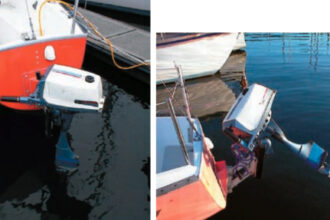
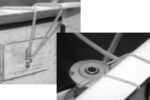
I’m 60-plus, and shall we say I’ve been in better shape? My dear wife, Liz, is way behind in years, ahead in wisdom, and a heck of a lot sweeter on the eye, but she now contends with a lower back that’s been through surgery. I rigged up pulleys with a rope and foot loop so she could raise and lower the engine with leg strength. That worked fine for her, but old fuzzy here still had to horse it up to and down from the outboard bracket on launch and retrieval. Who needs the Honda T-shirt when the lower unit is already imprinted in your chest? It was a wheeze.
“Plus, it puts us out of trim, dear.” Gripe, gripe. You are safe to assume I was the first to cave.
Throughout most of the outboard industry, “long shaft” meant 20 inches as measured from the horizontal surface on which the engine rests to the cavitation plate above the propeller. But, avast, matey! On a Honda 2, “long shaft” means 23 inches. A new, air-cooled, Honda 2-LS now decorates Sarafina’s transom. That’s close enough to 25 inches for me, and I can put the little hummer over my head with one hand.
Grave concerns
Aside from the obvious compromises incurred when making drastic reductions in horsepower, I had grave concerns over one remaining detail. The Honda 2 has a small integrated gas tank. My apprehension was spawned by the memory of rough seas and perilous attempts to pour more fuel than salt water into the old Seagull outboard. Liz reminded me I used to perform that task “with all the grace and agility of a rooster with socks on.” It had to be addressed. Simply losing the socks was not the answer.
For some of us, certainly for me, the better solutions to such problems emerge out of the mists between waking and sleep. Before drifting off the next few nights, I planned to submit this one for review. Morning Two showed promise. A few years back, I enjoyed fl ying radio-controlled model airplanes. This particular solution lay in combining aspects of both hobbies.
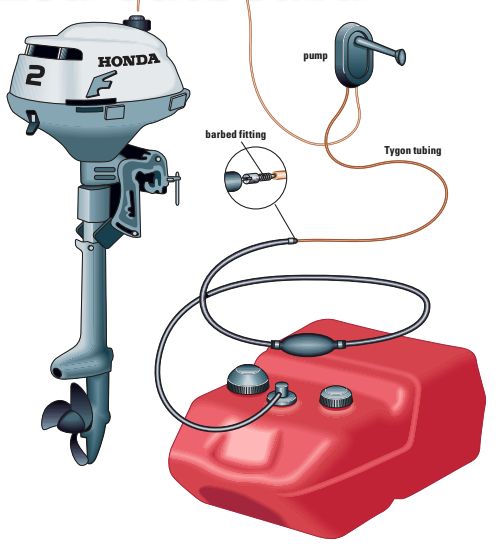
Filling up the little kicker now takes about 30 seconds with a small hand-cranked gasoline pump no bigger than a bar of soap. Mounted on a block of wood clamped to the stern pulpit, it keeps all aspects of filling and topping off the tank within easy reach of the cockpit. Manufactured by Hobbico and designed for use with gasoline and glow-fuel models, the pump costs $13.99.
In our application on board, the suction side of the pump is fitted with a few feet of small-diameter Tygon tubing made for gasoline transfer and available at hobby shops. The tubing is connected to a small barbed fitting inserted downstream from the priming bulb in a standard outboard fueling hose.
Discharge fitting
The other end of the hose is snapped to the standard brass discharge fitting on a 12-gallon fuel tank located under the stern seat. The pump’s discharge outlet, if fitted with enough tubing, comfortably reaches the filler cap on the outboard. Lefties will be pleased to know that fuel moves through the pump with equal efficiency in either direction whether it’s cranked clockwise or counterclockwise. That’s why the inlet and outlet nozzles are not labeled on the pump: their function depends on direction of rotation.
If the pump ever loses its prime or fails altogether, we could always use the outboard hose-priming bulb as a backup. Filling completed, the discharge end of the tubing is folded over and clamped tightly with a spring-type wooden clothespin. No balancing act; no socks, bruising, spilling, or drowning. All good.
In the absence of an alternator, we added a 50-watt solar panel to the two flexible panels atop the companionway hatch. Our power requirements are modest. Sailing in calm conditions or at anchor in our typically bright sunlight, the combined array easily produces 3.75 amps and at times even better by a millifrickle.
Flickas are beamy for their length and pretty heavy. Sarafina is 8 feet by 20 feet 2 inches, with a draft of 39 inches and displacement of approximately 6,500 pounds fully provisioned with two aboard. Her waterline length is 18 feet 2 inches, making the theoretical hull speed about 5.7 knots.
The new kicker will push Sarafina to 3.5 knots in smooth water, while 2.5 knots gives the best fuel economy. It will run at 2.5 knots for two hours with each filling of 1 quart. This, multiplied by the 48 quarts in the main tank, predicts a range of 240 nautical miles … on paper in perfect conditions.
The motor has a centrifugal clutch and swivels a full 360 degrees for great maneuverability. Setting the anchor does require building momentum since the engine doesn’t have enough oomph to drag lots of chain rode. Head seas can also make for slow going.
Better than no engine at all
Some will say, “Well, I guess it’s better than no engine at all.” Which reminds me … Larry (Pardey), I tried the sculling-oar bit. It was a disaster. Certainly, in trading horse-power for reduced weight we have limited our options. However, we still have motive force in moderate amounts from an engine we can both handle with ease.
It’s just the ticket for cheating around a headland, making a little breeze when the seas are glassy, and for chugging in and out of harbor. Doesn’t part of good seamanship involve anticipating and avoiding situations you can’t power out of? At least we can hope that, through this whole experience, we will become better sailors.
Thank you to Sailrite Enterprises, Inc., for providing free access to back issues of Good Old Boat through intellectual property rights. Sailrite.com