Second of two parts: How aluminum and copper alloys behave and applying the theory to your boat
Issue 20 : Sept/Oct 2001
Aluminum alloys for use on boats are generally limited to the 5000 and 6000 series. The former contain aluminum and magnesium and are used for plating on aluminum hulls, while the latter add silicon as well, and are used for extruded shapes (such as masts and other spars). Both types of alloys form a tough oxide film on the surface, which is light gray in color. Thanks to that film, they’re sufficiently corrosion resistant that they need not be painted, and aluminum boats with unpainted hulls and even decks are becoming increasingly common, while unpainted aluminum spars have been around for years. As with stainless steel, however, these aluminum alloys can suffer from several kinds of corrosion if the naturally occurring oxide film is broken or prevented from forming. They’re also quite vulnerable to galvanic corrosion.
Pitting corrosion
Pitting corrosion is the most common type of corrosion seen with aluminum and shows up frequently on spars. It first forms at a weak point in the oxide film, after which chemical reactions within the pit will increase the chloride concentration and sustain the reaction. It shows itself as a dusty white or gray powdery deposit which blotches the surface. If you clean the deposit away, you’ll see small pits or holes, as shown at left.
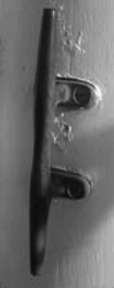
Pitting in aluminum exposed to salt water can be fast at first — with the pits reaching a depth as much as 3⁄64 of an inch in the first two years, but it typically slows after that, taking 20 years to reach 3⁄32 of an inch. Given that many masts are quite thin (5⁄32 to 3⁄16 of an inch), pitting can be a very real and serious concern.
Stress corrosion
The corrosion rate varies depending on the situation, but it can increase if the aluminum parts are under stress. Corrosion fatigue can be caused by a combination of stress and ongoing corrosion and can cause a metal part to fracture long before it otherwise would. The degree of visible external corrosion isn’t a good indicator of relative corrosion fatigue, and the only defense is to choose the right materials for any parts subject to alternating stresses.
Galvanic corrosion
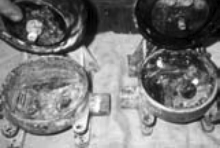
Aluminum sits very high on the galvanic series, meaning it will lose out to almost any other metal in contact with it. It must be electrically isolated from other metals if the two are in the presence of an electrolyte. Failure to do this will result in the aluminum corroding, often at a very rapid rate (example below).
Crevice corrosion
Crevice corrosion takes place in narrow areas where pieces of aluminum are joined or where aluminum joins another material. A variety of mechanisms can work to start crevice corrosion in aluminum, but it generally progresses due to galvanic action once two areas on the same surface have become passive and active.
Preventing corrosion
Because it will corrode whenever the oxide film is prevented from forming, aluminum should always be separated from other materials, even from other pieces of aluminum. This can be done in various ways: by using an adhesive waterproof paint such as epoxy, with spacers and gaskets made of plastic or a non-conductive material, through application of a waterproof bedding compound, or with a joint paste such as a barium chromate paste. (A barium chromate paste marketed as Duralac is widely available in New Zealand, Australia, and the United Kingdom; check with your marine supplier to see if they can import this, or if a similar product is available in the United States.) The best protection will be achieved by using a combination of these techniques. Make sure that whatever you use doesn’t create additional problems. For example, avoid using silicone caulk on aluminum unless it’s neutral cure, as acidic-cure silicone (that smells like vinegar) will produce corrosion (photo at right).
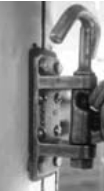
Anodizing is a process whereby an especially tough oxide film is created on the surface of the metal. Anodized spars look good when new, and anodizing will slow pitting corrosion, but it won’t prevent it, and it’s no defense against either crevice or galvanic corrosion.
Copper alloys: Brasses and bronzes
Copper has been in use longer than any of the other metals typically used onboard — about 6,000 years. In its pure form, copper is quite soft but has excellent resistance to corrosion and conducts electricity very well. Pure copper doesn’t see much use except in wiring and as wooden-boat sheathing, but copper alloys constitute some of the best metals available for the marine environment.
Brass
Brasses are copper alloys that include zinc, with the percentage of the latter varying from about 10 to about 40 percent. Brasses are the least useful of the copper alloys for marine applications because their zinc content makes them prone to general corrosion and “de-zincification” when immersed in sea water. De-zincification takes place when galvanic corrosion attacks a brass fitting so that the zinc (the less noble metal) is eaten away, leaving just the soft copper. Brass is suitable for interior fittings, but should not be used for any underwater fittings or fasteners.
Much confusion results from the fact that some brasses are incorrectly called “bronzes.” These include commercial, manganese, and Tobin bronze. If in doubt, check the composition and avoid using any “bronze” that contains zinc below the waterline.
Bronze
True bronzes are alloys that include varying amounts of silicon, aluminum, and tin; common types include silicon bronze, aluminum bronze, and phosphor bronze. Bronzes are protected by a very tough oxide film, which gives them their characteristic green color when exposed to sea water or marine air. Although they do corrode, they do so very slowly and uniformly and are not subject to problems such as pitting, crevice, weld, or stress corrosion. Silicon bronze can be easily welded with no loss in strength, meaning that it can be used to fabricate a wide range of fittings that are more commonly made of stainless. An increase in temperature (within the range found in the tropics, for example), causes the oxide film on bronze to form more quickly but doesn’t otherwise enhance the corrosion rate.
Bronzes are the metals of choice for underwater use, except on aluminum boats where they can cause serious galvanic corrosion (see photo below). Otherwise, use bronze for through-hull fittings, hardware, fasteners, propellers, and shafts. Silicon bronze is a good all-around choice for most applications.

Applying the theory: corrosion and boat gear
Rigging
The vast majority of sailboats use 1 x 19 stainless-steel wire for standing rigging, and we’ll restrict our comments to this type of rigging, but it is possible to use other materials, including galvanized or stainless wire of 7 x 7, 7 x 19, or 1 x 7 (Dyform) construction.
Corrosion and wire fatigue are the primary sources of problems with rigging wire. Although inevitable, both can be delayed: corrosion can be slowed by using the best-quality stainless wire you can buy and by careful choice and installation of terminals. Keeping the rig properly tuned and ensuring that toggles are used on both ends of all shrouds and stays can reduce fatigue. Using good-quality wire is very important, as even small imperfections can lead to greatly accelerated corrosion. Quality control is uneven in wire manufacturing, and you should only purchase wire from reputable manufacturers. Finally, you can slow corrosion by buying a superior grade of stainless. The 1 x 19 wire is available in 304 and 316 grades. Type 316 is more corrosion-resistant, but is typically weaker for the same diameter. Make sure to check the breaking strength of any wire you use.
Rigging wire rarely fails in the middle of a shroud or stay, but instead at (or even in) an end fitting such as a swage or other terminal. Swaged fittings are especially prone to crevice and stress corrosion, and my advice is not to use them. Compression fittings have a number of advantages:
- They can be taken apart at any time to check on the condition of the fitting and the wire.
- They can be re-used even if the wire must be replaced.
- They’re much less prone to crevice corrosion because they’re filled with sealant when assembled.
- They’re easy to assemble, so you can do the work yourself, saving money and ensuring that the job is done correctly.
Standing rigging should be replaced immediately if there are any signs of pitting or broken strands. Specifying when to replace wire is difficult, as it depends in part on the quality of the wire, the type of end fittings, and how the boat has been used. In general, though, rigging used in salt water in northern latitudes should be replaced about every 10 years, while wire should be renewed every 5 to 6 years in the tropics, even though it may look to be in fine condition. These times might be extended somewhat if the wire is 316. Freshwater sailors are likely to do much better than these rough estimates suggest. No matter where you sail, inquire with a local rigger if you’re in doubt about the integrity of your rigging.
If stainless steel is used for running rigging, it should be 7 x 19 construction, which is more flexible than the 1-x 19 used for standing rigging. This wire is also suitable for lifelines. Lifelines should never be plastic-coated, as this will encourage (and hide) corrosion. If your boat has plastic-coated lifelines, replace them with bare wire, and increase the size so that the outer diameter of the bare wire equals the outer diameter of the plastic-coated wire. They’ll be stronger and last longer. Ends should be fashioned with a thimble and Nicropress sleeve, and a lashing should be used to secure and tension the lifeline. Replace running rigging and lifelines whenever you replace standing rigging.
Aluminum spars
Aluminum alloy spars require much less in the way of regular maintenance than do wooden ones. Coatings are essentially optional. Although most masts are either anodized or painted, they can be left bare with no harmful effects. Problems with aluminum masts crop up where they’re welded, where fittings and hardware made from other materials are attached, and at cutouts or openings.
Aluminum and plastic (or other electrically and chemically inert) fittings can be mounted directly on a mast or boom using aluminum rivets. Galvanic action won’t be a problem, but it is advisable to apply some joint paste before installation. Apply it to the fitting if it’s aluminum, and on the rivets in all cases, to forestall any problems with pitting corrosion.
Stainless and bronze fittings — including sail tracks — must be electrically isolated from the spar, or pitting and galvanic corrosion will result. They should be mounted using stainless machine screws or Monel rivets, as galvanic action will cause aluminum alloy rivets to corrode rapidly. Isolate the fittings using a durable plastic spacer, and liberally apply joint paste to the fasteners. These should be removed and rebedded every year or two if you’re in a warm climate.
Aluminum masts are susceptible to cracking in the vicinity of any welds, and these are most common near spreader sockets. Check welds frequently for signs of cracking or corrosion. Cracks may also develop around any openings, such as exit points for internal halyards. These should have rounded (rather than square) corners. If internal halyards are fitted, make sure that there’s a hole at the base that will allow the mast to drain, as a surprising amount of water will find its way in, which can produce serious corrosion at the base of the mast.
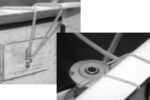
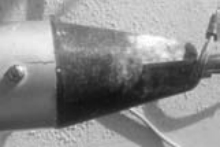
Aluminum alloys used in making castings, such as spinnaker and whisker pole ends, are not as corrosion-resistant as the marine-grade alloys used for the poles themselves. Serious galvanic corrosion between the pole and the casting can result and may cause the pole to split (see photo below). The only solution is to disassemble the pole periodically and apply liberal amounts of joint paste or other anti-corrosion compound.
Rigging fittings and deck gear
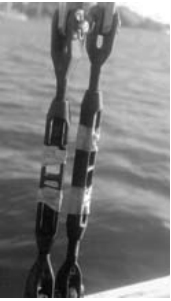
Turnbuckles are frequently doused with salt water from waves and are susceptible to stress, crevice, and pitting corrosion if made from stainless steel. This is especially true of closed-body turnbuckles used in the tropics, as they’re impossible to flush with fresh water and therefore become perfect sites for corrosion. All-stainless turnbuckles are also prone to galling, which can cause thread damage and weaken the turnbuckle (see below). All of these problems can be avoided by using open-body silicon bronze turnbuckles; at the very least, ensure that the turnbuckle bodies are bronze. Turnbuckles should be checked for wear and greased annually.
Chainplates on steel and aluminum boats usually form an integral part of the boat’s structure and rarely develop problems. On wood and fiberglass boats they’re typically mounted on the outside of the hull, or somewhat inboard, piercing the deck or cabintop. In either case they’ll be metal (usually stainless steel or bronze) and fastened with bolts. Bronze chainplates shouldn’t suffer from corrosion, but chainplates made from stainless steel are prone to stress and crevice corrosion.
Outboard-mounted chainplates of stainless will develop problems where they’re bedded against the hull and where they’re pierced by bolts; the bolts that secure them to the hull are also very susceptible to crevice corrosion if made from stainless. Sealing inboard-mounted chainplates completely against leaks is very difficult, and these usually corrode where they come through the deck. With both types, problems are likely to be hidden from view, and will be found only by completely removing the chainplate and pulling all the bolts.
Even if they look to be in good condition, stainless-steel chainplates should be replaced every 10 years or so in the tropics. Use silicon bronze chainplates and bolts whenever possible if replacing these fittings, as the bronze ones will last for the life of the boat.
Mast tangs are typically made of stainless and are subject to weld decay and to stress corrosion at any bends. Carefully inspect these fittings for cracks, and replace them immediately if any are found. Problems can be avoided if bronze is used to fashion replacements, but you should be very careful to isolate these completely from an aluminum mast.
Blocks are often made with a combination of aluminum and stainless steel parts, and these will corrode after a number of seasons in the tropics. There’s little to be done, except rinse them frequently with fresh water, disassemble them if possible, and apply joint paste. Or replace them, preferably with blocks made from a single type of metal.
Winches, roller furling gears, and windlasses are all susceptible to corrosion, with the amount dependent on how and where you use your boat. Equipment that may last for years if used only on occasional weekends in a northern climate can corrode quickly and severely if you’re cruising in the tropics. In any case, don’t believe manufacturers’ claims that a unit equipped with sealed bearings will deliver a “lifetime of service.” I’ve experienced serious corrosion problems with all of these types of equipment, all of which were produced by major, reputable, manufacturers.
If you’re thinking about purchasing equipment, keep the principles of metal corrosion in mind, and buy gear with the least potential for corrosion, especially for galvanic action. For example, “old-fashioned” anchor windlasses made of bronze (with perhaps some stainless gear shafts) are less likely to develop trouble than models combining aluminum and stainless. The same holds true for winches: although they’re cheaper and lighter, if you’re sailing on salt water don’t buy winches with aluminum drums. Look for models with bronze or 316 stainless drums and gears. There’s no magic formula for maintaining equipment, other than to strip it down frequently and to always use good-quality lubricants.
Since 1993, Mark has been sailing Nomad, a 35-foot Cheoy Lee Lion, with Kim des Rochers. They’re currently in New Zealand.
Thank you to Sailrite Enterprises, Inc., for providing free access to back issues of Good Old Boat through intellectual property rights. Sailrite.com