And why shouldn’t women share the stress of docking?
Issue 52: Jan/Feb 2007
The National Marine Manufacturers Association recently released a survey stating that boaters, by a whopping margin, are healthier and happier than non-boaters. That’s pretty encouraging for those of us who like to get out on the water. Unfortunately, not everyone is as happy about being a boatowner as the survey suggests. I don’t know if they polled mostly men, or if it was equally divided between the sexes. I do know that there are a lot of women out there who don’t enjoy boating nearly as much as their partners do.
I can state this from experience, having spoken on the topic of women in boating at a number of boat shows. That’s when women tell me, “Sailing is his thing. I’m just here to keep him company.”
So I ask, “But isn’t it your boat too?” and they invariably respond, “Well, yeah, but I just handle the lines.”
Now, there’s nothing wrong with being the line handler. And I’m well aware that in an emergency there can only be one captain. But in all other circumstances, the “little lady” shouldn’t be relegated to the foredeck or the galley simply because tradition dictates it.
Sure, lots of women do the navigating, some make the radio calls, and most will take the helm when they get out in open water, but could they handle the boat completely on their own, including getting it safely back into the slip, if they had to?
Safety is the number one reason that women boaters should be as competent as men. But they also limit their enjoyment and satisfaction when they play a lesser role. Why? Because it’s only fun for a while to just go along for the ride.
Taking up golf
To illustrate my point, imagine a couple who decide to take up golf together but the woman only carries the clubs and fetches drinks. How long do you think she’ll want to keep going out to the golf course? It’s the same with boating: it’s far better to be a partner than a passenger.
Boating is an exciting and rewarding sport that offers you as much in return as you put into it. I won’t lie and say it’s nothing but wonderful and idyllic moments. There are those, to be sure. But like everything else, there are times on a boat when you wish you’d taken up horticulture instead.
Yes, sailing is challenging. Yes, there’s a lot to learn to do it well. Yes, it has its uncomfortable moments. But when you set yourself up for success and approach boating with the right attitude, there’s no reason a woman can’t enjoy it as much as a man.
Like falling in love all over again, you should focus on the positives, because the secret is out: boating is fun. It’s relaxing. It offers independence, freedom, and endless opportunities for travel and adventure. It gives you a chance to interact with nature, reconnect with your family, and make new friends. You can’t say the same about horticulture.
Beyond attitude — whether their own attitudes or their partners’ — one of the biggest factors that keeps women from getting fully involved on their boats is fear. Because fear feels so unpleasant, we often avoid potentially scary situations. This would include times when we’re not in control, when we don’t understand how everything around us works, and when we’re not totally comfortable in our surroundings. Like on a boat, maybe?
Ever-changing conditions
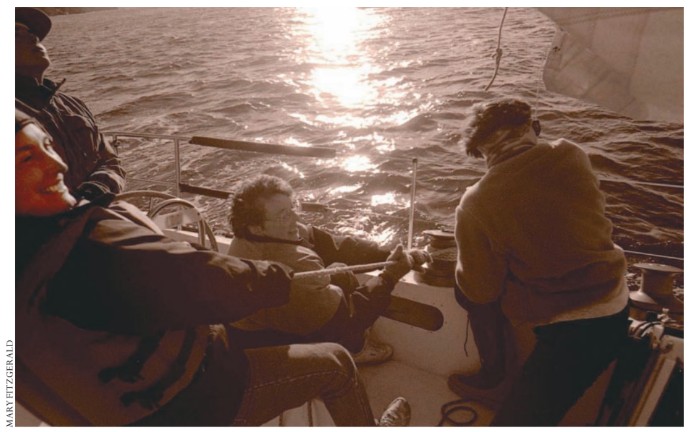
Sailing exposes us to a unique environment. On the water we face everchanging conditions and experiences that landlubbers never have to deal with. These include a host of things which some may find frightening, such as heeling, big waves, being out of sight of land, and having someone fall overboard.
Come to think of it, who wouldn’t be scared in those situations?
Luckily, scary things aren’t nearly so intimidating when you understand why they happen, how they work, and what you can do to take control of a situation. When it comes to fear, education and experience are the cure.
So figure out what it is about sailing that makes you afraid, then learn all you can about it. Take heeling, for example. When you’re a novice sailor, it can be pretty disconcerting to find yourself and the platform on which you’re riding leaning over at a precarious angle. It’s unnatural. If your car did that when rounding a curve, it could tip over, right? Well, unless you know something about sailboat design and the way sails work, you could easily assume that your boat might do the same.
A little education, however, will teach you that a boat’s keel and ballast work to overcome the pressure put on the sails by the wind. As the boat heels further, some of the wind will actually spill out the top of the sail. Then the keel takes over and brings the boat back upright. Little Sunfish and sailing dinghies do tip over because they have neither ballast nor fixed keels. Their crews expect to go swimming. Larger keelboats are designed to return to an upright position, even if the boat rolls 90 degrees or more.
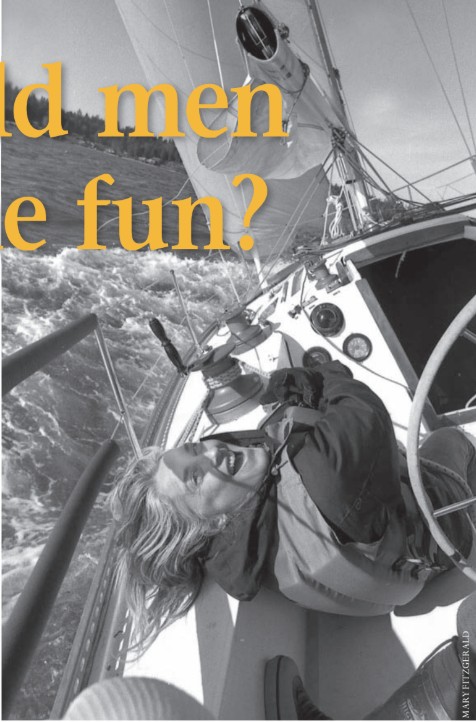
Knowing that makes a huge difference. That knowledge helps ease the fear while you get out there on the water and repeatedly experience your boat heeling over. When it leans so far that the toerail is in the water, you’ll see that it’s not tipping over. That’s what sailboats do. In fact, heeling is kind of fun. It’s what makes sailing so exhilarating once you get over your fears. It’s just a matter of getting used to the feeling and understanding the forces at work.
No mystery
Once you’ve taken the mystery out of scary things by learning as much as you can, you’re more able to face them. Then experience kicks in. The more you experience something that once scared you, the more you realize just how much you and your boat are capable of.
One aspect of boating that separates the men from the women is docking. When it comes to equality afloat, docking is the Great Divide. It’s so unusual to see a woman take a boat in or out of a slip, that it turns heads, doesn’t it? Why is that?
Part of the problem is that men don’t seem to want to give up the wheel. Maybe they’re worried that their partner will damage the boat, but a man has just as much potential for screwing up a docking evolution as a woman. It’s all a matter of experience and training, and we all have to learn somehow.
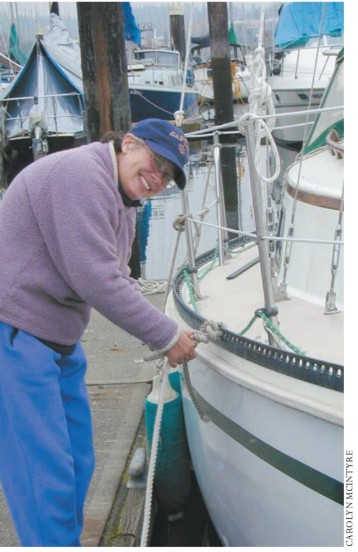
If you or your partner are nervous about bumping into something, remember: that’s what fenders are for. Don’t deprive yourself of the satisfaction and pride of taking the wheel when docking. Nothing feels better than when you bring your boat into the slip just right. Yes, people will be watching. We all watch. But we all know that we could be in your position. You’ll find that your fellow sailors are a pretty helpful bunch. They’ll be more than pleased to cheer you on if you’ll only make the effort.
Take a deep breath and practice. Start with easy landings and move up to the trickier ones. Make it your goal to get your boat-handling skills to the point where you can share docking duties with your partner fifty-fifty. Whoever takes the boat in or out of the slip one time, handles lines the next, and vice versa. That way, both of your skills stay sharp.
There is one thing
If this thought scares you, keep in mind that with training and experience there is absolutely nothing aboard a boat a man can do that a woman can’t do just as well.
Actually, I’m wrong. There is one thing. We can’t pee over the rail. But considering that doing so can easily lead to a man-overboard situation, I don’t recommend it for men, either. All other boating activities, however, are gender-neutral. Driving, docking, navigating . . . even maintenance and repairs.
Yes, maintenance. It’s not that women aren’t mechanically inclined. It’s just that few of us have ever been encouraged to work with tools or been taught how to do mechanical things. Actually it’s fun to fi x things. There’s instant gratification when you take something that’s broken and make it whole again. There’s tremendous satisfaction in doing things that you never before thought you could.
You may find that you’re simply not interested in sharing in the maintenance or tinkering with your engine. That’s OK. But you should at least understand how all the systems aboard your boat serve you and what you need to do to keep them working efficiently.
Take a few minutes to make your engine’s acquaintance. Find out what those hoses running back and forth are for and how the thing runs. Learn what it needs to operate well and what can cause its early demise. Do the same with your plumbing system, electrical panel, and anything else your partner may have always taken care of.
Engines, electrical panels, docking . . . you can do it all. You can be an equal partner aboard your vessel.
Don’t limit yourself because of your fears, your attitude, or your partner’s attitude. Aim to have skills and knowledge on par with your partner’s. If you catch yourself thinking, “I couldn’t do that,” make it a point to find out how.
While you may never take your boat out without your partner, you should be able to do so should anything ever happen to him while you’re under way. You want to be prepared for that one-in-something chance that things will go wrong.
Decide to get out there and try new things, to learn about those areas in which your nautical knowledge is lacking, and to practice those skills that are shaky.
Do these things and you’ll be a safer and more competent mariner. Do them, and you’ll be tremendously proud of yourself. Do them, and you’ll have a heck of a lot more fun. But mostly, do them because it’s your boat, too.
Thank you to Sailrite Enterprises, Inc., for providing free access to back issues of Good Old Boat through intellectual property rights. Sailrite.com