A noted designer tells what makes a boat seakindly
Issue 62 : Sept/Oct 2008
In all the books I have studied about yacht design and the sea, there has been very little written about seakindliness. Many years ago, I read that the skippers of big four- and five-masted lumber schooners sailing out of Maine at the turn of the century often hoisted heavy weights to their mastheads, to ease the snappy motion of the vessels when they were riding lightly loaded in a combination of large ocean swells and soft breezes.
These big schooners normally carried a hold full of timber as well as a full deck load, resulting in a relatively high vertical center of gravity (VCG) and a very easy motion when sailing up to Boston and New York to deliver their cargo. However, when returning to Maine with a heavy cargo of coal and without the great weight of timber on deck, the ship would have a very low VCG and be much more stable. This resulted in a snappy roll in light air, snappy enough that it could tear the rig out of the ship or the stomach out of a seaman, so they said. The answer was to hoist heavy weights to the masthead to raise the vertical center of gravity, thus slowing the roll and easing the motion, particularly when beam seas and light breezes combined to place the vessel on her worst behavior.
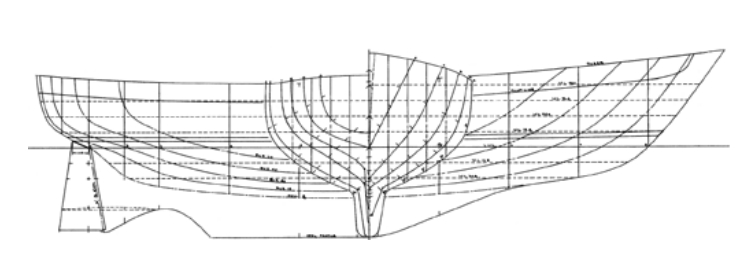
Now, as I think back on the 1969 Transpac Race aboard Mystic, my 56-foot aluminum ketch design, I realize that the reason for her doing so surprisingly well was due, in large part, to her seakindliness in rough weather rather than to any design brilliance of mine. Mystic is a keel/centerboard, ketch-rigged motorsailer, with a moderate 15-foot beam on an almost 47-foot waterline, a deep wineglass hull section, moderate displacement, and a rather shoal 6-foot draft.
The start of the race was in very light air; during the first night we feared we might even drift onto the rocks of Catalina Island. After a couple of days of very light air, the breeze began to fill in and continued to pick up until, finally, we were on a broad reach with all sail set, the anemometer measuring 26 to 28 knots and the knotmeter reading 10 to 11 — even 13 to 14 knots at times on the face of a wave. In effect, we were running before a stiff 40-knot breeze, a near gale!
After the first rough day, as we listened to other yachts on the radio, we heard that some boats were falling out with broken gear, others with “crew fatigue” (read: seasickness). Indeed, a couple of our own crew were not showing any great appetites, but the rest of us were able to stand our watches.
Three-course dinners
Fortunately, our cook, a remarkable young woman, was one of the finest and served up a solid breakfast, hearty sandwiches at lunch, and marvelous three-course dinners complete with wine and desserts. This kept us at our best and working hard on deck to get every fraction of a knot that we could out of the boat. Mystic’s 24-foot 6-inch x 56-foot foretriangle permitted us to set a huge spinnaker, and we also carried a big mizzen spinnaker, thus making every mile we could while the strong quartering breezes held.
Along with the great food, Mystic’s relatively easy motion allowed her crew to get a decent rest, and a well-fed and well-rested crew can often perform miracles. Our miracle was a surprisingly good second place in Class B. It was an incredible finish for a vessel that was designed as a husky, comfortable motorsailer — not a racing yacht, by any stretch of the imagination.
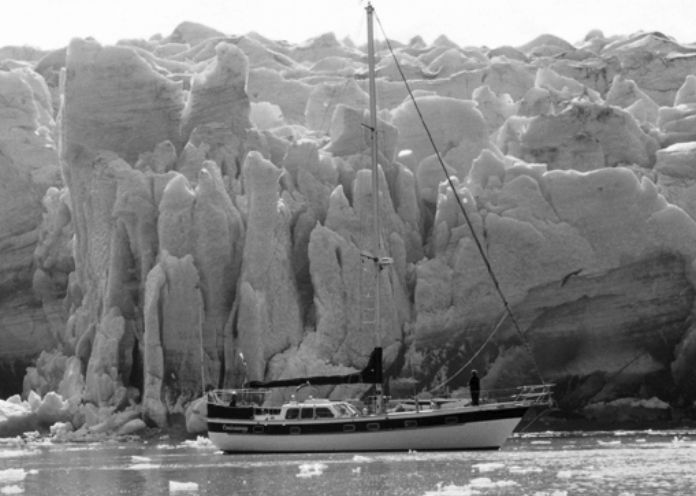
The advantage of a seakindly vessel was really brought home to me by the late Lindsay Stewart, a New Zealand delivery skipper. Lindsay visited me about eight years ago, and we had a fascinating time together as he told me about the travels that he and his wife, Olive, had made. They covered thousands of miles aboard Cruisaway, their Oceanic 46 cutter, sailing the waters from New Zealand to all over the South Pacific, north to Alaska, south to Patagonia and many other areas that most of us just dream about. (See cover photo, Good Old Boat, January 2002 issue, and photo on facing page.)
Lindsay was adamant that Cruis-away was the best cruising yacht of her size that he had ever sailed, and he sailed dozens of vessels in his yacht-delivery career. The reason he gave for this was her easy motion — her seakindliness — in heavy weather. This one factor enabled him and Olive to maintain boat speed when “faster” yachts were slowed by high seas and their crews fatigued by the snap motion. Lindsay regaled me with stories of occasions when, cruising in company, they would leave harbor a day after lighter, faster yachts and, due to stormy conditions, arrive at their destination well ahead of the fleet.
Unfortunately, Lindsay Stewart was killed a few years ago while on a delivery trip in the Mediterranean, thrown overboard while up the mast trying to make repairs in storm conditions. However, his words about seakindliness and comfort were, to a large degree, the inspiration for this article. So much has been written about performance and speed, and so little about the importance of seakindliness in maintaining speed in heavy going, that I felt such an article would be of interest to readers.
Note the difference
It is important to note the difference between “seakindly” and “seaworthy.” Perhaps the best way to consider it is to say that a seakindly vessel is one that is easy on her crew and gear, while a seaworthy vessel is one that gives the expectation of getting there and back in safety. Obviously, the best cruising yacht of all is one that is both seakindly and seaworthy, while at the same time providing good performance in all weather. I will further qualify that by emphasizing “good” performance and not “great” or “spectacular” performance and “all weather,” not just “light” or “heavy” weather.
The primary motions that affect seakindliness and crew comfort are heave, roll, and pitch. Heave is the rise (ascent) and fall of the vessel as a wave passes under her and, to some degree, the amount and speed with which she is thrown to leeward by the force of the seas. Roll is the side-to-side oscillation in a beam sea. Pitch is the fore-and-aft oscillation in waves. The factors that affect those motions are displacement, beam, waterline area, prismatic coefficient (Cp), and center of buoyancy (CB).
Obviously, a boat will only be set in motion when a force is acting upon her. The speed of that motion will be determined by the mass (displacement) of the boat and the amount of the force. That amount is governed by the waterplane (waterline) area; the larger the area the wave has to act upon, the greater the force and the swifter the motion for a given mass.
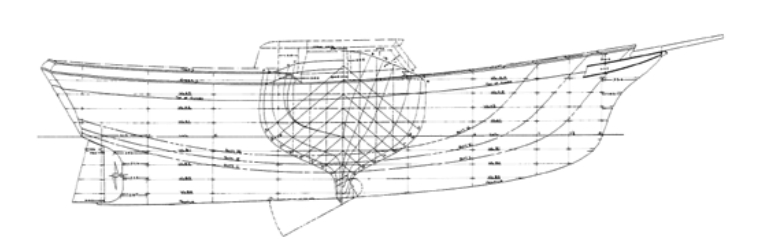
Displacement is, undoubtedly, the greatest single factor in determining motion comfort and seakindliness. For a given wave height, the heavier vessel will ascend more slowly and over less distance than a lighter vessel of similar length and beam. Beam is the second major factor. A beamy yacht will have greater waterplane area and will rise higher and faster than a narrower yacht of similar displacement, since there is greater force acting on the same mass. Beam also increases stability; a very stable yacht will react more quickly to beam seas than her narrower sister.
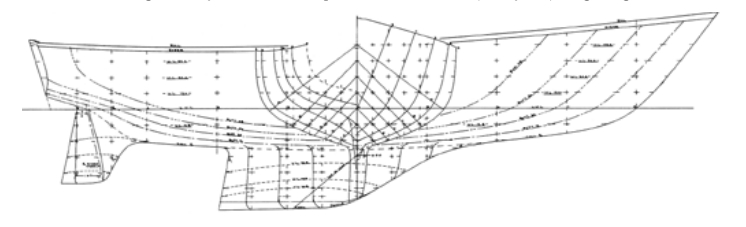
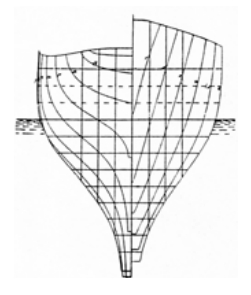
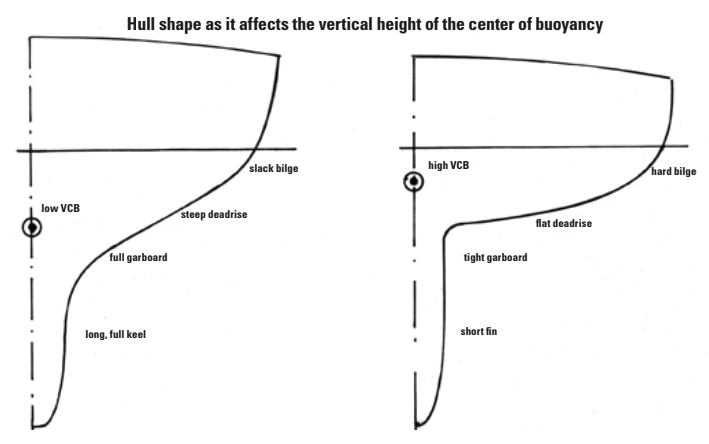
The shape of the hull obviously has a definite effect on seakindliness, and the vertical height of the center of buoyancy (VCB) can make a big difference. Two vessels of identical length, beam, and displacement can have very different reactions to a swell. A vessel with a high VCB, due to having hard bilges and a relatively flat bottom, will be more stable than one with moderate deadrise and slacker bilges that carries her displacement lower. The latter, having less form stability, will tend to roll more slowly as a beam sea slides beneath her, perhaps to a greater angle of heel, but her slower motion will be more comfortable than the snap roll of her more powerful sister.
Carried to extremes
Heavy displacement can be carried to extremes, of course, particularly when combined with a small waterplane area, as it was in the ridiculously narrow British Six-Beam cutters of the 1890s. Such a vessel may ascend so slowly when beating to windward in heavy seas that she takes green water over the bows with every wave, thus limiting the crew’s ability to handle the yacht or even to move safely about on deck. Though she will have a very easy motion, that type of yacht can be almost as dangerous as one that cannot be safely handled due to crew fatigue and seasickness.
Another factor to consider is the rig. A husky rig can be an asset in heavy weather, slowing the roll, due to its inertia. On the other hand, a very light rig, such as a carbon-fiber mast, will tend to promote faster acceleration of both the initial roll and the recovery. In any case, losing the rig in a storm is a double disaster, as the yacht is unable to make sail and at the same time is rolling to extremes with a snappy motion, due to loss of inertia.
The lateral plane is a consideration as well, since generous lateral plane area can dampen the roll. That, undoubtedly, is one of the factors that Mystic had going for her on the Trans-pac: her long keel and centerboard slowed the roll. The boats that had the most trouble with crew fatigue in that race were the small, light, beamy, fin-keel/spade-rudder yachts with minimal lateral plane.
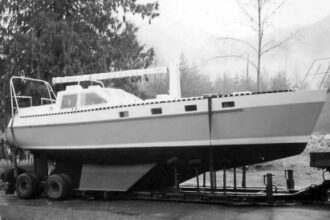
I do not feel that a long, full keel is essential to seakindliness, though. A cutaway full keel or a moderate fin hull with a skeg-hung rudder or even a large spade rudder can be seakindly, provided the vessel’s directional stability is sufficient enough that she does not overtire the helmsman. I have had reports from owners of a Douglas 31 that survived a hurricane and a Cape North 43 that handled a gale with aplomb. The Douglas is a very cutaway “full-keel” hull and the Cape North is a moderate fin hull with skeg/rudder. However, both yachts are of good displacement with reasonable deadrise, factors contributing to seakindliness.
A lesser villain
Pitching is usually a lesser villain when it comes to seakindliness, at least with sailing yachts. The average sailing yacht has a prismatic coefficient between 0.52 and 0.56 and a center of buoyancy about 52 to 54 percent of her waterline length abaft the bow. I have seen pitching become a problem with a very low Cp of 0.46 to 0.48 in a short chop, but that affects performance more than comfort. I do feel that some Euro-style designs, principally those with extremely wide sterns and fine bows, may move the center of buoyancy and the center of flotation too far aft for comfortable motion in some seas, and I would not even try to predict such a vessel’s motion or safety in severe storm conditions. The combination of wide stern and fine bows can also create a yacht that trims down by the bow as she heels, thus increasing the chance of green water on the foredeck in adverse weather.
What really determines seakindliness and comfort in extreme conditions is the acceleration of the rise and fall of the yacht or of the snap of the roll. Scientists have shown that an alternating force of one gravity (1 g) will cause motion sickness in the average person. Tank tests at Stevens Institute on a model of a 100-foot motor yacht of my design proved to me that a yacht can develop 1 g of acceleration and greater in beam seas of only 10- to 15-foot height. Fortunately, the roll of the motor yacht was eased with the installation of bilge fins, and the roll of a sailing yacht is eased with wind pressure on the sails, as long as the breeze holds steady.
The necessity for seakindliness becomes a major factor in safety, sea-worthiness, and comfort when storm conditions increase wave size while the sail area is reduced to compensate for gale winds. Then the amount of sail that can be carried may be of too small an area and set too low to effectively dampen the roll in heavy seas. In those circumstances, the combination of heave and roll can make it almost impossible to work on deck and equally impossible for the crew to operate efficiently due to fatigue and nausea.
A rough guide to seakindliness is the Comfort Ratio. This is expressed as:
displacement (in pounds) / 0.65 x (0.7 LWL + .3 LOA) x B1.333
The waterplane area is rarely given by designers or builders, so the formula calculates it roughly from the overall length, the waterline length, and the beam, and adds an additional beam factor for rolling. The formula cannot take into consideration the variations in hull shape, the deadrise, VCG, form stability, rig weight, or other factors that affect seakindliness. It is only a very general guide and, as any guide, should be used intelligently and with consideration given to the points mentioned previously.
Use with discretion
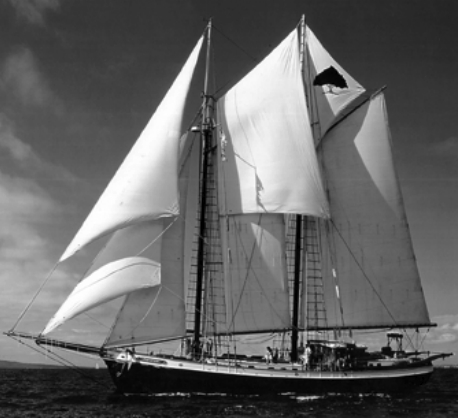
Also, the formula should only be used to compare yachts of relatively similar size. For example, the 70-foot schooner, Tree of Life, has a Comfort Ratio of 64.7. The Hiscocks’ world-girdling 30-foot 6-inch Wanderer III, with her 20,160-pound displacement carried on 26.5-foot waterline and a slender 8.4-foot beam, has a ratio of 65.4. Despite the figures being so close, no one can possibly imagine that the little Wanderer III will be as comfortable in heavy weather as a 60-ton schooner. However, the Wanderer III definitely will have a much easier motion than 90 percent of the boats her size, including my Douglas 31 design with a Comfort Ratio of 31.3. And the Douglas will be more seakindly than my 30-foot Nimble yawl with a ratio of just 22. Conversely, the much lighter, fin-keel Nimble will be faster than the Douglas, which will be faster than Wanderer III. That is the trade-off.
Finally, I will stress that the Comfort Ratio and general seakindliness of a yacht are major concerns only to those sailors who intend to take their vessels on extended voyages where they may expect to encounter severe storm conditions. These can occur in some of the larger lakes, such as Superior, but are rare during the sailing season and can usually be avoided by keeping an eye on the weather. The same comment applies to coastal cruising and short voyages in the Caribbean.
Still, if you are one of those adventurous sailors who dream of rounding Cape Horn and sailing the Seven Seas, then seakindliness should play a large part in your choice of a yacht. I suggest you look for moderation in all aspects of the vessel, avoiding extremes of light displacement, wide beam, flat deadrise, super-wide sterns, high-aspect-ratio fins, and very light rigs. Such top-performing yachts make fine racers and fun coastal cruisers but are a long way from being a good choice in which to ride out a mid-Atlantic gale or a South Pacific gear-buster.
But also be aware that there is a happy medium between the speedsters and those ultraheavy yachts, such as the old Tahiti ketch, that to my mind sacrifice too much in the way of performance and livability for the ultimate in seakindliness. Moderation is the answer. And always remember: Murphy’s Law reigns supreme once you lose sight of land.
Ted Brewer is a contributing editor with Good Old Boat and one of North America’s best-known yacht designers, having worked on America’s Cup boats, as well as boats that won the Olympics, the Gold Cup, and dozens of celebrated ocean races. He also is the man who designed scores of good old boats . . . the ones still sailing after all these years.
Thank you to Sailrite Enterprises, Inc., for providing free access to back issues of Good Old Boat through intellectual property rights. Sailrite.com