Was it luck or a guardian angel that saved them?
Issue 62 : Sept/Oct 2008
It was not the time of year when the river usually floods. High water could be expected in spring, but this was late November and the Mississippi was rising at a rate of about 2 feet a day. We were just two days from New Orleans and more than anxious to be off this unpredictable river soon.
At first we thought the high water wasn’t all bad; it was hurrying us along. With the current’s velocity strengthened by all the extra water, our speed sometimes jumped to almost 11 miles per hour, double our normal 5.5. But, just so we didn’t get too optimistic, a new hazard developed. We saw a marked increase in the amount of floating debris, much of it larger than our boat. As the river climbed its banks, anything not firmly rooted slid into the water and started heading south. While massive logs and full-sized trees were intimidating to see, at least their visibility helped us avoid them; few had been in the water long enough to soak up and become the dreaded submerged snags.
After nervously weaving our way through a maze of floating timber, we were startled first by a dull thump, then by a loud thwack, and immediately the boat began to shudder like an overgrown blender. The sounds were not like those that accompany log-hitting or bottom-bumping; we’d had enough experience with these to call them familiar. After a near stall we slowed to idle, and surprisingly the engine continued to run. In neutral, it hummed quietly and the boat quit shaking. In forward at low RPM, the vibration was noticeable but not jarring. At normal RPM, nothing was normal. We guessed prop damage, a circumstance with which we had no experience. Whatever the problem, we were not going anywhere fast, if at all.
The current would continue to carry us downstream at near-cruising speed, so we could go, but probably not stop, with any control. Turning to either side to avoid traffic would be iffy, and turning 180 degrees to travel upstream in order to dock or anchor in a side channel was impossible.
The mast was tied on deck, so that alternate power source was unavailable. The dinghy had no outboard; why did we think rowing and sailing were such good ideas? This was a few good years ago, and no towing services were available for recreational boats. In fact, no small-boat facilities existed in the busiest section of the Mississippi where ocean freighters joined the already abundant commercial traffic.
A silly thought
No doubt, some self-sufficient, independent boater would have tossed out an anchor, donned scuba gear (and lights), jumped over the side (into the Mississippi?), and fought the current while finding and fixing the problem before lunch. For us, on our first trip away from Lake Michigan’s familiar shores, doing it ourselves would have been a silly thought. This river trip was a time of many firsts, and the new feeling of helplessness was most unwelcome.
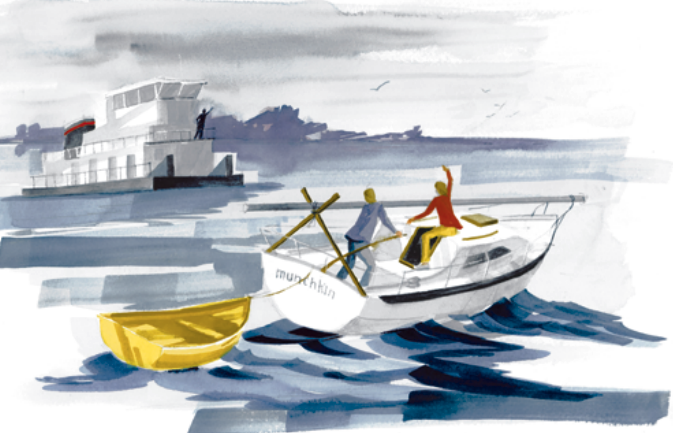
What happened next went beyond good luck. Today, the concept of guardian angel — not just the figurative one — might be suggested, and an argument could be made that the coincidence fit the profile. Just as the depressing reality of our situation set in, a towboat rounded the last bend. A towboat with no barges in tow. Without consultation, two sometime sailors began waving frantically. We did own a VHF radio — it had been purchased just for this trip — but we hadn’t developed the habit of actually using it yet. Arm-waving was an acceptable and understandable distress signal, and we knew we fit that profile. We can only guess what the towboat crew was thinking when they spotted the two figures on that little boat, fanning the air as though arm power might propel the boat. The tow turned toward us; we hadn’t realized how big it was until it crossed the river and came alongside. Small by Mississippi standards at 80 feet, Joe-C was huge next to our 27-foot Ericson, Munchkin.
Shouting over engine sounds, we explained our problem. The captain shook his head as he told us there were no yards for recreational boats between here and New Orleans, a fact we didn’t want confirmed. That meant 70 more miles downriver and through a connecting lock into Lake Pontchartrain. Our spirits sank. As if reading our thoughts, Captain Jack said, “I’ll take you to the lake. You’ll find small-boat docks there.” He spoke as casually as if he were giving us a ride to the corner store, but our spirits did another about-face. “Get ready to come aboard,” he said. “I won’t tow the boat with you in it.”
This turn of events was practically cause for celebration. Not only were we saved, we were also getting a ride in a real riverboat. Not wanting our two scaredy-cats to attempt an escape (and not even thinking about water ingress), I hurried to close all ports and hatches as David made up a towing bridle with our mooring lines. One of the towboat’s crewmen then tied a knot connecting our tiny bridle to the tow’s 2-inch-diameter line and quickly tossed the combination astern. Panicked, David wondered out loud what kind of knot was now holding our home. The crewman replied, in charming Cajun cadence, “I don’t know . . . it holds most of the time.”
And of course it did this time too. Once we’d boarded the tow, we learned that it, too, had suffered damage from river debris. Encounters with logs had bent its shafts, explaining why the tow had no barges. That bad luck had be- come our good, but we were too relieved to feel any guilt.
Instant hero
Captain Jack was our instant hero. Two of the three crew-members were his sons, so boat operations were handled in the informal way families adopt after years of working together. Home port and a repair yard for Joe-C were on the north shore of Lake Pontchartrain. Our destination was on the south side, so at least the tow would not go out of its usual way to take us along.
Pointed downstream again, Captain Jack kicked up the RPM. Because of the bent shafts, he said, he’d be traveling slower than usual, with his “slow” defined as small-boat “speed.” Still, as we watched anxiously, our boat was leaving a wake no sailboat was meant to make. (How were those cleats installed? How are the cats doing? What are the cats thinking? Good thing I can’t hear their yowls.)
As we moved along at Captain Jack’s version of slow, we’d hear an occasional muffled thud, followed by a distant crunching noise. With the initial sound, the captain would turn the wheel sharply, forcing the stern to swerve to one side, thereby redirecting the tow’s wake. “Wheel inspectors,” he finally said. “Don’t want them to inspect your boat.” Temporary confusion gave way to nervous enlightenment when we looked astern and watched huge logs shoot out of the tow’s wake and, thankfully, away from our boat. Apart from the new concern about wheel inspectors, we now understood just how tiny our boat looked to the river people. No wonder they thought we were crazy to be taking “that li’l boat” out into the ocean.
The crew launched an activity campaign, we guessed for the kind purpose of keeping our minds off the little boat. First, we were given the grand tour, and it was grand. The tow was spotless, from bridge to engine room. In order to enter the spotless engine room, however, we were required to don jumbo earmuffs that protect eardrums from jumbo motor noises. Naturally, the muffs excluded all other sounds too, but this did not stop our tour guide from continuing his explanation of ship’s functions. And, since we did not wish to seem impolite, we continued to nod and smile as though we’d always been competent lip-readers.
An enjoyable supper
Supper was another delight, proof that all towboat crews do not suffer from the absence of home cooking. Sunday dinner by our standards, it was apparently an ordinary meal by theirs. Luckily, we’d relaxed enough to be able to enjoy it.
After dinner came the river stories, many of which were no doubt very amusing, except that “funny” so often depends on the listener’s position relative to the story. We knew the crew’s intentions were good, but it was difficult to listen to tales of small-boat disasters without thinking, “There, but for the grace of Joe-C, go we.” Much better, from our perspective, were the stories about riverboats and river people; we could, and did, listen to those for hours.
The hazards of commercial traffic and even ordinary river debris generally keep recreational boaters in port after dark, so night travel on the river was a new experience. From the vantage point of the towboat’s wheelhouse, the blinking channel lights fell into place to outline a clear water map. The loom of New Orleans grew into an eerie glow of light patterns, as all manner of big-ship facilities lit up the banks.
It was past midnight by the time we arrived at the lock that would put us into Lake Pontchartrain. Captain Jack called the lockmaster with what was probably an unusual request: “I have this little boat here with me; you want me to tie it on behind, bring it alongside, or just haul it up on deck?” We suspect this last option was tossed in for our entertainment, but fortunately, the lockmaster voted for the side tie, so that was how we locked through — much less rocking for our boat.
A few more minutes and we were out of the lock and about to lose our security-boat. Captain Jack gave us clear directions and some cautious advice: “There’s an anchorage right here where you could spend the night, but you’d be smarter to go on to the small-boat harbor. It’s calm tonight, and you should be able to travel OK if you take it slow. But tomorrow, it’s going to blow like stink.” Never having understood the precise conditions of “stink,” we chose not to learn them firsthand at this time and under these circumstances. As the crew cast off our lines, we started the long, slow trip to the little-boat harbor: “Just follow that shore till you see a real bright white light; turn left, and you’re there. I’d take you myself, but I’d put this tow aground if I tried.”
A very black night
The harbor was not far distant, but with our top speed of maybe 1 1/2 miles an hour, it took a few hours. In the middle of a very black night, we turned left at the bright white light and tied up to the first vacant small-boat dock we found. Sometime between then and daybreak, the weather did indeed take a turn, bringing howling wind, pelting rain, and a nasty chill. From the cocoon of our cozy bunk, we silently thanked Captain Jack one more time and drifted back to dreamland.
After the weather stopped stinking, David was able to confirm our guess about the damaged prop. A small strand of polypropylene line had wrapped the prop; when it could not unwrap, it forced one propeller blade to break away from the hub. (Why wasn’t the poly line floating, which is supposed to be its advantage over other materials?) It was good to learn that a one-bladed prop could actually push the boat. But the best thing we learned was from our hero. We’d wondered out loud if there was some way to repay him for his help, but Captain Jack had just smiled. “The only payment I want is to know that someday, you’ll lend a hand to somebody who needs help. That’s the way things work on this river.” If it were a movie, that would be the signal for the symphony to begin. But Captain Jack’s sincerity was both honest and contagious.
The whole experience was so contrary to the endless horror stories we’d heard before our departure about “inevitable” Mississippi encounters. We were so lucky to have found another side of the river.
David and Zora Aiken have been meandering by boat since 1974, finding inspiration for painting and writing. Their home since 1978 has been a good old now-classic 1963 Chris-Craft sloop, Atelier. Their published books include Good Boatkeeping, Second Edition; Cruising, the Basics; and Fiberglass Repair: Polyester or Epoxy.
Thank you to Sailrite Enterprises, Inc., for providing free access to back issues of Good Old Boat through intellectual property rights. Sailrite.com