This stylish performer offers racing speed with cruising comfort
Issue 31 : Jul/Aug 2003
Can you believe this year’s America’s Cup regatta? For starters, each syndicate spent upward of $75 to $100 million (pocket change when you’re the biggest cable operator in the world) for one 80-foot-long boat, a spare boat, sails, crew salaries, and soft drinks.
In case you slept through the competition (which was easy), in about the same amount of time it took the bulbs I planted last fall to bloom, the Swiss relocated the Holy Grail of sailing to Europe.
But, get this: on more than one occasion I listened as, after keeping us waiting during interminable delays, the chief umpire announced, “Sorry, boys, the wind’s blowing today. Guess we’ll have to head back to the clubhouse.” I began to wonder if the whole project was a scheme to sell beer and hot dogs.
Then, when 10-knot winds actually arrived on the Hauraki Gulf and racing began, the defender’s boat came apart and flooded. On one memorable occasion, the end of the boom shattered after tons of water coming over the gunwale filled the bilge. You might call that a minor design failure. On another, in 18 to 25 knots of breeze when “seas” were 4 to 6 feet high, the Kiwis’ rig came down when a shroud fitting broke. The problem? The course was “too bumpy.” Ha!
All this carnage occurred on cutting-edge racers that go to weather at 9 knots! Heck, any good old boat more than 35 feet long will do seven.
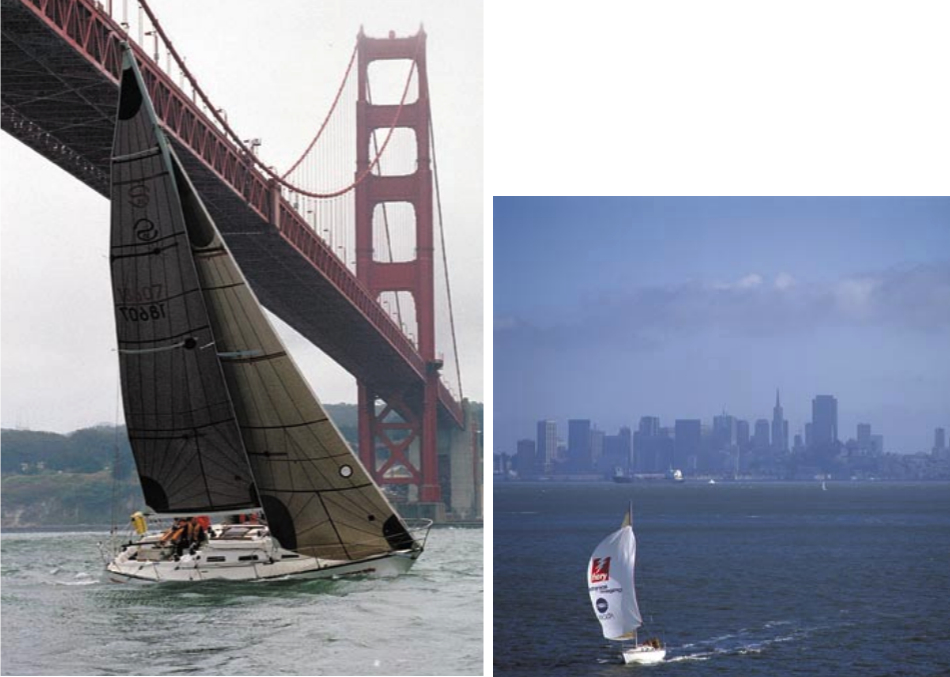
Especially the Santana 35, which thrives in blustery winds, stays together in big seas, and — unlike the America’s Cup boats — has a fixed head and galley.
The beginnings
Like so many builders of the era, the history of the W. D. Schock Corporation and the Santana 35 began with a kid from Southern California who enjoyed sailing and tinkering on boats. The kid grew up in the same culture that produced the likes of Hobie Alter, Dennis Connor, an encyclopedia of other skilled yachtsmen, and Ted Williams.
Wilbert Dwayne “Bill” Schock built his first sailboat in the family’s garage in Hollywood, a kit version of an International 14 he purchased at age 12. During the construction effort, a passing sailor noted his efforts, immediately placed an order for three boats, and inadvertently planted the seed for a company that is now among the industry’s longest-lasting production-boatbuilding operations.
After returning from World War II, Bill set up shop and began building dinghies, especially the Sabot and Lehman 10. When business slowed, he kept food on the table by repairing woodie station wagons and making wooden toilet seats.
Then, in the early 1950s, he purchased the company that built the Lehman 10 and became the first production-fiberglass company in the United States. (Interestingly, a claim shared by several builders of the time.)
While striving to add to the Lehman’s performance and appearance, Bill moved the mast, redesigned parts of the deck, and made other modifications. By the time he was finished, he’d produced the design for the Lido 14, which put his name, and the name of his company, in the national version of the industry’s Yellow Pages. More than 7,000 Lidos have been built and are sailing in 70 fleets. These days the company is still producing the Lido, albeit now in a 26,000-square-foot facility in Corona, not far from the Newport Yacht Club.
Tom took over
Bill’s sons, Tom and Steve, spent enough time with the boss to take an interest in the business. When Bill retired, Tom took over day-to-day operation and still maintains a hands-on presence at the shop. His sailing career began on the racecourse as a child, where he developed into one of Southern California’s premier sailors. Mild-mannered Steve is a designer whose most noteworthy creation is the Schock 35, a stepsister to the Santana 35 (see sidebar on Page 6).
The yang of the company’s personality is a penchant for building cutting-edge performance yachts. The Schock 50, a water-ballasted sloop with a lifting keel, was built in 1998 for Steve Black, who planned to enter the Singlehanded Around the World Race.
Then, at the turn of the century, the company unveiled the Schock 40, a radical 40-foot lightweight (7,000- pound displacement) with a canted ballast keel, foils fore and aft, and a 7-foot bowsprit. A rocket ship, she’s now in production, but is clearly “not your father’s Oldsmobile.”
Tom is a forward thinker, yet when he looks in his rearview mirror he sees the remnants of many of his contemporaries. The dramatic downturn of the industry in the 1980s was fatal for many production builders like C&C, O’Day, Cal, Pearson, and Columbia. It devastated his distribution network as well.
Having overcome the vagaries of the marketplace, Schock boats still progress down the company’s production line at predictable intervals.
Well-received quarter-tonner
By the time Shad Turner was commissioned to produce the lines for the Santana 35, he’d been working with the then 30-year-old company for several years. Earlier, during the company’s adolescence, he designed the Santana 25, “a quarter-tonner that was well received in the marketplace,” Tom says. “We built more than 100 of them.”
He then produced the Turner 30, “an elegant and very successful boat that did well on the racecourse”; the Santana 30/30, a popular family-oriented performance cruiser; and the New York 36.
Also in the design mix was Gary Mull, who designed the Santana 22, of which more than 800 were built. Both Gary and his 22-footer were legendary in Northern California for their ability to sail in blustery conditions. The 22 recently underwent a face lift, was retrofitted with a new deck, and reintroduced in 2002. Not surprisingly, the company has delivered 13 of the new millennium model.
Shad Turner’s Santana 35 was introduced in 1978. “At the time, we were used to building one-design boats and had been successful, but we decided to enter the International Offshore Rule (IOR) world with the Santana 35. Meeting IOR measurement rules was like hitting a moving target,” Tom recalls. “The IOR handicapping committee was comprised of architects who changed the rule every year so we’d all need to pay them for new designs. We’d design and produce a good boat and, at the stroke of a pen, the committee would change the rules. It was devastating. It was a chaotic time. Business was very good, but we were always squirming.”
His wife, Jane, adds, “Tom didn’t need to go gambling in Las Vegas. The whole business was a big gamble.”
Planned regatta win
Shad Turner’s target was a 35-footer with an IOR rating of 27.5, roughly the boat’s waterline length. Tom says, “To make a big splash, we planned to introduce the boat by winning a major regatta. We planned to introduce it at the Southern Ocean Racing Circuit (SORC) in 1978.” The IOR became the fly in the ointment when measurers decided she was 6 inches too long under the rule and ineligible for competition.
This decision particularly disheartened Tom, who had orders from 12 potential buyers. To avoid a total meltdown he says, “We hauled the boat to San Francisco, where she immediately began winning races.” Thus a new page was written in the history of amateur yacht racing.
In the process, the company inadvertently produced a sloop with a race pedigree. She is also a stylish, comfortable performance cruiser. There’s no requirement that you put up a spinnaker. That she was raced does not mean that the crew slept on a bed of nails or survived on C rations. She’s very mannerly in a blow and relatively dry, as I’ve learned sailing off the California coast in stiff northwesterlies. Add durable; any boat living as long as she has that is still sailing in the Pacific outside the Golden Gate or in Great Lakes conditions, should be sturdy enough for most sailors. Having weight on the rail in a blow and having a set of reef points (and knowing when to use them) are important factors.
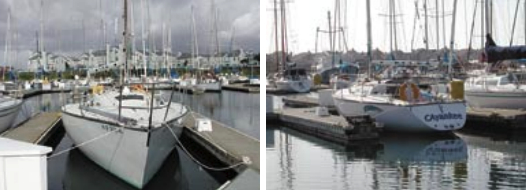
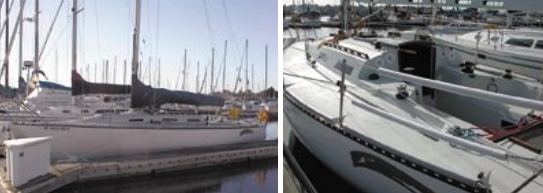
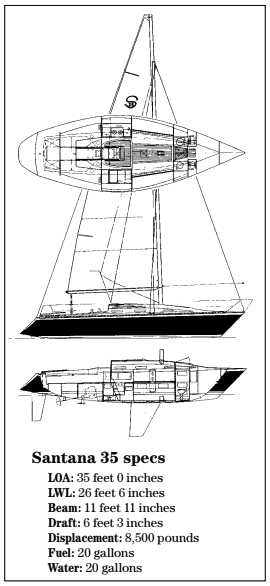
Although she certainly didn’t have a mainstream appearance at the time she was introduced, now, a quarter of a century after her introduction, when viewed from abeam the look is still eye candy. When the 35 is posed docilely at a dock, a near-flat sheerline separates a modest bow overhang and reverse stern. A low, forward sloping cabintop and extended cockpit combine to produce a graceful profile. Slip the docklines and hoist sails, and 8,500 pounds of fiberglass, wood joinery, and metal are transformed from raw materials into a pleasing and comely shape.
Lots of room
The first thing you’ll notice is that the low cabintop eases visibility forward, whether you’re standing or controlling the tiller from the coaming. Seven-foot-long cockpit seats mean there’s room for six to eight passengers; the downside could be that she may be the designated party boat after the sun passes the yardarm. She’s a bit full in the waist (at 11 feet 11 inches) but Shad Turner designed a midsection that tapers aft to a relatively narrow stern. Her decks are wide and easy to work under sail. Shrouds are inboard at the foot of the cabintop. So, in addition to supporting the spar, they provide handholds and leave space for crew stretched out for a nap.
A critic may complain that the mainsail traveler spans the cockpit. That’s a good trade-off for a control positioned at the end of the boom that produces better mainsail trim and allows the driver to trim the main. Odds are that the driver will be the only person aft of the traveler, anyway, out of the way of trimmers. That way, the crew won’t be able to hear her grinding her teeth or shouting imprecations.
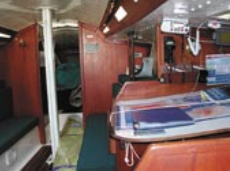
Let’s start with the basics. Most of us can stand up under 6 feet 2 inches of headroom without banging our heads. It takes at least three paces to maneuver 11 feet from the foot of the companionway to the forward bulkhead. The Santana 35 has a full-sized galley with adequate space to cook a turkey and store a case of eight-ouncers in an icebox. An old fashioned, (pre-pushbutton navigation) full-sized chart table is to starboard opposite the galley, so chef and naviguesser both operate in the most comfortable spots when at sea. The dining area has a drop-leaf table on the centerline that seats six comfortably. If pressed, you could probably find a way to create space to cabinetize a TV-VCR, although I’d opt for a book rack.
Head with privacy
The head, located forward, spans the hull and offers the privacy of a solid door. Space for sail storage is in the bow, not the aft cabin. After that, what else in life is there?
The 35 even looks like a cruiser, rather than a fiberglass tube. Underfoot is a teak sole. The main saloon is surrounded by an oiled teak interior and ports built flush to the cabin sides.
From a purely functional standpoint, you can stretch out on one of four berths and two convertible settees without banging your toes; the berths are all about 6 feet 6 inches long. At sea, pilot berths amidships will provide the most comfortable sleeping quarters.
“Builders seem to think sea berths need to be large but the facts of the matter are that when we’re at sea on an overnighter, we tend to curl up in small spaces at the junction of the hull and berth. That way we don’t move around and are better rested,” Tom says.
By the time the first Santana 35 began its trip down the production line, the W. D. Schock Corporation had 20 years of experience in the production of fiberglass sailboats. In the ensuing years, the company has maintained a reputation for producing lightweight, but durable, laminates. The company managed to avoid many of the problems associated with many of the boats built in the 1970s and 1980s. “We’ve had no problems with delamination and few blisters,” Tom says of the blemishes that plagued many builders of the era.
However, overtensioning the stays may create a crack between the deck and forward bulkhead.
Handlaid woven roving
The hull of the Santana 35 consists of a 1⁄2-inch Baltek end-grain balsa core encapsulated in handlaid woven roving bonded with polyester resins. The hull-to-deck joint is an inward-turning flange on the hull over which the deck was laid and bonded with zinc chromate tape, and fastened with an aluminum toerail secured with 1⁄4-inch bolts on 4-inch centers. Owners do not report leaks from this joint. Deck hardware was attached with bolts through solid marine-grade plywood.
The rudder is a fiberglass shell filled with foam that is strong and light. The rudder stock on the first boats produced was a hollow, 2-inch-diameter fiberglass section sleeved with stainless-steel pipe. When San Francisco Bay sailors encountered “rudder stock bend,” the company designed and provided owners with an epoxy resin that, when poured into the pipe, doubled the load strength to more than 7,000 pounds. End of problem.
The internal structure athwartships consists of Douglas fir beams encased in fiberglass; longitudinal support is provided by furniture, bunks, and the forward bulkhead.
The mast is a sturdy SparCraft section built “when that company was in its heyday,” Tom says. It was an oversized aluminum section with a single set of tapered spreaders and rod rigging. Most boats are still sailing with the original rig and standing rigging.
The Santana 35 is as fast on the water as on paper. With a displacement of 8,500 pounds, her displacement-to-length ratio is 203. The ballast-to-displacement ratio is 38 percent, so she’ll need weight on the rail or reduced sail area in a freshening breeze. She carries 299.5 square feet of canvas in the mainsail and 250.5 square feet in a 100-percent foretriangle. By most calculations, she’s halfway between “real fast” and “average fast,” but the 7⁄8 fractional rig means she’ll struggle in winds of less than 5 knots.
Impressive performance
I’ve sailed aboard and against the Santana 35 in varying wind conditions and been impressed with her performance. Initially rated in the mid-90s under PHRF, she currently rates between 114 and 120. Closehauled, she sails to weather within 40 degrees of the apparent wind at 5.5 to 6.5 knots. Off the breeze, on a tight reach under a spinnaker, she’ll break loose and hit 11 to 13 knots, well above her calculated hull speed.
During one stretch, the 2003 America’s Cup races were postponed nine consecutive days when the breeze didn’t exceed 8 knots. The Santana 35 will sail in those conditions. Then races were postponed because the wind was more than 19 knots, a typical July day on San Francisco Bay. The Kiwis’ boat broke twice when winds exceeded 20 knots.
Given that set of circumstances, I propose the formation of an America’s Cup for Good Old Boats and nominate the Santana 35 as a potential contender.
Interested? Used boats are priced at $25,000 to $40,000. With proper planning you can buy the boat, hire a crew, buy soft drinks and Oreos, rent a condo for the duration of the Cup regatta, and still have at least $75 million in the bank.
Postponements?
Fuggiddaboutit!
Thank you to Sailrite Enterprises, Inc., for providing free access to back issues of Good Old Boat through intellectual property rights. Sailrite.com