An easily towed water-ballasted trailersailer
Issue 81 : Nov/Dec 2011
The Santana 2023 has a tall family tree dating to the early days of production fiberglass boats. W.D. “Bill” Schock, like many boatbuilders of the post-World War II years, had roots in childhood boat-building. At age 11 he built a Rainbow Skimmer from plans he found in Popular Mechanics. Bill later went on to become an aeronautical engineer, but following his wartime duties he shunned aircraft work to return to his childhood love of boats. In 1946, he put together an International 14 in his Newport Beach, California, garage, later selling it to an admirer. Thus began a boatbuilding legacy that is still thriving.
In the 1950s, the W.D. Schock Co. produced a number of now-famous, one-design dinghies, including the Thistle and the Snipe. In 1957, Bill stretched a Highlander hull and added a cabin to create the Schock 22 — a winner of the Ensenada race. After purchasing rights to several small boats from Barney Lehman (famous for inventing the cam cleat and for whom the Barney post is named), he took over construction of the Lido 14, of which more than 6,000 have been built.
In 1960, Bill moved to Santa Ana to build a larger production facility. There, the Santana line was born. Gary Mull designed the Santana 22, a popular model numbering more than 700. Other Santanas appeared, including the Shad Turner-designed Santana 23. It is from the molds of that shallow-draft keelboat that the water-ballasted, trailerable Santana 2023 was developed, with production beginning in 1992.
The company rode out the passing of Bill Schock to a heart attack in 1991, with son Tom Schock taking over the helm of the company. It also survived the decline of the sailboat market in the 1990s by being well diversified into the manufacture of industrial fi berglass products and components. Over the years, the company has built more than 100 boat models and 13,000 boats. Currently, 14 models are in production under new owner, Alexander Vucelic von Raduboj, who bought the business in December 2010. Tom Schock is still involved as its “product ambassador.”
Design
The 194-boat production run of the Santana 2023 ended in 1998 with three models in concurrent production: the 2023A (82 built), 2023C (97 built) and 2023R (15 built). The design team included Shad Turner, Steve Schock, Tom Schock, and Jean-Michel Bernasconi. Foremost among their criteria was simplicity: no other boat in this size range has a simpler or faster system for setting up the rig.
The hull lines are very attractive and modern. The Santana 2023A is sleek and European looking with a different deck and cabin arrangement from the other models. The 2023R is a racer, while the 2023C has a taller cabin trunk for more cabin space. A long list of options offered upgrades, the most popular being a deluxe package that provided four opening portlights forward, teak handrails on the cabin trunk, and a Lewmar forward hatch. It also was available with a 30-foot “tall rig” for better performance.
The 2023 is the first water-ballasted boat to be reviewed in Good Old Boat. There are a number of trailersailer boats designed with water ballast — most in the 19- to 26-foot range — the majority built by MacGregor Yacht Corp. and Hunter Marine. The Santana 2023 employs essentially the same water-ballast principle.
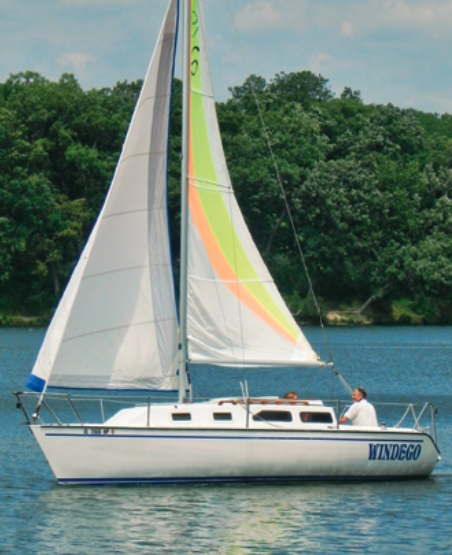
The test boat for this review is a 1993 Santana 2023C, with the deluxe package, owned by Alex Krinickas and his wife, Barbara Morris, of Rockford, Illinois. They bought Windego at an in-the-water boat show in Racine, Wisconsin, in 1993, nine months after the arrival of their daughter Alexandra. At the time, Barb was insistent that their 16-foot 9-inch O’Day Daysailer was too small and unstable for a family boat; they fell in love with the Santana and took it home.
In 18 years of sailing Windego, the family has taken her to Bayfield, Wisconsin, on Lake Superior; Lake Winnebago at Oshkosh, Wisconsin; and other Wisconsin lakes, as well as on many Lake Michigan trips. Because of the confined space aboard and growing children, they never anchored out. They daysailed or obtained a marina transient slip so the kids could get off the boat.
Daysailing the Santana 2023 is easy because the set-up procedure is so simple and takes so little time. The sales brochure claims a seven-minute set-up time. Perhaps a well-rehearsed crew could manage that, but 15 or 20 minutes would not be unusual for the occasional sailor — and that is still quick. The Santana 2023 sits low on its trailer and needs only 27 inches of water for launching.
Construction
The Santana 2023 is built of solid, handlaid fiberglass. The deck is cored with 1/2-inch balsa and reinforced in high-stress areas with plywood. The hull-to-deck joint is a shoebox design with a rubrail screwed through the overlapped deck and hull into a wooden sheer clamp. Adhesive adds security to the joint. The bulkheads and furniture are tabbed to the hull, which makes for a structurally stiff boat. There is no fiberglass interior pan.
The 53-inch-long, 45-pound centerboard retracts into a pocket in the water-ballast tank, leaving 5 inches of board exposed. The board pivot is at the bottom edge of the pocket, making the board easily removable for repairs. The centerboard does not intrude into cabin space. Just forward of the centerboard well is the poppet valve for the water-ballast inlet/drain.
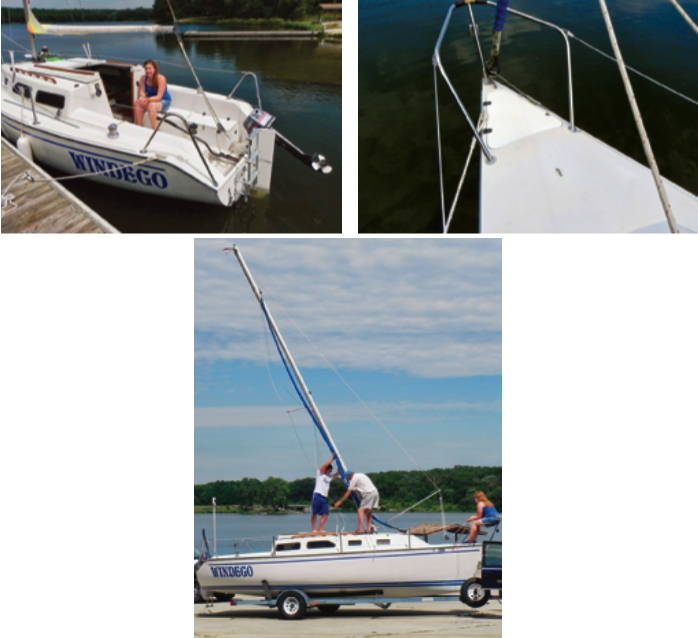
The rudder pivots for trailering and beaching, moved up and down by lines running up through the hollow tubular aluminum rudder stock that enters the hull just forward of the transom. If desired, the rudder can also be pinned in the down position with a through-bolt. A reinforced area of the transom will support an outboard motor of up to 9.9 horsepower.
Deck
The deck has relatively wide sidedecks, with aggressive non-skid on all walking surfaces. Toerails are absent, allowing for comfortable seating along the rail. A pop-top swings up on four arms to create standing headroom and can be left up while sailing. Just aft of the mast tabernacle is a strange raised spot in the deck, a leftover from the mold for the Santana 23 where the mast was placed. The shroud chainplates are mounted inboard on the high cabin trunk, allowing for easy passage forward as well as tight sheeting of headsails.
A single lifeline runs the length of the boat between sturdy railings forward and aft. Someone boarding the boat from a swim ladder will find the aft rails handily placed for support. Teak grabrails (a factory option) are mounted on the cabin trunk. Forward is a small self-draining anchor locker. Four smallish composite cleats are at the corners of the deck. The seats in the T-shaped cockpit are just 64 inches long — barely adequate for napping.
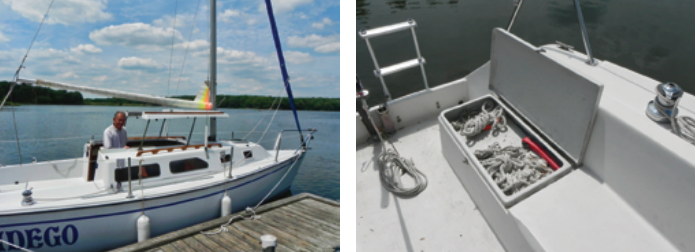
A locker in the starboard seat has space for a fuel tank for the outboard, while a shallow locker under the port
seat holds lines and winch handles. Space below the cockpit seats is dedicated to berths, but some storage is possible in a 12-inch space under the footwell.
The companionway has no bridge deck to speak of; if the two drain ports in the transom became plugged, the cockpit could easily fill until sea or rainwater entered the cabin.
Rig
The mast is supported by upper shrouds led over swept-back spreaders and lower shrouds that terminate at the same chainplate. There is no backstay.
For raising the mast, the main halyard is attached to the very solid stainless-steel gin-pole. The mainsheet tackle is attached to the gin-pole and to the deck aft of the headstay lever.
There is no turnbuckle on the forestay. Once the mast is up, the headstay lever swivels up so it can be attached to the roller-furling drum, and is then pushed down and pinned in place by a bolt through the center bow-pulpit stanchion. This simple system tightens all the rigging in one fell swoop and allows the furled jib to be tied to the mast for storage and transportation — ready for quick rigging.
Temporary lines hook into the mast below the spreaders and to the deck to stabilize the mast laterally while it’s being raised. With this system, one person can raise the mast in a leisurely fashion.
The standard working jib has a wire luff and furler. The test boat has a 150 percent genoa on a CDI Flexible Furler. The owner installed the long genoa tracks on the sidedeck, but these were later included by the builder as part of the optional “genoa performance” package.
Further simplifying the set-up procedure, the multi-colored, loose-footed, full-battened mainsail rolls up on the boom. A shaft from the boom serves as the gooseneck and passes through the mast where a handle is attached for furling the sail. A topping lift supports the boom while the mainsail is being hoisted or furled. Carabiners on the mainsheet tackle allow it to be quickly attached to or disconnected from the transom and the end of the boom.
There is no halyard on the mast for the standard jib arrangement (and the CDI Flexible Furler has an integral halyard). The main halyard is secured to a horn cleat on the mast. This is simple, but allows little tension control. Fitting the sail with a Cunningham might be advisable.
Accommodations
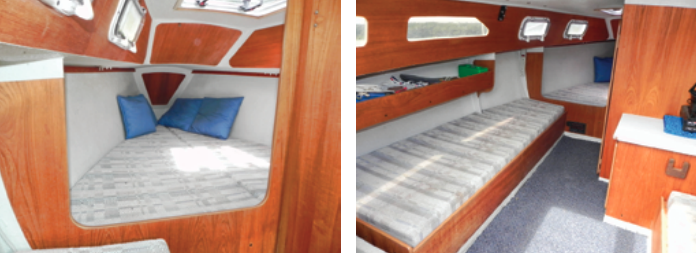
The first thing you notice when stepping below is the teak — lots of teak! All the furniture and cabinetry is oiled teak-faced plywood. Exposed interior fiberglass surfaces have a slightly off-white pebble texture, and there are enough of them to offset the teak. Light streams in through the companionway and a total of eight portlights, as well as the smoked-glass forward hatch.
To port is a long settee berth with storage beneath and a backrest that’s also a deep fiddle for a bookshelf. Aft of that is a quarter berth, also with storage beneath. Exposed hull surfaces are nicely finished, even in the under-settee compartments. The wood under the settees and berths is MDO paper-faced plywood that has not been finished.
On the starboard side, the galley and head are forward, leaving room for just one settee berth the same length and width as those opposite (72 x 30 inches). Seating is aided by a removable wooden backrest that creates a storage space and also keeps a seated body’s head within the cabin trunk. The cushions are 3-inch foam covered with a nice fabric.
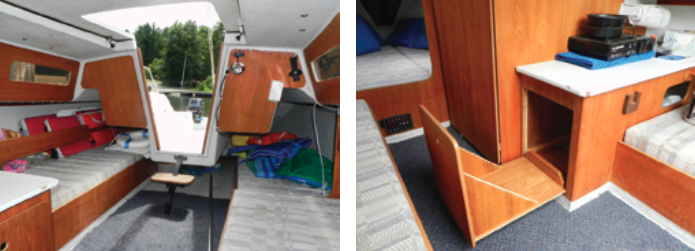
The galley has 45 x 17 inches of counter space for a small two-burner stove. Outboard on the counter is a small sink with a pump for the fresh water that’s stored in a plastic jug below. Beneath the counter is a large slide-out drawer that accommodates a portable ice chest. There’s no provision for a table. Maximum headroom with the companionway hatch closed is just 54 inches.
Forward of the galley is a large compartment to house the head and, forward of that, the roomy V-berth, 82 inches long and 72 inches wide.
The water-ballast valve and air vent are located under the head of the V-berth, and there is some additional storage here too.
The battery is also located under the head of the V-berth and the electrical panel is mounted low on the V-berth bulkhead, which also provides support for the mast. The panel is convenient to the battery but could be easily damaged by feet and items sliding about the cabin. Standard electrics are limited to running lights and cabin lights.
Under way
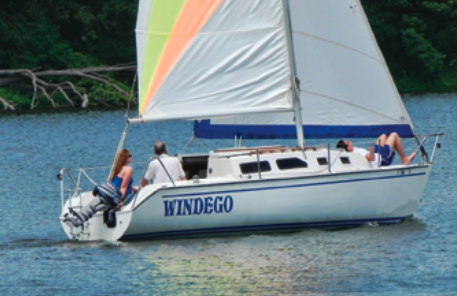
As we left the marina slip on Pierce Lake with Alex, Alexandra, and her brother Nathan along for the ride, the 8-hp outboard provided plenty of power.
Alexandra easily hoisted the mainsail as it rolled off the boom. We rolled out the genoa and were soon sailing in constantly changing, swirling winds.
We lowered the weighted centerboard with the control line that leads into the cockpit footwell. Long ago, Alex upgraded the coaming-mounted sheet winches to Lewmar 16 self-tailing models — probably a bit overdone, but nice anyway. The aluminum tiller has a nice foam grip. Balance was neutral to slight weather helm. The rudder gives back more pressure than one would expect — not heavy, but firm enough to know you are moving the tiller.
The boat tracked well and tacked quickly without slowing down, but in a jibe, the end-of-boom sheeting tends to rub past the helmsman and is a bit unwieldy to release quickly. When at the helm, I found that the cabin trunk sometimes intruded into my forward vision, and I had to stand up to look ahead. Acceleration is brisk, and Alex reports top speeds of 7 knots.
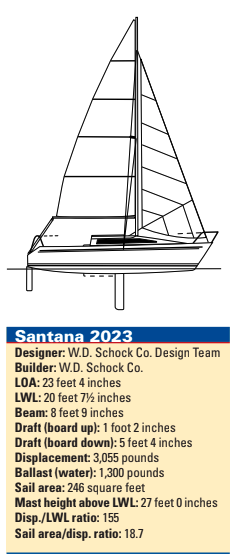
The Santana 2023’s wide beam, which I measured at 8 feet 9 inches, provides good form stability. (Beam is noticeably absent from published specifications as it is over the legal road-width limit in many states.) With its wide flat underbody, it was a bit stiffer than many water-ballasted boats — at least initially. Reefing early helps keep water-ballasted boats on their feet.
Conclusion
Setting up the Santana 2023 for sailing is a piece of cake. The boat is well constructed, finished, and handsome. For landlocked sailors, it is a great boat for most trailer-sailing adventures: comfy enough for a couple on short cruises, simple enough for a trailer-launched daysail. It offers spirited handling, yet it’s stable.
Of the few misfires I saw, one was the use of plastic edging on the cabinetry, which was damaged and coming loose. Also, the original hatchboards had warped and delaminated — Alex had replaced them with solid oak panels. Because of the forward location of the water-ballast valve (a compromise for cabin space), the ballast can’t drain completely while the trailer is still on the ramp. You get some funny looks for dumping 1,300 pounds of water in the parking lot!
If the boat was stored outdoors, I’d want to be sure the cockpit drains stayed clear and the cockpit well covered. Tom Schock says the water ballast needs to be drained occasionally and the tank aired out because, on a few early boats, rot formed where the sole joins the hull. The tank was modified on later boats to avoid this problem. Limited parts are still available from W.D. Schock Co.
The few Santana 2023s that race in PHRF fleets around the country rate around 168 seconds per mile. By comparison, an O’Day 23 swing keel rates 240.
Pricing for 12 boats on one online site ranged from $4,500 to $12,500, with most asking around $9,000.
Allen Penticoff is a freelance writer, sailor, and aviator. He has trailersailed on every Great Lake and on many inland waters and has had keelboat adventures on fresh and salt water. He presently owns an American 14.5, a MacGregor 26D, and a 1955 Beister 42-foot steel cutter that he’s restoring.
Thank you to Sailrite Enterprises, Inc., for providing free access to back issues of Good Old Boat through intellectual property rights. Sailrite.com