A classic beauty that might surprise in light weather
Issue 18: May/June 2001
WHEN YOU THINK ABOUT CLASSIC 40-foot fiberglass yachts, there are perhaps half-a-dozen vessels that come immediately to mind. Two of them, the Block Island 40 and the Bermuda 40, are from the board of Bill Tripp, and two others are Phil Rhodes’ creations, the Bounty II and the Rhodes Reliant.
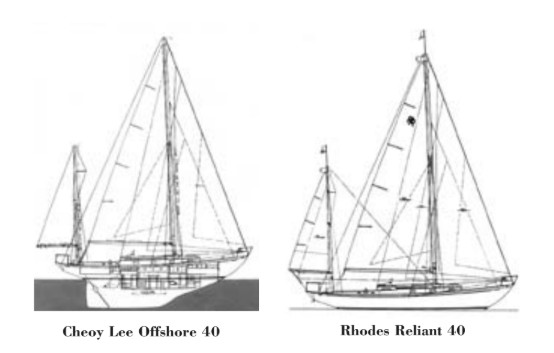
A fifth classic is also a Rhodes creation, in a way, as the Cheoy Lee Offshore 40 is a mirror-image plagiarism of the Reliant, and was created almost solely to cheat the designer out of his due royalties. Having had a number of yachts produced in the Orient myself, I can recall my own bitter experiences and sympathize with Phil Rhodes. How frustrated and angry he must have been when the first Offshore 40 appeared.
The Reliant is typical of the CCA cruiser-racers of the late 1950s to mid-1960s with husky displacement, moderate beam, and moderate sail area. Although keel/centerboarders such as the aforementioned BI 40 and Bermuda 40 dominated the racing scene to some extent, there were always skippers who preferred a keel boat to the slightly beamier centerboarders, and we won our share of silver aboard Bill Luders’ full-keel 39-foot L-27 against the best 40-foot keel/centerboarders afloat. The Reliant figures are interesting:
Length overall . . . . . . . . . . . . . . 40 ft. 9 in.
Length waterline . . . . . . . . . . . . 28 ft. 0 in.
Beam . . . . . . . . . . . . . . . . . . . . . . 10 ft. 9 in.
Displacement . . . . . . . . . . . . . . . 22,040 lb.
Displ/length ratio . . . . . . . . . . . . 448.2
Sail area . . . . . . . . . . . . . . . . . . . . 750 sq. ft.
SA/Displacement ratio . . . . . . . . 15.3
Capsize screening factor . . . . . . 1.53
Comfort ratio . . . . . . . . . . . . . . . . 44.9
Light air speed
These figures certainly indicate a seaworthy and comfortable yacht although one that might be hard pressed to keep up with a contemporary beamy, long-waterline, light-displacement cruiser in a good breeze. The Reliant might surprise us in light air though. Despite her longish keel, she has a very short waterline and narrow beam by today’s standards so her wetted surface may not be much, if any, greater than the modern 40 footer. Her sail area, while moderate for her displacement, is quite adequate to move her along very nicely in a light breeze and her handsome yawl rig can quickly set a good-sized mizzen staysail or spinnaker to astound the skipper of today’s ubiquitous sloops.
Still, it’s in really heavy going where yachts like the Reliant begin to shine. Her high comfort ratio assures a much steadier motion and a smoother ride than any contemporary ultra-light cruiser can provide. As well, her low capsize screening factor indicates a yacht that, unlike too many of today’s cruisers, will recover quickly if knocked down past the capsize point in extreme conditions. The one drawback of her two-cabin accommodation plan is the companionway offset to starboard. The wise skipper will keep it closed tightly in stormy conditions and regulate the comings and goings of the crew. I never heard of a Reliant taking a big sea through the open companion-way in a knockdown to starboard, but I suppose it could happen in a real gear buster, and an ounce of prevention beats two tons of sea water in the bilge.
No one yacht is perfect, but the Reliant comes very close to perfection in my opinion. In any case, her truly classic beauty more than makes up for any minor quirks she may have. She is definitely a yacht that will receive approving gazes from knowledgeable sailors in every port she visits.
Ted Brewer is one of North America’s best-known yacht designers, having worked on the America’s Cup boats, American Eagle and Weatherly, as well as boats that won the Olympics, the Gold Cup, and dozens of celebrated ocean races. He also is the man who designed scores of good old boats . . . the ones still sailing after all these years.
Thank you to Sailrite Enterprises, Inc., for providing free access to back issues of Good Old Boat through intellectual property rights. Sailrite.com