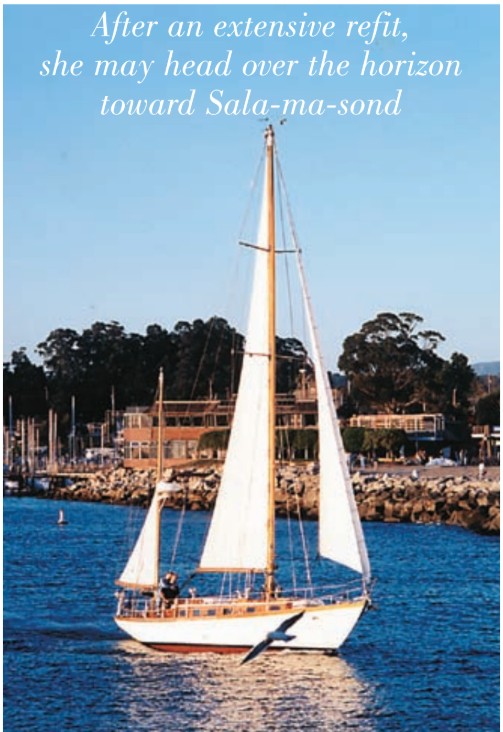
After an extensive refit, she may head over the horizon toward Sala-ma-sond
Issue 18: May/June 2001
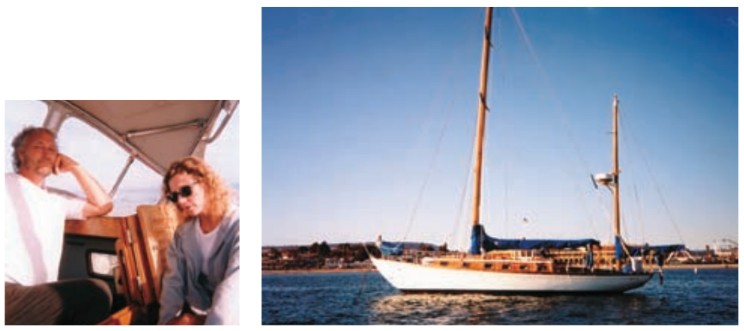
WERE YOU TO TAKE YOUR DINGHY down the main fairway of the Santa Cruz Harbor, in Northern California, out on the end of E Dock you might spot the clean lines of a 24-year-old cruising boat. She flaunts a jaunty sheer with long overhangs and an old-fashioned yawl rig. Sala-ma-sond was the last Offshore 40 built by Cheoy Lee, and she carries hull number 3026.
She spent most of the last two decades in Santa Cruz, sitting under a full boat cover, rejoicing in the name Flying Eagle and accumulating all manner of cruising gear, but her owner never quite cut the ties that bind. So there the grounded Eagle sat until Tim Litvin came along in 1997, looking for a certain 40-foot Cheoy Lee.
Tim is the kind of guy who knows exactly what he wants, and he had been to the ends of the earth hunting for the particular one that was just right for him among the 150 Offshore 40s built. The year 1996 had been a bad one for Tim, a year when a deranged drifter had broken into his boat and driven her out of the harbor into the teeth of a monstrous winter gale pounding the California coast. Samantha was Tim’s first boat, an Offshore 27, also built by Cheoy Lee. However, the storm got the better of the inexperienced pirate, who ended up driving her on the beach and stealing as many of Tim’s personal possessions as he could stuff into his backpack. He was later arrested in downtown Santa Cruz when one of Tim’s many friends spotted the man bumming for quarters, inexpertly playing Tim’s guitar.
Samantha was a write-off, and with his insurance settlement Tim had to turn his back on the boat that had been his home for six years. He had put many hours into modifying the boat for his cruising plans, but he suddenly found himself literally on the beach with nothing but a bag of sodden clothes and a lot of friends made during his six years in the harbor. He got a temporary home on a friend’s boat and set out to find a bigger and better replacement for Samantha.
Closer to the sea
Tim had grown up in Illinois, and right from the start knew he wanted to live someplace else . . . farther from the snow and closer to salt water. He got his diving certificate, learning to scuba dive in the muddy waters of the Mississippi River, a place so murky that trainees are tied together with rope lest they get lost in the zero visibility.
He took off for Florida, where he studied marine biology and worked as a bicycle mechanic. He never imagined he might own a boat himself. Eventually, he found his place in the computer revolution overtaking Northern California in the 1980s. When he tired of paying rent instead of buying a house he stretched his imagination one more time. He wanted his future home to float, and in floating it had to look good. Tim has a very particular aesthetic sensibility: “The Cheoy Lee was the only boat that caught my eye,” he says. It helped that the Offshore 27 was strong, seakindly, and inexpensive. He labored for years in his free time, honing his carpentry skills by modifying the cabin, finding a space aboard for his computer, and planning an early retirement afloat.
Boat theft is not common in California, where the coast is rugged, harbors are few and far between, and there is nowhere to take a stolen boat to resell it; thus the theft of Samantha was not only bizarre but also almost unprecedented. At the time it seemed a catastrophic setback, but Tim doggedly set about finding a new home. He searched far and wide for a boat that suited his aesthetic tastes and his pocketbook, but he couldn’t find any design that suited him so well as the Hong Kong-built Cheoy Lees. Tim loves the details on these boats, including the copious use of rare teaks, the handmade hinges on the furniture, and the British influence in the choice of hardware.
Special layout
Most Offshore 40s were built in a three-cabin layout, with two stern cabins, but Tim wanted a so-called E-type layout, which offers two cabins with a small quarterberth. He didn’t rest until he found exactly what he was looking for, and found it ironically enough in his own backyard after using his vacation time scouring the country for the perfect boat.
“People either love maintaining teak, or else it gets away from them and the aesthetics end up looking like hell,” Tim notes with a wry smile. His boat looked pretty good for a few weeks after he bought her. As he was living aboard, he preferred not to use the full boat cover she came with. Sure enough, the varnish all over the boat soon started to peel in sheets like sunburned skin. “Luckily the teak will come back just beautifully, with some attention,” Tim adds.
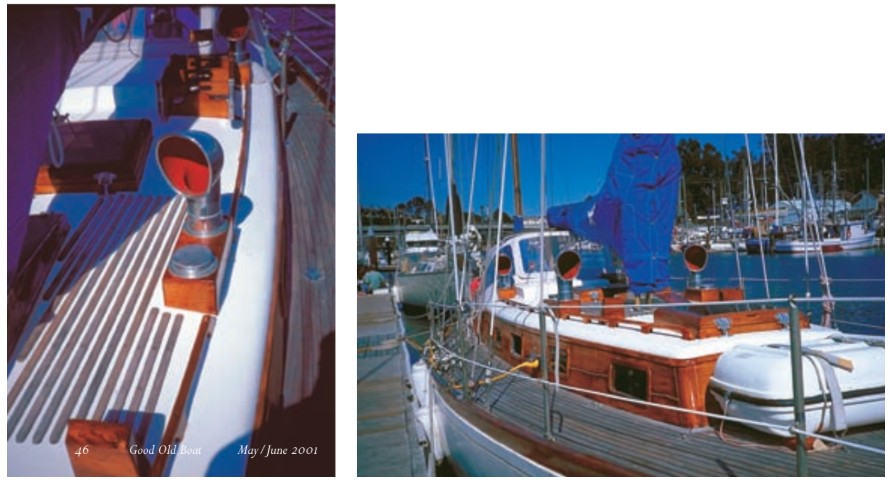
He knew he had bought a project boat, and he had a clear idea of how much work he had let himself in for, because the 27-footer had consumed about two weeks a year in time spent varnishing. Even though she does have a solid fiberglass hull, Sala-ma-sond appealed to Tim because she looked so traditional with teak-covered decks and a fiberglass cabin with teak overlay, not to mention the two wooden masts. “I think it’s beautiful, but it does drive the market value down owing to the increased maintenance,” Tim says of the yards of wood exposed to the elements.
Most Offshore 40s sell in the $30,000 to $80,000 range, depending on their condition. In an effort to reduce the annual varnishing binge, Tim has taken to using clear polyurethane, which he describes as being essentially a pigmentless paint with UV inhibitors and anti-oxidants. Smith and Company, of Richmond, Calif., sells the polyurethane as a “five-year solution” for dealing with teak. Tim loves it, saying it looks to him every bit as good as varnish. So far he hasn’t had to touch up any areas where he has applied the polyurethane, but he says when the time comes to recoat, the job is supposed to be relatively simple, using a heat gun to remove the old polyurethane.
Removing wiring
Above decks, Tim had to decide how to deal with the original standing rigging and the previous owner’s penchant for electronics. The electronics were badly dated, and Tim has been busy removing wiring and elderly systems that used to be state-of-the-art and now look astonishingly old-fashioned. One prime example was the vast flying saucer on the mizzen that serviced the radar. The radome was a couple of feet across, and the radar in the cabin was a huge black box, complete with rubber shades to allow the operator to see the screen in the strongest light. It was a tussle, because everything worked just fine, but a combination of windage aloft and intrusion into the living space below decks forced Tim to deep-six the radar. Flying Eagle was a heavy-looking boat, but Sala-ma-sond is returning to the sleek look associated with Cheoy Lees.
Tim removed the boom gallows that used to stand over the cockpit, noting that the fitting had the nasty habit of chewing the boom when he rested it in the gallows. A modern topping lift has replaced that. Then there were the charming teak belaying pins hanging in the shrouds. “I’m just not a belaying pin kind of guy,” Tim shrugs, preferring to rely on the original, but very serviceable, winches. “I want a classic boat that is a practical vessel to sail. I like the clean lines, and I don’t want the essence of the boat to be smothered.” As the standing rigging is replaced, Tim is employing Norseman fittings to replace the swages.
On deck, the original teak boarding ladder has its own storage chocks, keeping it close at hand, but unobtrusive. Similarly, the original hard dinghy has its place, upside down on the foredeck in factory-supplied chocks. A dodger is a must for the usually cool, damp sailing conditions found in Northern California, where the Pacific Ocean is chilled year-round by the frigid Alaska Current. Tim’s was custom-built by Sherman’s Custom Canvas of Santa Cruz, and highlights his demand that beauty not be sacrificed to practicality. The dodger comes with an abundance of handholds and offers good visibility, but at the same time it has incorporated its own particular sheer at the sides where the canvas is cut into a graceful curve, rarely seen in such canvas work. Another little touch offered with this dodger is the flexible solar panel mounted in the top; but in this case the panel is simply tucked into its own flap, a simple, elegant solution that eschews nuts, bolts, or screws.
Work in progress
Below decks, the cabin is a work in progress, and Tim’s plans call for a rearranged galley with more convenient access to the sinks, moving them outboard and away from the stove. Meanwhile, his one slight modification to the V-berth has, like so many boat projects, led to an unforeseen complication. Now the berth is a proper double bed, but the insert blocks access to the head through the door that formerly gave direct access from the forward cabin. It’s not exactly a huge problem, as all Tim has to do is open the aft-facing door from the main cabin. But his sense of what’s proper has been disturbed, and he wants to regain that private access to the head. He is building a folding door that will ultimately slide across the V-berth entrance, opening a private access to the head and closing off the forward cabin from the saloon.
If that sounds elaborate, take a look at the former settee that was located to starboard, opposite the deep and comfortable U-shaped dinette to port. As much as Tim is a lover of the classic, he is also thoroughly up-to-date when it comes to electronics. If you can imagine, he built a similar computer center in the ill-fated Samantha. He also provided a reading chair for his partner, Tai Moses, who likes to devour her books while wrapped up in her “throne.” (Tim’s term for the reading chair he built, not mine!) “It’s a good curl-up-and-read corner,” says Tai, but she notes that the seat still lacks a reading light.
That little issue highlights Tai’s problem with Tim’s refit. “The whole boat is such a work-in-progress; there are lots of projects for Tim to tackle,” she says, acknowledging that the focus at the moment is on making the boat a seaworthy cruising vessel, not a livable home. However, Tai points out, Tim didn’t waste any time making the V-berth more comfortable. She says they both puzzled for some time over the purpose of the wretched cutout that came with the boat. It kept falling out between the berths, and Tai didn’t like that. “I thought perhaps it was a chastity cut-out,” she says archly.
Feminine touches
Now she’d like a few more feminine touches in the somewhat austere cabin, like curtains perhaps, though Tai, a writer and editor at the Santa Cruz Metro magazine, is very clear she has little interest in galley arrangements. A thoroughly modern woman, Tai acknowledges Tim is the chef on board, and she is happy to let him design the cooking arrangements, which will doubtless work for her more modest cooking style.
On deck, Tai wielded a brush with a will and helped Tim deal with the woodwork. It was hard work putting the polyurethane coat on, but Tai found the work satisfying, watching the wood become transformed by her labor. She’s really excited about the longevity of the polyurethane coat, too, because traditional varnish wasn’t an option, with its need for care every few months: “A girl has her limits,” she says.
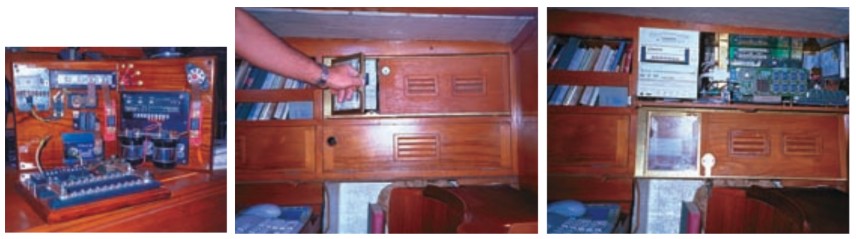
The computer on board is a full-sized desktop, which, as he relies on it for work, is being constantly upgraded. Tim built the wooden frame himself for the screen, which is shortly going to get a metal bracket to allow it to swing out from the side of the cabin. “I have a lot of luxuries built into my PC,” Tim says, delightedly showing off the various features of his flat-screen computer. “It works as my television, FM radio, and six-disc CD stereo-recorder. Using my landline phone, the PC also gives me voicemail, and fax-modem capabilities. At sea it connects to my SSB to provide email as well as electronic navigation.”
He built the hard drive’s metal casing that slides into and out of its own locker, providing easy access to the components for servicing or replacement. The disk port has its own brass frame with a beveled glass window, and the hard drive slides in and out on a set of perfectly smooth rollers of Tim’s design. “It took a while to get that lot sorted out, but it works really well, it looks good, and it’s extremely practical.”
Double filters
When I went by to look at the boat, Tim had a couple of projects he was working on, including a double set of fuel filters for the diesel engine. He recently had his fuel tanks polished and was busy getting ready to complete the refurbished fuel system with a standard double-filter setup offered by Racor. However, standard isn’t a word Tim can live with, so he modified it slightly by installing the filters on their own teak backing plate and, as a final touch, installed a tiny teak accent to the filter selector switch. It’s smooth, with perfect grain, coated in polyurethane of course, and looks as though it came from the factory that way.
To keep his electronics in top shape, Tim is designing and building his own primary electrical charging and monitoring system. He selects his own components and is trying to keep them in as compact a space as possible, ensuring good connections by using solid copper straps instead of cables. You or I might rest content with a simple breaker bought off the shelf, but aboard Sala-ma-sond, homemade is best.
If you ask Tim what his plans are, he gets evasive. Acknowledging his weariness with the less-than-tropical Santa Cruz climate, he is willing to admit he does dream of setting off into a tropical sunset. But there’s just so much work left to do! Rearranging the galley, organizing the head access, and maybe enclosing the quarter berth. The projects never end for this part-time carpenter. In the meantime, Tim and Tai take daysails on Monterey Bay and short cruises along the California coast.
I get the feeling that when this perfectionist feels the boat is reasonably ready, he will let go the docklines and finally take that journey over the horizon to complete the tropical odyssey he started so many years ago, when he left Rock Island, Illinois. Despite his unwillingness to let me know, I detected a hint in his voice when he told me what the name of his boat means. Sala-ma-sond is a quotation from Dr. Seuss, which means “faraway island, a place of freedom,” and Tim explains the name’ origin with a dreamy look in his eye.
Michael, his wife, Layne, and their two dogs recently completed a trip from Santa Cruz, Calif., to Key West, Fla., in their Gemini catamaran, Miki G. Michael lived aboard a Flicka 20 for 10 years, including a cruise in the Bahamas, before marrying and being faced with demands for hot running water and a larger head.
Thank you to Sailrite Enterprises, Inc., for providing free access to back issues of Good Old Boat through intellectual property rights. Sailrite.com