A sailor’s vivid impressions of Pacific sea, sky, and wind
Issue 38 : Sept/Oct 2004
My friend Tom originally met Steve at one of the yachtsmen’s hangouts he frequented. There he made arrangements to help crew Steve’s cutter, Haiku, to San Diego. As luck would have it, Tom got the flu, and it quickly turned nasty enough to make going offshore out of the question. Phone calls were made, more arrangements hastily concluded, and I found myself volunteering to go in Tom’s place.
At nine on the night of October 12 my ride dropped me off at the old Oyster Point Marina in South San Francisco, and I went aboard, introduced myself to Steve, and started moving my gear below. I immediately disliked the man. He was a gruff and sarcastic SOB, who complained about the amount of luggage I had brought. It did not seem to matter to him that most of it was there for his benefit: my chart portfolio of the California coast, my sextant, navigation kit, foulies, and safety harness, not to mention food and clothes for myself for a few days as a courtesy so he need not share his stores or equipment with a stranger.
Steve described himself as “a recovering dentist” who had forsaken the suburban rat race and was striking out for the South Seas. The harbor in San Diego is full of these people, waiting for a wind or spare parts or courage to head west to Hawaii or south to the Canal. Steve fit the stereotype. Haiku’s 28 feet were hastily crammed with the debris of this man’s life, cooking utensils, power tools, sailbags, even some dental instruments.
There was precious little room for my gear; I had to park most of it in the way on the cabin sole before I could crawl into the quarter berth and get some sleep. Even the head was buried under a mountain of luggage so that relieving oneself first required a three-point transfer of cargo.
The ship’s cat
The third member of the crew was Steve’s cat, Fang, a grotesquely obese creature who obviously disliked boats and water intensely. Everything below smelled of cat poop and kibbles, along with the usual small-boat brew of sweat, dirty clothes, stale food, sewage, diesel, and decaying plankton.
It was 10 in the morning before we were under way. Steve had left a long list of chores to be done at the last minute, and as a result we wasted hours of daylight and a favorable tide. We motored to the city, turned left toward the Golden Gate, and left again threading the channel between Four Fathom Shoal and the beach. As soon as possible, Steve headed offshore for deep water. October is not a good time to go to sea in the Northern Pacific.
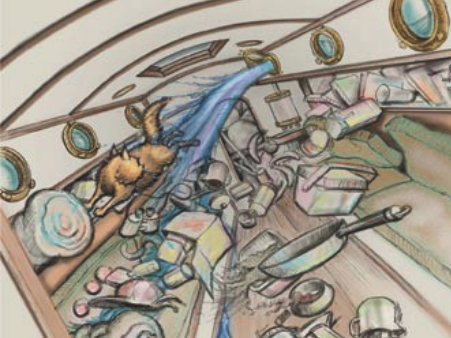
The first of winter’s gales hit us about noon. In a matter of minutes we went from a lazy rolling swell to a brisk, then stinging, wind. Just as they tell you in the books, the first bit of weather tells you what gear is adrift. Within minutes the cabin was a shambles: clothing bags and food and equipment boxes were rolling about everywhere, the cat’s litter tray overturned, and an open port got hit by a stray sea. Water poured in as if from a fire hose, and I got soaked trying to secure it. As I stood up, I tripped on some loose gear and, on the way down, took the decorative antique lantern with me, adding kerosene and glass shards to the general confusion below. It took me an hour to clean up enough to make the cabin safe from injury and fire.
Meanwhile, on deck
On deck, Steve had secured the engine, hoisted the storm jib, and rigged the self-steering vane for a southerly course, lashing the rudder down. With a 30-knot wind blowing on her starboard quarter, Haiku roared along like a locomotive, alternately rolling from side to side (although favoring her port to her starboard) and simultaneously pitching in a treacherous following sea with a sickening corkscrew motion.
Fortunately, the captain seemed to know what he was doing and, in spite of his lubberly and unseamanlike housekeeping, the boat was well managed. But like even the best of seamen, the skipper had his touch of first-day-out seasickness and soon went below to try to sleep it off. I was left to the first watch, thanks to my immunity to the mal-de-mer.
As the afternoon wore on, the storm increased. Piled higher and higher by the unforgiving nor’wester, the seas grew, following ever faster from behind, towering over the boat as if to crush her, then sliding beneath her at the last moment to break with a crash and roar just ahead. The word “billows” kept coming into my mind, from either Melville or Robert Louis Stevenson’s “The Land of Counterpane,” I couldn’t remember which. I could never see why the word “billows” was used; now it made perfect sense.
I had little to do besides contemplate my situation; the small scrap of sail forward and the windvane kept us pointed downwind where we needed to be in this weather. Haiku, a squat ugly duckling of a boat, was thriving under these conditions. She was built for this. Her hull lines and sturdy rig carried the memory and experience of the British mariners who had developed this shape and this balance over a thousand years of tragedy and landfall. If her crew exhibited due prudence, she would not let them down. For my part, I realized I had been offshore in small boats before, and I had been out in bad weather before, but I had never been offshore in a small boat in bad weather. The sky and sea turned a monotonous gray and the boat’s course, not quite parallel to the coast, gradually diverged farther out to sea. Dark came early in the overcast, and the last sight of land was of the lights of Monterey. Soon we were driving off alone into the darkness.
GPS fix
I hoped the skipper would duck into Monterey Bay for some shelter, perhaps even spend the night there or in Santa Cruz. It was not to be. He was up, refreshed from his nap, and took the watch. He took a quick fix on the GPS, plotted the position on the chart, and laid out our night’s course. I made it a point to look over his work. He seemed to be a fairly competent navigator, so I could sleep with some sense of security.
The rest of the equipment was not so reassuring. The radio transmitter was not working, although the receiver was functioning. In this storm, we seemed to be the only non-commercial traffic on the water between San Francisco and Point Conception. I turned to my berth, covered with gear, where Fang had settled in the only soft spot left. For a while I thought I would have to fight him for it, but I eventually persuaded him to move and crawled in, not even bothering to remove my dripping foulies. There was nowhere to put them, and I was too tired to worry about it.
I never sleep well the first night in a strange bed, and this time was no exception. Besides the frantic symphony of motion below and the crash and thump of loose cartons and cans and other detritus, the green glare of the GPS screen was right in my face. Outside, the wind howled louder and louder as the night wore on, the jib flapped, the halyards slapped against the mast, and there was the constant sound of waves crashing against the hull and rolling under the keel. The groans and sounds of hull and rig were normal — even reassuring — nothing unusual or unexpected, but I would need some time to get used to this particular boat’s song.
Snoring crew
At midnight the skipper woke me up. I know I slept because he complained about my snoring, but it couldn’t have been for very long. Still, I was looking forward to getting on deck, the stuffiness and stench below was starting to get to me. I snapped my safety line to the pad-eye by the hatch and crawled out to the port side of the cockpit. My instructions were simple: steer due south (the skipper had disconnected the windvane because the wind was from the north now, and self-steering gear was not effective with the wind directly aft).
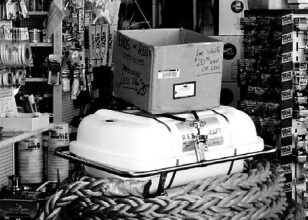
He also warned me that Fang had installed himself underneath the life raft (it was lashed to the cabinroof) and refused to come out. He wanted to practice deploying the raft, in case it became necessary to do so, but that would mean crushing the beast between the hatch cover and the raft. In order to remove the raft, it was necessary to slide the hatch out of the way, and the cat was in its path. Fang was determined not to move, and I didn’t think he was likely to feel any differently even if the boat were on its side and filling with water.
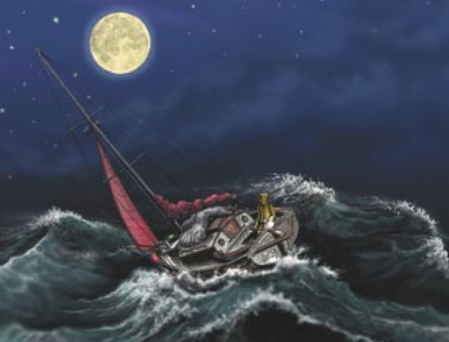
The world outside had changed. It was totally dark, but the sky had cleared, a full moon was overhead, and the sky was filled with stars. The mountains of water made their presence known by occulting the stars behind them, and in certain directions the sea had transformed itself into a bubbling molten silver. The temperature had dropped, and it was further exacerbated by the biting wind and the spray, which was now pretty well constant. I was well protected by my foulies, but my hands and feet were bare, and they were soon stiff from cold. The water, as always in the Northern Pacific, was deathly cold. It was an arctic desolation, an alien planetary landscape from the edge of the universe, which, after all, is exactly what it was. I had seen the sea like this before but never from a small boat close enough to the water to reach down and touch it. It was as beautiful as it was terrifying.
Feet braced
Without Iron Mike hooked to the tiller, I had to work now. I sat with my back to the cockpit bench, my feet braced on the opposite side, both hands on the tiller, and my eye on the steering compass. After the initial period of learning the boat’s response, the steering became routine. Most of the time the tiller was limp and the boat raced downwind like a living thing. Occasionally some vagary of wind or wave would bring her head around, and some effort was required to swing the boat properly under the compass card as it locked onto the earth’s magnetic field. The longer I delayed, the harder I had to work and the more likely I was to overshoot and be forced to correct. Eventually, the brain mastered the feedback and the boat’s wake trailed behind in a straight line over the rolling sine waves of the sea.
The helmsman’s hands are where the sky and the sea, the sail and the hull meet: the microscopic boundary between the atmosphere and the ocean where the boat travels with man at its precise center. Of all of man’s artifacts, a sailboat is most like a living thing. It reacts to the chaotic forces of nature not only through the hands of its crew but also through the minds and experiences of the thousands of generations of mariners and shipwrights who preceded us. Their skill and their failures are embodied in the graceful lines of the hull and sails, as sleek and sensuous as the hips of a beautiful woman. Or as my friend Tom says, “Aargh! Me likes the turn o’ her bilge, matey!”
At daybreak I volunteered to continue at the helm while the skipper cooked breakfast: coffee, biscuits, and gravy. The simple meal was delicious. Shipmates now, we opened up a bit to each other and reviewed the night’s events. My trick at the helm had been pretty uneventful, except that we had been pooped once during the night by a rogue wave. A ton of water landed in the cockpit, almost knocking me down and pouring several hundred gallons through the open companionway hatch.
Catnap
The darned cat, of course, slept through it all. The electrics pumped out the yacht’s bilges, but I had a little trouble locating the cockpit drains (they were under 2 feet of water) to make sure they were not plugged up with debris. My foulies were well buttoned up but were never designed for hands and knees in hip-deep water. It wasn’t until after the water was cleared that I realized how dangerous that can be: the first wave stops you helplessly in the water, unable to maneuver; the boat gets hit full force by the next and capsizes her; the third sends her to the bottom.
Through the night, the wind had moderated somewhat (or maybe I had just gotten used to it). The seas, on the other hand, were now enormous. They came racing impatiently behind the boat, foaming at their crests, scud and bubbles blowing down their forward faces and their trailing slopes. The color of the seas well offshore is totally indescribable, like dark blue ink poured into a glass of water, all offset by the blinding white of foam and spindrift and contrasted against a paler, but no less blue, sky. They would momentarily tower over us, but Haiku lifted her skirts and let them slide harmlessly beneath her rump so they could continue their breathless rush to the end of the world. The waves looked as high as a four-story building, although the radio assured us that they were but “19- foot seas.” It is a discrepancy that has been documented before; the mariner should be forgiven for a bit of a stretch of the truth. It is as much an optical illusion as a sailor’s exaggeration.
Later that morning we saw the only other vessel that shared that windswept ocean with us. A huge container ship crossed our bows about a mile ahead of us. I could see an officer on her bridge through binoculars, watching us through his. We waved at each other, and I felt sorry for him. His ship was built to carry cargo, a blunt box with a flat bottom, riding broadside to the seas. With no top hamper to steady her, she rolled sickeningly in a beam sea.
Petered out
The gale blew all day but began to moderate by evening. As we expected, it had petered out to nothing by the time we rounded Pt. Conception and changed course to parallel the coast. We secured the jib and fired up the engine and traveled within sight of the coast toward our destination. As if on cue, Fang emerged from his hideout, went below, and lost himself in the clutter of the cabin. He had spent the whole gale on watch and now he was ready for some serious sleep.
The day was cool and crisp and, as we threaded our way through the Channel Islands, we could easily imagine ourselves the only ship on a primeval ocean. The islands rose like monoliths from the sea, some close enough aboard for us to see the colonies of sea lions littering the narrow and cramped beaches . . . at this distance, tiny maggots crowding the carcass of a dead whale, a monstrous dead whale of stone, the size of a mountain, floating in the deep blue vastness. Every fissure in the rock, highlighted by the long shadows of a setting sun, continued the cetacean illusion. The islands were wrinkled behemoths, without a particle of green fur, brown rocky skins like an elephant seal’s. With nothing but the sea lion colonies to give them scale, it was even difficult to judge their distance and size.
I recalled the last time I had sailed this way, a few months earlier. Then it was night, and we had taken the channel side on the lee of the islands. It had been overcast and dark, the islands invisible but sensed from our knowledge of the area and the silent witness of the chart. The low cloud layer, by coincidence, was at the precise level of Anacapa Light, and the sweeping beam from the rotating beacon perfectly illuminated the exact bottom of the cloud layer. It was an unforgettable illusion, truly the Light at the End of the World, a godlike flash as the sword of light sliced over our heads again and again, precisely at the level of the fog bank.
Sleepless night
But there was no light from our present perspective, just an occasional aid to navigation blinking its coded message. For Haiku’s crew, it would mean a sleepless night. We were approaching the crowded waters of southern California, with their heavy commercial and yachting traffic, and the threat of collision had to be dealt with by constant vigilance. Steve went below and used the radar, calling out ranges and bearings which I, with my dark-adapted night vision, could verify with binoculars. Navigating by GPS and radar, we approached our destination until daybreak when my shipmate finally begged me to carry on alone for a while so he could get a few hours of sleep and make our final approaches alert and refreshed.
I was tired as well, a bit punchy from the night’s sailing, although my work had been physical rather than mental, so the fatigue was not as severe. I knew that with sunrise I would get my second wind. Through the dim twilight we were well into the oil patch, threading our way through the pumping stations and offshore platforms. The ocean is foul here, not from the derricks and pipelines, but from petroleum bubbling up from the sea itself. The stench was everywhere, and I could see the droplets of petroleum floating past, some still racing up from some hidden fissure in the sea floor to break at the surface after countless millennia under the crust of the earth and the shroud of the sea.
Soon even this dead zone was behind us, and that sacred time came when, just before sunrise, there is plenty of light to see but no harsh glare to squint the eye. A trick of the atmosphere colored the scattered clouds a bright solar yellow, while between them was the dark violet of an early morning sky, a color once described to me as “Maxfield Parrish blue.”
Unexpected combination
The combination of colors was unexpected; a salmon and indigo is what one usually expects from this time, but some trick of the light or some unexpected illusion of these two contrasting colors — violet and yellow — came from the sky in alternating bands as the parallel stripes of cloud and sky provided the color backdrop. The surface of the sea, almost perfectly calm, also had its alternating pattern of crest and trough, tiny wavelets just a few inches high and a few feet apart. The pattern of the waves suddenly meshed with the striping in the sky and, for a few moments, the surface of the sea exploded into a geometrical spray of yellow/violet reflections that throbbed and propagated in a bizarre Op Art extravaganza. The effect was not at all natural in appearance. It appeared almost mechanical, computer generated, artificial. It only lasted a few seconds while the geometries of sky, sea, and boat motion briefly merged in perfect synergy.
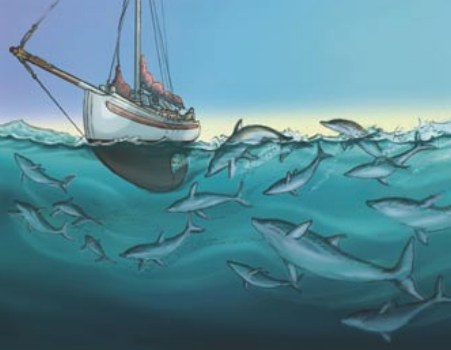
Then it was over. The alignment shifted slightly, and the yellow/violet kaleidoscope collapsed back to undifferentiated chaos. The colors changed slightly to something more familiar in the gradually increasing illumination of the scene. It had my attention, and I shifted my head back and forth in a vain attempt to recapture that fleeting pattern of reflections. It was not there, but looking into the water itself, I could see something below the surface. A huge pod of Pacific dolphin was passing under Haiku, the nearest to the surface just a foot or so below. They are smaller than our Atlantic Coast porpoises, and more boldly marked, and there were thousands of them. In a moment they were gone.
Thank you to Sailrite Enterprises, Inc., for providing free access to back issues of Good Old Boat through intellectual property rights. Sailrite.com