It needed to be cheap, simple, compact, and long-lasting
Issue 22 : Jan/Feb 2002
The anchorage where I kept my Pearson Ariel is a bayou, a tributary of the Jourdan River in South Mississippi. It’s a dead end that is protected on all sides, providing excellent shelter. However, down here we can sometimes experience that powerful storm called a hurricane. I wanted a mooring that would be up to the job in the event of a hurricane.
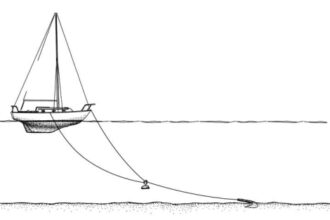
The bayou is comparatively deep (19 feet), and it’s not over 200 feet wide. The best location for the boat would be parallel to the long axis of the bayou, lying to a mooring off the bow and several stern anchors firmly planted in the mud or tied to trees.
I wanted a compact mooring anchor that would not stick up four or five feet from the bottom, as might a long-shanked mushroom. The anchor had to bury itself in the soft silt and mud of the bottom, leaving only the chain above the bottom. Finally, as there are alligators in the bayou, diving to check the mooring is out of the question, at least for me! Once the mooring was laid it would be down many years, maybe as many as 10 years.
The challenge was to design and build a mooring system that would meet all criteria and endure over time. I had seen an upside-down triangle pyramid-type anchor that looked good for a start but was expensive and not readily available. Plain old weights such as railroad wheels, engine blocks, and concrete were not suitable and would probably drag.
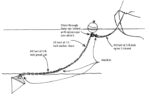
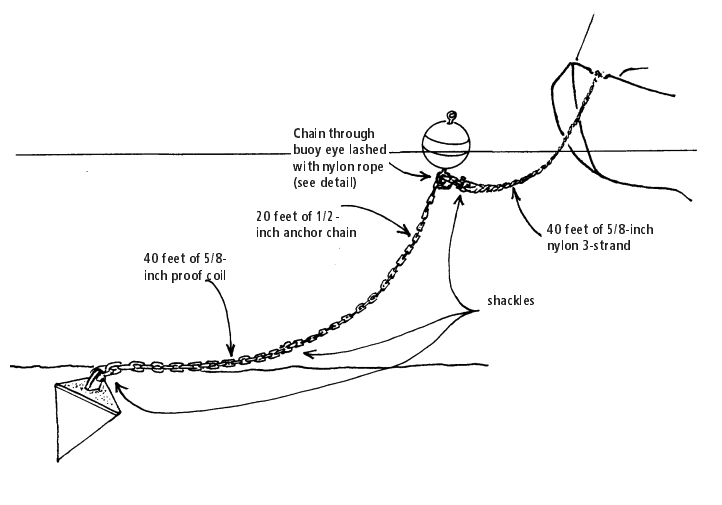
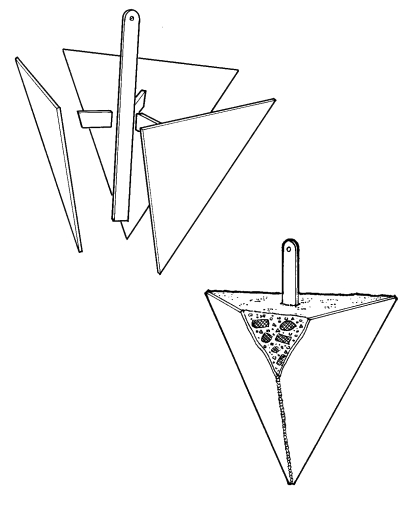
I had some used lead pigs in the shop, about 300 pounds, which gave me a start. I designed a triangle-shaped steel structure similar to a fishing sinker and about two feet on each side at the base. The structure was welded from 1⁄4-inch mild steel plate. A vertical piece of steel flat bar, 1⁄2 inch x 2 inches, was welded inside the structure. This was welded to a three-piece web of horizontal bars made of the same material which, in turn, was welded to the inside of the structure (see illustration on Page 51). A 1⁄2-inch hole drilled through the wide side of the flat bar, l inch down from the top, gave me an attachment point to shackle on the chain. The entire structure was welded on all the seams. It was very strong.
Launching problem
I realized that once I filled my upside down triangle with lead, I would never move it. How to launch it and set it in the bayou?
My old boat trailer was pressed into service to support the upside down pyramid while I filled it with lead. The lead was set in a loose mix of sloppy high-strength concrete to keep everything from moving. Once the concrete set, even if the side walls rusted out, the shape, lead, and center bar would remain. Total cost to build the mooring anchor was $50 for the welded structure from a local welding shop and $30 for the lead. The concrete was about $10. So far OK, but this was the easy part.
I wanted a mooring capable of a working strength of 6,900 pounds, as the entire boat weighed 5,400 pounds. This is definitely overkill, but a hurricane can tear up lots of things. I did not want my boat to be one of them.
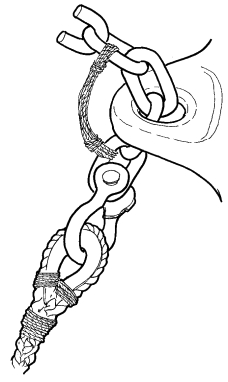
I purchased 5⁄8-inch proof coil chain for the first 40 feet, reasoning that I could lift this chain to check the mooring even if I could not lift the mooring anchor. From here I shackled 20 feet of 1⁄2-inch chain and then 40 feet of 5⁄8-inch three-strand nylon.
The problem was to find a shackle small enough to fit the chain yet large enough to hold the rope with thimble while being strong enough to marry the two. This was not easy. The solution was three beautiful Wichard shackles that mated the two. They cost almost as much as the chain but gave me a lot of confidence that I had a 6,000-pound working system from mooring to on-deck eye splice.
Belt and suspenders
In hurricane conditions, I would bridle the eye splice on the bow back to the mast as well as to the bow cleat. I would not trust the cleat alone. The stern would be secured by two Danforth anchors set on 200 feet of 5⁄8-inch nylon three-strand to 20 feet of 5⁄8-inch chain. I would also secure additional lines from the bow to a Danforth on 3⁄8-inch chain leading forward, as well as lines port and starboard from bow and stern to pilings 100 feet away on shore. That should do it. Total cost about $250. Just the cost of a conventional 250-pound mushroom anchor. (We contacted our favorite tire shop about the price and availability of scrap lead. They said they’d sell their used tire-balancing weights for five cents a pound. -Ed.)
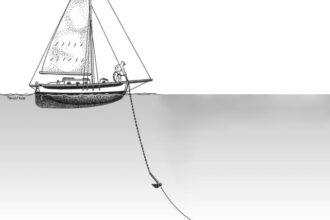
Next came the setting part. The bayou has a boat launching ramp on the shoreward side. I towed the mooring over to the ramp with the car, backed the trailer down until just the eye on the mooring anchor was visible. I carried the chain and rope onto the bow of the Ariel and brought the bow of the boat over the mooring. I assembled the mooring and ran 1⁄2-inch braided Dacron rope from the bow cleat on deck through the starboard chock, through the shackle on the mooring anchor, and back through the port bow chock to the mainsail halyard winch on the mast. With my wife tailing the line, I winched the mooring anchor up from the trailer. The bow of the boat sank 18 inches, while the stern rose in the air. Some heavy anchor!
Once the anchor was clear of the trailer, I put the boat engine in gear and motored out to the drop site. I slowly paid out the line on the winch to lower the anchor to the bottom. My wife slowly let out the chain so it did not pile up in one spot. Once the anchor was down, I pulled the line up from the standing part and backed away from the mooring in the intended direction down the centerline of the bayou. When all the scope was out, I backed down hard and set the anchor. The boat stayed in one place, and after 15 minutes I considered the mooring set.
This mooring has served for three years with no problems. Annually I clean the rope part and inspect as much of the chain as I can get a look at. So far all is well, with little sign of deterioration. We have not had a hurricane in this time, but I am ready. I try to take good care of my boat. She takes good care of me.
Bill is a marine surveyor and boatbuilder who has been living, eating, and sleeping boats since the early ’50s when he assisted at Pete Layton’s Boat Shop. Since then he’s worked for Charlie Morgan (Heritage), Don Arnow (Cigarette), and owned a commercial fiberglass boatbuilding company (Tugboats).
Thank you to Sailrite Enterprises, Inc., for providing free access to back issues of Good Old Boat through intellectual property rights. Sailrite.com