A maxi trailersailer for inland and coastal waters

Issue 66 : May/Jun 2009
The O’Day 26 is one of the last models in a long line that originated with George O’Day, the 1960 Olympic Gold Medal sailor and boatbuilder. Among the 76 models bearing his name is the 16-foot 9-inch Daysailer, a pioneering fiberglass sailboat that helped bring sailing to the masses. His lasting contribution to the world of sailing may be that his designs were all well found, modern yet conservative, and marketed to the public in a way that assured the company would survive. Some of the greatest runs of sailboats rolled out the O’Day factory doors, so we find them plying the waters everywhere. (See May 2002 Good Old Boat for a profile of George O’Day.)
By the time the O’Day 26 came along in 1984, George O’Day was pretty much out of the picture (he died at age 64 in 1987). He’d sold the company to Bangor Punta that, in turn, sold it in 1983 to Lear Siegler. In production between 1984 and 1986, the O’Day 26 is not to be confused with the 1960s-era O’Day 26 which was a Phillip Rhodes design, or the Gary Mull-designed Ranger 26 built for Ranger by O’Day and sold through its dealer network.
Rather, the later O’Day 26 is a slightly extended version of the O’Day 25, the production of which ended with the arrival of the 26. It was designed by C. Raymond Hunt Associates, with John Deknatel serving as the chief designer and assisted by Winn Willard, Peter Boyce, and John Kiley. It takes a sharp eye to tell the 25 and the 26 apart as most of the differences between them are in sail area, ballast, minor window changes, and a little lengthening. Approximately 87 were built. Our test boat, owned by Bill and Martha Siegworth of Beloit, Wisconsin, was marketed as a 25th Anniversary model (1959-1984) but sold as a 1985.
Whether left in a slip, at a mooring, or towed on a trailer each time out, the O’Day 26 provides a spacious platform for coastal and inland-lake sailing. The Siegworths often tow their Martha J. to Lake Mendota at Madison, Wisconsin. At other times, they take her on extended vacations of a week or more to places as far afield as Bayfield, Wisconsin; Grand Traverse Bay, Michigan; and Kentucky Lake.
Design
The O’Day 26 has a subtle sheer and a modest reverse transom which, combined with a straight bow angle and rakish cabin trunk, make it a fine boat to look at. Despite the substantial freeboard needed to provide standing headroom and reasonable accommodations in the cabin, the O’Day 26 does not come off as being overly boxy. The road-legal 8-foot beam and firm bilges provide good initial stability as well as plenty of storage space.
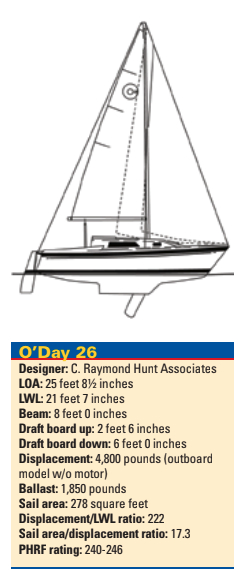
While the builder’s brochure hints that a fixed-keel version of the 26 was available, it appears none were ever built. The 26 has a 6-foot 8-inch-long lead-ballasted stub keel with a weighted centerboard, a configuration it shares with the O’Day 23 and 25. The boat carries 1,850 pounds of ballast and draws 2 feet 6 inches with the board up, 6 feet with it down. Overall displacement is 4,800 pounds, making this one of the largest trailerable sailboats available.
Whereas most O’Day 26s have tiller steering and an outboard motor on a transom bracket, the Siegworths’ boat has the Edson wheel steering and inboard Yanmar diesel options. The rudder on all versions is outboard.
Construction
The hull is fabricated of solid hand-laid fiberglass while the deck is of balsa-cored sandwich construction. The deck is bonded to the hull with adhesive and mechanically fastened, with an aluminum-and-rubber rubrail capping the joint. A molded-fiberglass inner liner forms the berth flats and cabin sole.
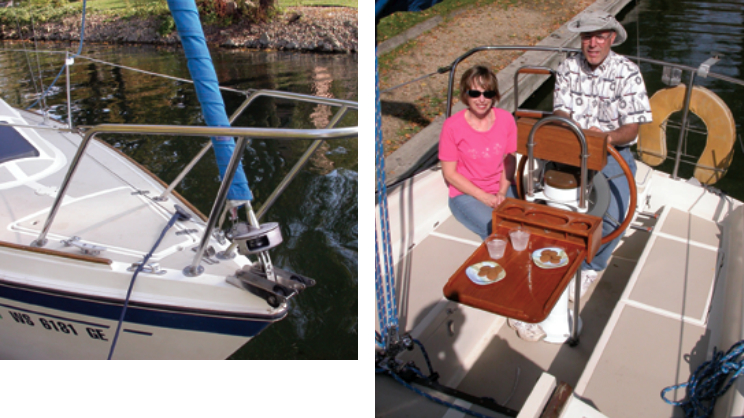
A few teak details on deck give the O’Day 26 a touch of class without creating a maintenance chore. Bill added some wood by fabricating a beautiful teak rim for the wheel and a mahogany instrument holder. He also installed an aftermarket teak cockpit table. Teak grabrails along the cabin trunk make for good holding while going forward along the wide sidedecks. The commodious cockpit has 6-foot 8-inch x 19-inch seats and a wide bridgedeck. The large companionway was originally fitted with solid-wood hatchboards, but on the Martha J., they have been replaced by three tinted Lexan panels to admit more light below.
On deck
In the cockpit, a 24-inch-long locker on the port side provides storage. (On outboard-motor models, the gas tank goes here.) Aft on the starboard side is a handy 18-inch insulated beverage cooler that drains to the cockpit scupper. Forward of the cooler is a 35-inch-long locker that, on models with inboard engines, opens to the engine below and provides access to the shaft packing gland. This locker becomes home to fenders, lines, brushes, and assorted boat maintenance items. Working on the engine through this locker would necessitate emptying it of all the stored items and crawling in. Another large access panel to port in the area of the quarter berth makes overall access to the engine quite good.
Single lifelines and bow and stern pulpits keep people where they need to be — on the boat. When they’re off the boat, a long swim ladder gets them back aboard. An anchor locker forward accommodates a Danforth-type anchor and adequate rode and chain for coastal cruising. Martha J. has two small stainless-steel bow rollers for anchoring and chocks with good-sized cleats for tying off lines. The toerail is a raised section of the deck molding capped with a teak strip that ends at the bow chocks. A large tinted hatch mounted on the forward end of the cabin trunk lets in plenty of air. Two opening portlights with screens ventilate the head areas and large dark-plastic Euro-style windows mounted flush on each side of the cabin trunk pass plenty of light into the saloon. Molded non-skid in an easy-on-the-eyes almond color provides secure footing.
Accommodations
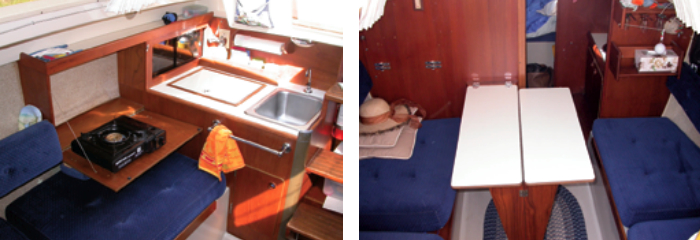
After descending the three wide teak steps into the cabin you find yourself with 5 feet 6 1/2 inches of headroom that slopes lower going forward. The overhead is molded fiberglass with a pebbled texture to its surface. At your feet is a teak-and-holly floorboard which lifts out for access to the shallow bilge. Behind the companionway ladder is the electrical panel and a small storage area. To starboard is a stainless sink and icebox combo. The self-draining icebox is a substantial 23 inches x 24 inches and 20 inches deep and is well lit by an overhead fixture. Also to starboard is a Plexiglas-fronted locker and a hinged panel that swings down to reveal the cookstove. The original equipment was a small alcohol stove that the Siegworths swapped out for a Kenyon butane stove. Water tankage is 15 gallons. The Siegworths have added an electric pressure pump.
Panels throughout the cabin are a teak-pattern laminate over plywood that gives the interior an air of quality and attention to detail. The original dark blue uncut-corduroy upholstery has held up well. The starboard settee is 5 feet 9 inches x 29 inches while the settee to port is 5 feet 8 inches x 30 inches and slides out to become a comfy 44-inch-wide berth. The port berth gains some sleeping length as it abuts the 6-foot 6-inch x 35-inch quarter berth. Storage abounds under both saloon settees and both have an upholstered back support that runs along the bottom edge of the fiddled bookshelf storage just below the sidedecks.
In the saloon, the table hinges down from the main bulkhead, and can be left half-folded to allow passage forward.
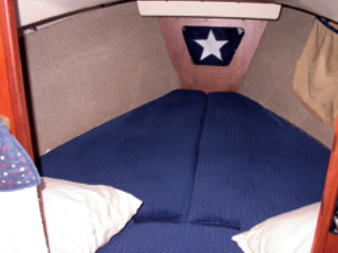
Original equipment included a chemical toilet in the head, but the Siegworths exchanged it for a composting toilet. The head has a privacy door, a vanity sink, and a storage area opposite to starboard. The V-berth forward is 6 feet wide, 5 feet 8 inches deep, and has a removable insert. In the cabin areas, the hull is lined with beige upholstery fabric.
Rig
The masthead rig is robust for a trailerable boat. The deck-stepped mast has a single set of spreaders, forestay, backstay, upper shrouds, and a single pair of lower shrouds.
Mast-mounted halyard winches did not come from the factory, but are often added. The mainsheet tackle includes a Harken traveler on the bridge deck, mid-boom blocks, and a cam cleat. Martha J. has roller furling on the jib and the Siegworths added the Dutchman sail-containment system to a new full-battened mainsail. Sail area is 278 square feet, giving the O’Day 26 a generous sail area/displacement ratio of 17.3. A large genoa is often carried and the boat sails quite well under genoa alone.
With a gin-pole, a trailer-mounted winch, and some innovations in temporary rigging, the Siegworths easily rig their O’Day in less than an hour — with minimal detachment of rigging. They transport the boom and mainsail on deck, leaving the cabin clean. The O’Day 26 can be launched at any ramp where there’s enough water to float it off the trailer. Bill says 4 feet at 30 feet from the water’s edge is minimum and 5 feet is good. The Siegworths’ boat, with trailer and gear, tips the scales at 7,700 pounds, which means they need a large vehicle for towing.
Let’s go sailing
I’ve sailed this boat many times with the Siegworths and with its previous owner. In fact, I’ve spent a lot of time on this boat and have often said, “I have dibs if you sell her.” For people who need to trailer their boat and still want the amenities of a “yacht,” few fit the bill like the O’Day 26. It has shoal-draft capabilities that will get it within wading distance of most shores and beaches, yet it’s heavy enough to take a bit of a pounding when the wind pipes up and the waves get steep. It makes its 6-knot theoretical hull speed and then some. In a good blow, it’ll top 7 knots. Under power, the 1-cylinder 8-hp Yanmar 1GM diesel with its two- bladed fixed prop pushes the boat over 7 knots as well. At lower cruising rpm it’s very economical — the Siegworths and previous owners have gone whole seasons and burned only a couple of gallons of diesel. The boat is rated for a 15-hp outboard that would be more than adequate power. The diesel option has a 14-gallon aluminum fuel tank below the cockpit.
Steering is modestly precise; the long keel stub provides good tracking, but does inhibit turning agility some. Coming about is a leisurely process. When the wind blows, weather helm is not pronounced as long as adequate headsails are carried and the main reefed. Even when a gust makes the boat suddenly over-canvassed, it remains controllable and has little tendency to round up, owing in part to its rather large rudder.
The centerboard is raised and lowered by means of a lightly loaded line in the cockpit footwell and can be easily adjusted to help balance the boat. Both owners I’ve sailed with often have not put it down — and it doesn’t really seem to affect handling much, although the one who is a racer says it helps with balance and other owners say it’s helpful in a blow.
The O’Day 26 is relatively stiff, though attention to weight trim is necessary to obtain top performance. Under genoa alone, the boat balances well on all points of sail.
The O’Day 26 is first and foremost a cruising boat. While light-air performance is adequate, it takes a bit of a breeze to really get it going. I’ve found it has a pleasant motion during most inland-lake sailing, but at times on Lake Michigan it’s been unable to blast through steep chop and the ride could get sloppy and uncomfortable. I would not consider this a “Lake Michigan boat” on any but the better days.
The New England PHRF ratings are 246 for the inboard version and 240 for the outboard model. For comparison, the Ericson 25 trailersailer rates 235 and the MacGregor 26 rates 222.
Conclusion
The O’Day 26 is truly an “average” cruising sailboat in all aspects of performance and handling.
With the small production run of 87 or so, O’Day 26s may be a bit hard to find but are well worth the search. Owning a trailerable boat of this size lets you enjoy the comfort and features of a keelboat while avoiding the cost of keeping it in a marina. You can also expand your sailing adventures to many faraway places.
Problem areas are few. A close inspection of the deck for core decay is necessary on any balsa-cored deck, and the usual chainplate areas should be examined too, but the O’Day 26 is not known for any inherent weakness in the deck. Hull blistering is reported infrequently. Some owners feel the stock tiller is weak and bendy and have upgraded to stiffer aftermarket tillers. Corrosion of the cylinder-head exhaust port caused by the raw-water cooling system is not uncommon with the 1GM diesel, and requires replacing the cylinder head.
An Internet search found prices ranging from a fixer-upper at $3,500 to a high of $15,900, though most are between $7,000 and $9,000, depending on condition and equipment.
In general, it’s worth buying the more expensive, doted on, always-well-maintained boat than the cheap fixer-upper. Most well-cared-for machines, be they airplanes, boats, or cars, seem to have a good karma that carries on to the next owner, ensuring good times and few hassles, while the poorly cared-for seem to endlessly suffer from one problem after another.
Allen Penticoff is a freelance writer, sailor, and longtime aviator. He has trailersailed on every Great Lake and on many inland waters and has had keelboat adventures on fresh and salt water. He presently owns three sailboats: an American 14.5, a MacGregor 26D, and a 1955 Beister 42-foot steel cutter that he’s restoring.
Thank you to Sailrite Enterprises, Inc., for providing free access to back issues of Good Old Boat through intellectual property rights. Sailrite.com