The alluring emanations of a seagoing home
Issue 107 : Mar/Apr 2016
At any auto parts store in the country, you can buy an aerosol can of New Car Smell. Have you ever seen a can of New Boat Smell at your local chandlery? No, you haven’t.
I remember walking the Southern California docks in my twenties, looking for my first sailboat, something I could live aboard and sail. My budget was small — the high four digits — but I found friendly brokers willing to give me their time and to share their knowledge. I must have boarded dozens of old boats during my search, at least a few in every marina between San Diego and Ventura.
Twenty years later, I don’t recall much about more than a couple of those boats, but I absolutely remember the smell of nearly all their cabins. But let me pause here. Smell isn’t the right term. What I’m remembering of these cabins is something pleasant. A scent that hit me when these boats were opened up, stuck with me, and came to represent the essence of a seagoing vessel, a scent inextricably linked to the promise of adventure and long-distance travel. Let’s call it . . . an olfactory experience.
Of course, some old boats reek of holding tank, fresh paint, mildew, or nasty bilge sludge. That’s not my thing. Rather, the bouquet I’m so fond of is probably a musty combination of salt water and old wood with subtle undertones of diesel. I know I’m romanticizing, but included in this aromatic tapestry must be some kind of magic. It’s strong aboard the 37-year-old boat my family and I sail today. When I return after she’s been closed up for a while, going below always brings a smile to my face.
Reminiscent redolence
I’m not alone. I’ve talked to others who share my appreciation for the particular nautical aroma of an old boat’s cabin. I’ve read of sailors who pull a book off the shelf at home, only to have the pages waft the smell of the old boat that book was carried aboard, bringing them back on board even while sitting in an armchair far from the sea in the dead of winter.
New boats don’t have it. Their fiberglass and fabrics are still off-gassing. They’ve not been lived in, no salt water has come below, no diesel has ever spilled, they’ve not aged. Savvy yacht builders and brokers might think about formulating an Old Boat Smell, a can of something they could use to freshen up the new models for the boat shows.
I suspect it would increase sales.
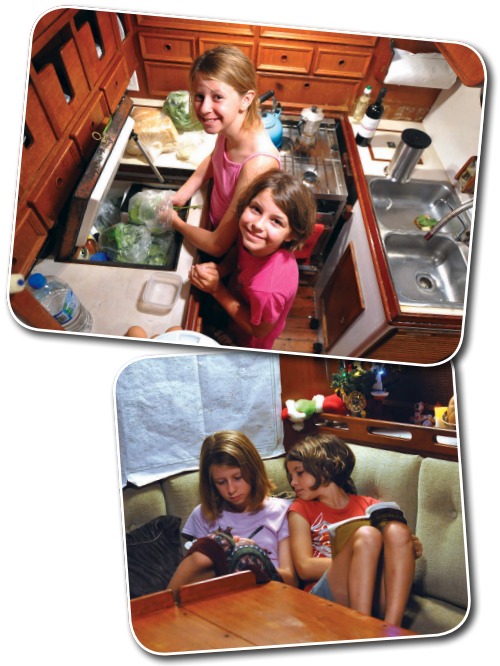
Michael Robertson and his wife, Windy, bought a cruising sailboat in Mexico, sold their Washington, D.C., home, and dropped out of their high-pressure lives in 2011 to voyage with their two daughters, Eleanor (12), above, and Frances (9). They’re currently aboard their Fuji 40, Del Viento, in Tonga. Michael is a coauthor with Behan Gifford and Sara Johnson of Voyaging with Kids (L&L Pardey Publications). Catch up with the Robertsons at www.logofdelviento.blogspot.com.
Thank you to Sailrite Enterprises, Inc., for providing free access to back issues of Good Old Boat through intellectual property rights. Sailrite.com