A go-anywhere cruiser from Hallberg-Rassy
Issue 59 : Mar/Apr 2008
Angus Phillips, the long-time outdoor writer for the Washington Post and an avid, all-around Chesapeake Bay waterman, is what one might call a serial collector of good old boats. In October, 2006, his personal fleet included an ancient 22-foot wood and fiberglass crabbing boat called Clarence S, a Capri 25 racing sloop named Red Stripe, a 1964 Boston Whaler known as Flying Tide, and a 15-foot 6-inch plywood and glass skiff with the handle Ida Claire. Rounding out the collection were a Grumman 17-foot canoe and a 13-foot white water kayak, both of which somehow remained nameless.
Was there something missing? Yes, there was: a cruising sailboat.
So when he first cast his eyes upon the “For Sale” sign affixed to the 31-foot Mongoose 2, even though it had obviously been neglected for a while and was full of leaves and twigs, his heart went a-twitter. Clearly, the full-keel vessel was robust and had good lines. But . . . another boat? He made an offer of $13,500 and was actually quite relieved when it was turned down. The boat languished on the market, however, and soon Mongoose’s owner called with that most fateful of questions: “What will it take to get you in this boat?”
The second offer was a cautious 10 grand, but Angus was still nervous about taking the plunge. So before any cash changed hands, he hired Fred Hecklinger, a local marine surveyor in his hometown of Annapolis, Maryland, who he knew to be a stickler for detail. He practically pleaded with him to find something that might squash the deal. “Don’t worry, Angus,” said Fred. “I won’t be wearing any rose-colored glasses.”
On the day of the survey, Fred got to the yard early and had already given the boat a good once-over by the time Angus arrived. Once there, Angus asked Fred what he thought. His answer was short, sweet, and emphatic.
“Buy it!” he said.
Background
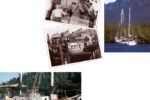
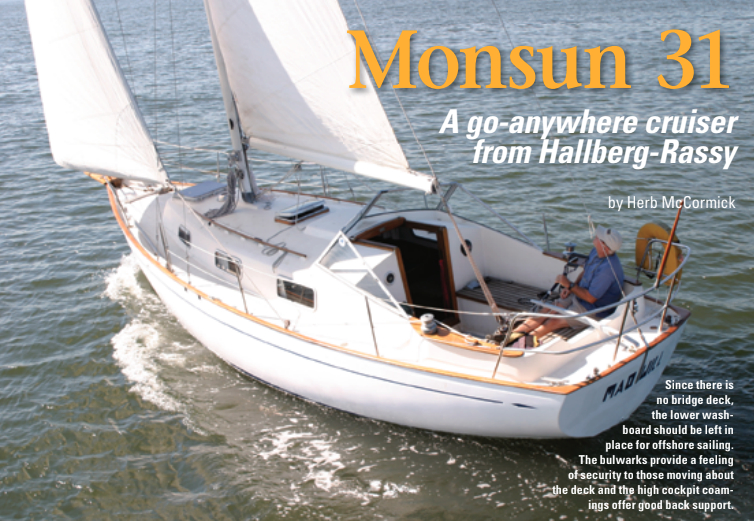
What Angus purchased was hull #42 of Hallberg-Rassy’s Monsun 31 line, one of 904 units built in a production run that lasted from 1974 to 1982. He promptly renamed it Mad Will, after his children, Madeleine and Willy. In terms of numbers sold, the Monsun is the most popular boat ever created by the renowned Swedish builder. But make no mistake: even though the boat needed a lot of work, Angus got a bargain. A surf through the used-boat offerings on the Internet last fall revealed several Monsun 31s on the market, ranging from $19,000 for a listing in Wisconsin, to a pair of ads in Northern California and Chicago, respectively, with asking prices of $38,000.
The Monsun 31 has an excellent pedigree. The late Swedish naval architect Olle Enderlein, who was responsible for many of the early Hallberg-Rassys, was its creator. Enderlein also drew an elongated version of the 31 called the Rasmus 35, one of which is owned by author Jonathan Raban and played a prominent role in his terrific book about his Inside Passage trip from Seattle to Alaska, Passage to Juneau.
As a long-range cruiser, however, the Monsun 31 can rest on its own laurels. In a nearly stock model, with the noted addition of a hard-top dodger, Swedish sailor Kurt Bjorkland rounded Cape Horn and completed three-and- a-half circumnavigations in the 1970s and 1980s aboard a staunch Monsun named Golden Lady, which is now a museum piece in the south of Sweden. And far-ranging American sailor John Neale — who currently sails an HR 46 called Mahina Tiare III that he uses to conduct offshore training clinics and expeditions — previously owned a Monsun 31 of the same name, aboard which he logged tens of thousands of miles rambling across the South Pacific.
Design
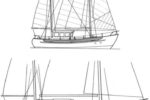
The profile of the boat shows a subtle sheer giving way to a classic wine-glass transom, all of which flows nicely with the low-profile coachroof and the signature Hallberg-Rassy windshield just forward of the cockpit — yes, it goes back nearly 35 years — that’s fashioned of heat-treated glass in an alloy frame. Overall, the decades have not at all diminished the appeal of the boat’s straightforward, but pleasing, lines.
Below the waterline, the Monsun has a full keel with a cutaway forefoot to improve maneuverability. The three-bladed propeller is nestled in an aperture at the interface of the keel and attached rudder. The internal ballast is iron, while the rudder is a glass-encased bronze casting; the rudder fittings are bronze as well. One potential trouble spot is the rudder’s leading edge, which on some boats has fatigued due to wear and aging.
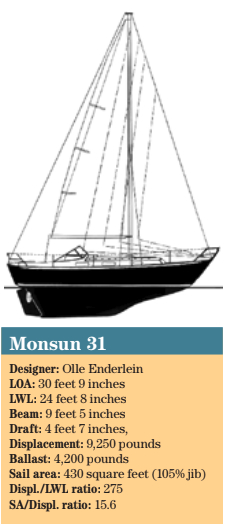
The Monsun is moderately proportioned in terms of waterline length, beam, displacement, and rig. Its displacement/length ratio is 275, heavy enough for ocean work, but not so much as to make it a slug. The sail area/displacement ratio comes in at 15.6, which is hardly high performance, but just about right for offshore sailing.
Construction
The Monsun 31 is built like the proverbial brick outhouse, with a solid, massive fiberglass hull laid up to Lloyds’ specifications and a deck and cabin trunk fashioned of a composite sandwich of glass and what Hallberg-Rassy described as a “polyvinyl cellular plastic” core. By whatever name, some 30-odd years down the road, the molded decks of hull #42, with integrated non-skid, remain stiff and sturdy.
The hull-to-deck joint is an overlapping fiberglass laminate topped by a pronounced glass bulwark and capped by a substantial teak rail. In fact, there’s teak everywhere, from the companionway frame to the hatchboards to the grabrails to the cleats, as well as in the cockpit seats and sole.
All internal bulkheads are glassed to the hull, including the reinforced main bulkhead that serves double-duty as the internal compression point for the deck-stepped mast. The mahogany interior is simply rendered, well crafted, and quite fetching. The cabin sole is no-nonsense fiberglass.
Accommodations
There’s nothing at all surprising about the interior layout of the Monsun 31, which originally came garnished with wall-to-wall carpeting, though Angus jettisoned every last bit soon after buying his boat. The forward cabin houses a 6-foot 7-inch-long V-berth, which serves as a very comfortable double bed once the drop-in insert is installed. There’s shelving above and good storage, as well as the water tank, beneath. Just aft is the head compartment, which can be closed off for privacy with a folding door. A hanging locker is opposite the head.
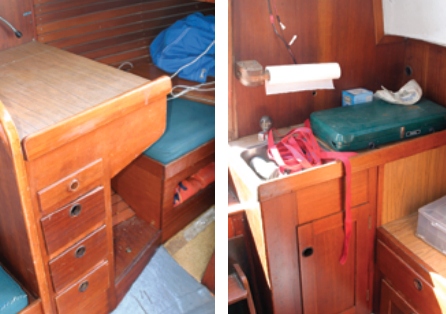
The central cabin features an L-shaped settee to port and a straight settee to starboard, each of which also measures 6 feet 7 inches. The boat originally came with a simple dinette between the two that could drop down to form a second double berth, a piece of furniture that currently resides in the garage. At the base of the companionway, the galley space is to port, an area Angus has yet to address. It is surprisingly small and, by contemporary standards, seems inadequate for a boat of this size. The forward-facing nav station, containing a series of handy built-in drawers, is to starboard. Just aft is a snug single bunk that doubles as the navigator’s seat; it would serve as an excellent seaberth when underway.
The engine compartment, behind the companionway, is home to the 23-hp Volvo Penta MD 11C diesel, which represents the single biggest expense Angus has incurred since buying the boat: a $5,500 bill to have the beast pulled and rebuilt.
Deck layout
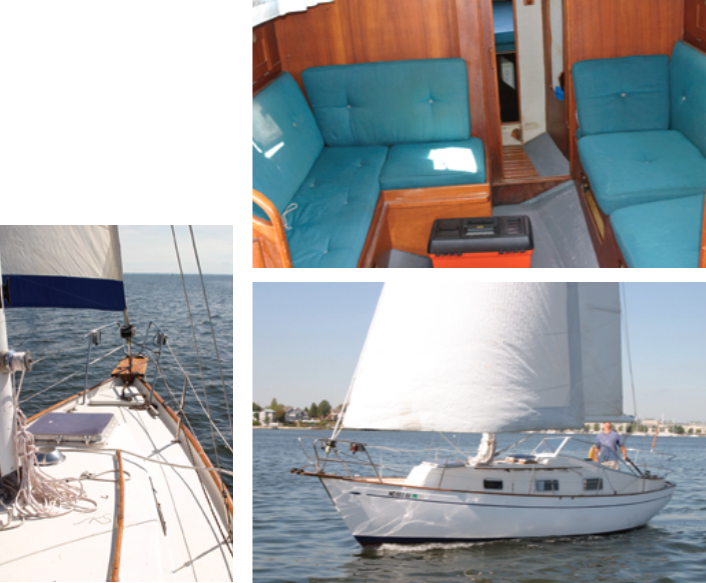
Starting at the bow, the Monsun 31 sports a staunch teak bowsprit with a pair of anchor rollers and the deck attachment for the forestay, which the previous owner retrofitted with a Profurl headsail-furling system. The good-sized anchor locker is just aft. The boat was originally equipped with wire halyards for the mainsail and the jib. Both are handled by a pair of winches on the mast; Angus replaced them with braided line, a change that also required new masthead sheaves.
Mad Will is still equipped with the standard rotating boom furler for mainsail reefing. Though Angus has experienced no problems with it, the device has been troublesome for other owners, and if one were contemplating any sort of extended offshore work, it would probably be wise to switch to a conventional boom with a fixed gooseneck and jiffy reefing. Selden <http://www.seldenmast.com> is one source for a new Monsun boom.
The deep cockpit is self-draining via a pair of 1 1⁄2-inch scuppers. Mad Will was affixed with a hydraulic wheel- steering system on a pedestal that leaked and required constant attention. Angus tired of it quickly and replaced it with a tiller and an extension, which he greatly prefers and believes is more appropriate on a 31-footer. The mainsheet and traveler are mounted on a beam just forward of the helmsman. The Lewmar 40 primary winches are also an arm’s length away, making the boat extremely simple to singlehand.
Performance
Angus invited me for a sail aboard Mad Will on a beautiful, but extremely light and shifty, afternoon last fall on Chesapeake Bay. To be honest, I wasn’t expecting much, but when the breeze puffed up into the 6- to 8-knot range, I was very pleasantly surprised. Close-hauled, the Monsun leaned nicely into the breeze and trucked along assuredly. As with most long-keeled craft, once she’d gathered a bit of momentum, the motion was extremely steady and self-perpetuating, as the boat began creating its own apparent breeze. The helm was light and easy, and steering from the cockpit coaming, via the tiller extension, was a true pleasure.
For his part, Angus was equally skeptical on his inaugural shakedown sail. “I was absolutely astonished the first time we took her out,” he said. “I didn’t think she’d sail a lick. But she moves in mysterious ways.”
Off the wind, unfortunately, we really didn’t have enough pressure to put the boat through its paces. But given its light-air performance, it’s reasonable to believe that the boat would do just fine in moderate- to heavy-air.
The New England PHRF association has assigned the Monsun 31 a rating of 201. For comparison purposes, it’s interesting to note other vessels with the same number, a list that includes the C&C 27, the O’Day 27 and 32, the Islander 28, the Chesapeake 32, the Chinook 34, the Ohlson 35 yawl, the Alberg 35, and the Cheoy Lee Luders 36. In performance terms, this would suggest that the Monsun is very much down the middle of the road which, for a small offshore cruiser, is precisely where you’d want it to be.
Summing-up
As Angus readily admits, Mad Will is a work in progress. He’s ordered a new mainsail for the boat and will be purchasing a new asymmetric cruising chute for downwind sailing. The interior needs a lot of cosmetic work, as well as new cushions and a galley stove. The wiring is a mess, as is the electrical panel, both of which need to be addressed from scratch. He’s shopping for an autopilot, a GPS, and VHF radio. For now, he’s happy to potter about the Chesapeake, but ultimately he wants to head for New England and Canada. With all the upgrades he’s planning, he certainly has the platform to take him there.
He also has the proper attitude. “I really do believe older boats are an incredible bargain,” he said. “Ninety percent of people are nervous about working on them. The truth of the matter is, any idiot can. It’s just a matter of crawling into dark and dirty corners you’d usually avoid. No one wants to do those jobs. But when you’re done, you really know your boat. It’s a very satisfying feeling.”
When our day of sailing was done, we dropped the sails and Angus started the engine for the return trip to the dock. The Volvo was purring along when the judges for Sailing World’s Boat of the Year contest came idling up in a big RIB. They’d been sailing the latest Grand Prix racers all day, and they no doubt thought we looked cute and quaint in our ancient 31-footer. But Angus couldn’t help himself. “Now here’s your Boat of the Year!” he hollered, and they all laughed.
They were out of earshot, however, when he added a postscript: “The year, of course, is 1974.” True enough, I suppose, but the Monsun 31 has all the makings of a timeless winner.
Herb McCormick is a career sailing writer and editor whose work has appeared in magazines and newspapers around the globe. He’s the former editor of Cruising World and has been the sailing correspondent for the New York Times. He’s a long-time sailor whose voyages have taken him from Antarctica to Alaska, with plenty of stops in between.
Thank you to Sailrite Enterprises, Inc., for providing free access to back issues of Good Old Boat through intellectual property rights. Sailrite.com