Coastal cruising with sprightly performance
Issue 52: Jan/Feb 2007
WHILE TED IRWIN’S STOCK-IN-TRADE was the large center-cockpit cruiser, often for the Caribbean charter trade, he also dabbled with smaller boats, targeting the individual sailor/owner. In 1978, his Irwin Yacht and Marine Corporation began marketing a line of performance cruisers called the Citation series. Included in this initial offering were the Citations 30, 34, and 39. With these three boats selling reasonably well, Ted gradually began introducing other models into the line. Over its 11-year history, the number of Citation series models fluctuated between three and four, with their lengths ranging from 30 to 41 feet.
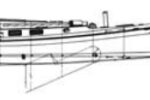
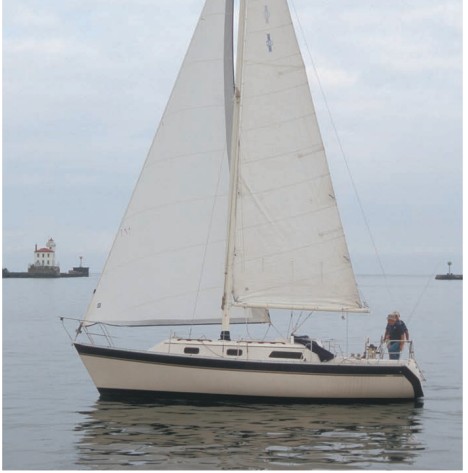
The Citation 31 was introduced in 1982 at the height of the series and was in production through 1985. The Citation 31 is a good example of a 1980’s racer/cruiser. The boat is a fairly high-sided and short-ended yacht with a straight stem and a nearly flat sheer. The dark, wide cove stripe minimizes the topside’s height, makes the sheerline appear higher at the bow, and takes a distinctive sharp down-turn aft to follow the reverse transom.
The cabin trunk is traditional looking and quite low. The cockpit coamings gracefully taper aft from the dodger molding to the transom.
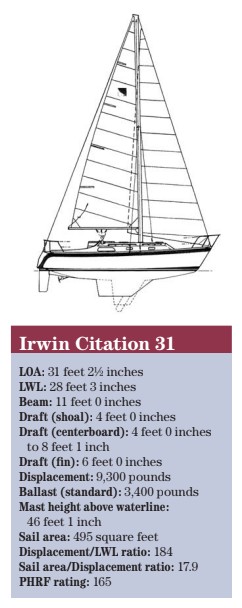
Three keel configurations were offered: shoal, stub keel with centerboard, and a deep fin keel. The latter offers the best upwind performance, as there’s more foil to generate lift. The flip side, of course, is the inability to venture into shallow water. The rudder is mounted on a shallow skeg.
The displacement/waterline length ratio is 184, which is moderately light. Coupled with its generous 17.9 sail area/displacement ratio, the boat is a reasonably lively performer.
Construction
The Citation 31’s hull is hand-laminated with polyester resin and alternating layers of glass mat and 24-ounce woven roving. Above the waterline, the hull is cored with Coremat. This stiffens the laminate and provides added insulation. Coremat consists of non-woven polyester fibers and microspheres held together by a styrene-soluble binder. It adds bulk and strength and weighs less than conventional fiberglass materials. It also saved the company a substantial amount of time in building the hull.
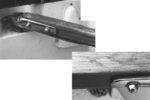
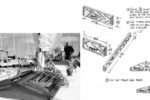
The horizontal deck surfaces are molded with a contrasting color non-skid pattern and are also cored with Coremat. In the areas beneath winches and major hardware, however, it was removed in favor of plywood, which has better compressive strength. The hull-to-deck joint is an inward-facing flange. The deck is set down on this flange, where it is chemically bonded with an adhesive and mechanically fastened with stainless-steel sheet metal screws on 6-inch centers (see sketch below). The fact that these sheet metal screws are not secured with nuts should be a concern to owners of these boats. Completing the assembly, the slotted aluminum toerail is screwed into place, both through the hull-to-deck joint and through the hull itself, 1 inch below the sheer.
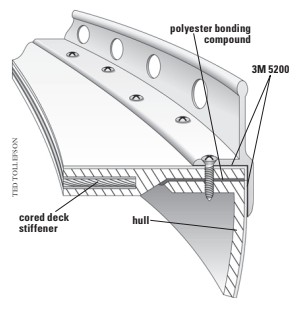
An interior fiberglass pan adds structural strength and stiffness. This fabricated grid not only forms the foundations of nearly all furniture, but also takes the place of stringers and some bulkheads, by supporting the hull in key areas. The main bulkheads are teak-veneered plywood, tabbed with fiberglass strips to the hull and the deck. Deck fittings are of average quality and are through-bolted with aluminum backing plates. The chain-plates are laminated into the hull with unidirectional fiberglass.
As noted, the Citation 31 came with a shoal-draft keel as standard. Two options — a deep-fin keel or a centerboard — were available. The spade rudder is mounted well aft and wheel steering was standard.
Deck features
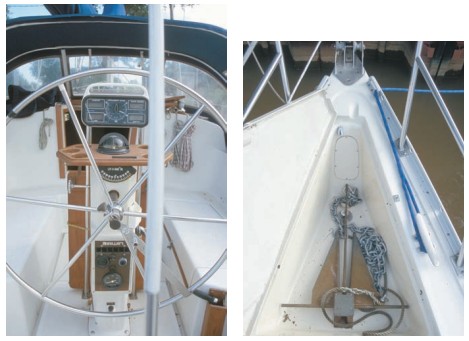
The stemhead fitting incorporates two anchor rollers. There’s also an anchor locker in the foredeck with a deck pipe leading to a chain locker below. The sidedecks are reasonably wide, the headsail tracks are recessed, and all footing surfaces are patterned in non-skid. There are four sections of teak handrails, dual lifelines connected to stainless-steel bow and stern pulpits, and a slotted aluminum toerail. On the cabintop there’s a large forward hatch, a smaller one aft of the mast, and a sea hood. Mounted on each side of the cabin trunk are two opening portlights forward and a single large fixed portlight or deadlight aft.
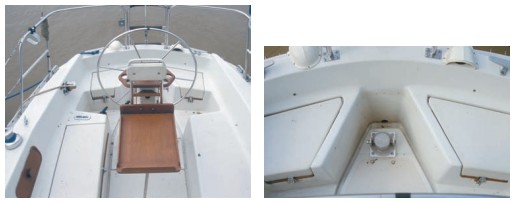
The cockpit is T-shaped and roomy. The coamings are properly sloped and average 12 inches high. Don’t sit in front of the coaming cubbyholes, however, unless their covers are removed. The large knobs on the covers will line up with the small of your back. For additional stowage, there’s a deep locker beneath the starboard seat and a pair of lockers flanking the helmsman’s seat. The one to starboard is designed to house a propane tank. A portion of the cockpit sole is removable and allows access to the engine, the stuffing box and shaft, and the hot water tank. Beneath the helmsman’s seat is the fitting for the emergency tiller. Completing the picture are the Irwin-designed/fabricated steering pedestal, a bridge deck, and a single 2-inch scupper.
All exterior wood is teak: handrails, accent strips above the portlights, and trim on the lockers and around the companionway.
Belowdecks
The interior is white and bright. The V-berth is an exception. All of its surroundings, except for the bureau to starboard and the aft bulkhead, are covered in teak. Even with the overhead hatch, an opening portlight to starboard, and a pair of reading lights, the forward cabin is cave-like.
The V-berth with insert measures 78 inches deep and 69 inches at its widest. Forward and above is a large shelf and beneath are six drawers and the polyethylene holding tank. A four-drawer bureau and a hanging locker offer additional stowage. The head compartment with its inboard-facing door is directly across from the bureau and hanging locker. This arrangement allows for standing headroom and space to change clothes. There’s a solid wooden door separating the V-berth and head from the saloon.
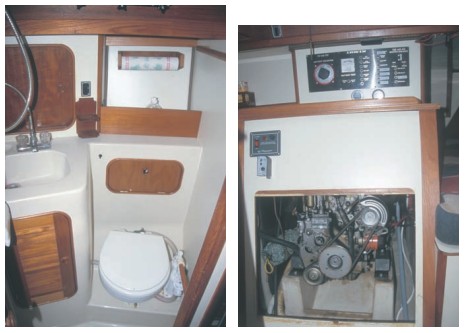
The one-piece fiberglass head compartment offers hot and cold pressurized water and is set up for a handheld shower that drains into the bilge. Natural illumination and ventilation are provided by an opening portlight. While fully adequate, the compartment seems a bit small, given the size of the boat, even with its wooden bi-fold door open.
In the saloon are opposing settees and a folding table mounted to the port bulkhead. The 30-gallon aluminum fuel tank is situated beneath the starboard settee, while the potable water tank is housed under the port settee. The settees are 75 inches long and 26 inches deep. As berths, the starboard is fixed, while the port converts to a pullout double. Because the settee bases are used for tankage, stowage is limited to the areas behind the settees. Smoked acrylic or wooden louvered doors cover these lockers. An overhead hatch, a pair of opening portlights, and the large deadlights provide the saloon with light and ventilation. Two fluorescent fixtures provide the artificial light. Flanking the overhead hatch is a short pair of wooden grabrails. The vinyl headliner is zippered in strategic places and is trimmed and battened with teak. The sole is teak and holly.
By locating the companionway steps slightly off-center and to port, Irwin has provided the starboard U-shaped galley with valuable extra inches. As a result, there is plenty of room for a large, deep stainless-steel sink to be placed almost on the boat’s centerline. Outboard is a gimbaled, two-burner Kenyon stove with oven, and aft of it a top-loading icebox. Hot and cold pressurized water, reasonable counter space, and numerous lockers, bins, and cubbies make for a usable galley.
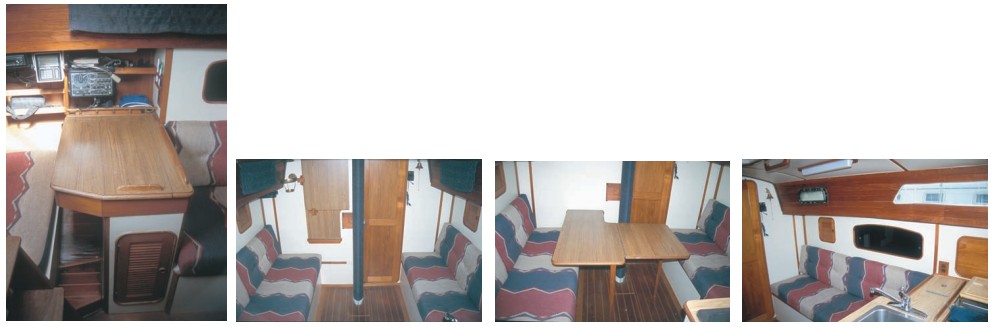
Space given to the galley was taken away from the forward-facing navigation station on the port side. However, nothing seems to have been lost. The lift-top chart table is ample and the shelving and outboard bins are adequate. There seems to be plenty of foot room for those sitting at the chart table and for anyone getting into the quarter berth, which is located just aft of the navigation station. As is often the case, the head of the quarter berth functions as the chart table’s seat. The quarter berth is 77 inches long and 36 inches wide. Beneath it is some stowage and the boat’s batteries.
In addition to the companionway and the large deadlights, the galley and navigation station receive light from a pair of fluorescent fixtures.
The rig
Like almost everything on an Irwin, the rig was made in-house and is considered to be adequately built. The mast has a single set of spreaders and is stepped on the keel. Both the mast and boom are aluminum extrusions painted white with Imron. Standing rigging is 1⁄4-inch stainless-steel wire and consists of a headstay, baby stay, a pair of cap shrouds, a pair of lower shrouds, and a single backstay. Changing from a single to a split backstay would be a significant improvement. The single backstay not only causes problems when using the centerline swim ladder, but also is angled in such a way that it significantly interferes with the helmsman. A helmsman who approaches 6 feet or taller is particularly inconvenienced.
The Citation 31 is a masthead sloop with a total sail area of 495 square feet — a 222-square-foot mainsail and a 273-square foot foretriangle. The main and jib halyards, the topping lift, and the lines for jiffy reefing run inside their spars. The halyards, as well as the mainsheet, are led to a starboard Barlow #16 winch, mounted aft on the cabintop. A series of line stoppers allows this winch to serve them all. The mainsail is sheeted mid-boom to a traveler on the cabintop. The sheets for the headsail are led through cars and tracks on the side decks and run aft to two-speed Barlow #23 winches mounted on the port and starboard cockpit coamings.
The Citation 31’s auxiliary is a freshwater-cooled 15-hp Yanmar diesel. The engine is coupled to a transmission with a 2.5:1 reduction ratio that turns a two-bladed propeller. Access to the engine is excellent from behind the companionway stairs and through a removable panel in the cockpit sole.
Under way
Generally, the Citation 31 performs up to the builder’s claims and expectations. As far as speed is concerned, it falls right in with other racer/cruisers of that era. Typical PHRF numbers for the Citation 31 with standard keel are around 165 seconds per mile. A Pearson 31 rates about 180, and a Cal 31 about 162.
It’s a reasonably comfortable and dry boat. The helm is responsive and easily balanced. While the shoal keel version doesn’t point quite as high as the fin keel version or even the centerboarder, it will make good passages, especially off the wind.
Under power, the boat handles well when going forward. Reverse is another matter entirely. Significant prop walk to port makes it difficult to back down in a straight line. This condition can be minimized with experience. The 15-hp Yanmar, while adequate in most instances, is a bit undersized. A few more horses would help the boat punch through rough seas.
Things to check out
Several owners report leaks around portlights, the overhead hatches, the engine hatch in the cockpit, and the hull-to-deck joint.
Severe groundings can damage the fiberglass keel mold and allow water intrusion and delamination.
The single backstay interferes with the helmsman and hampers the use of the swim ladder. Other items include: gate valves as seacocks, an undersized cockpit scupper, an Irwin-designed/fabricated steering pedestal, and a shower that drains to the bilge.
Conclusion
While not a bluewater cruiser or club racer, the Irwin Citation 31 makes a good coastal cruiser. Unfortunately, it suffers from some corner cutting. Its interior is above average for a production boat. A main drawback is that stowage is minimal, with tankage occupying the space below settees. Expect to pay $14,000 to $29,000, depending upon year, condition, and equipment.
Ted Irwin’s career
Ted Irwin was just seven years old when his family moved to Florida’s Tampa Bay area. This move kindled his interest in everything associated with sailboats: designing, building, and racing. At 15 he was building boats of his own design in his backyard, and at 21 he landed a job with builder and designer Charlie Morgan. At Morgan Yachts, Ted honed his skills as a draftsman, illustrator, and builder.
After a stint with the U.S. Coast Guard, Ted started his own boatbuilding business. In 1963, in a $75-a-month Quonset hut located on St. Petersburg Beach, he built his first boat, a 31-footer named Voodoo. Ted raced Voodoo from 1964 to 1966 and won 24 out of 28 races. This astounding record launched his career. Other successes, in the form of racing yachts, quickly followed: Black Magic, La Pantera, Razzle Dazzle, and R2D2.
Ted quickly took advantage of these successes as well as the knowledge he had gained in building high-tech racing yachts. In 1966 he incorporated as Irwin Yacht and Marine Corp. and moved to Clearwater, Florida. The original plant was 12,500 square feet. It soon grew to 75,000 square feet, employing more than 200 workers. Ted was a prolific designer and had as many as 15 models in production at one time. Irwin Yachts became one of the largest production sailboat companies.
In the beginning, Ted designed and marketed the Irwin 24, 27, 31, and 37. Gradually, the size of the boats increased and the plant began concentrating on center-cockpit models in the 50- to 60-foot range, designed and marketed for the crewed and bareboat charter business.
Despite numerous successes, Ted was forced to fi le for protection from his creditors under the federal bankruptcy code more than once. Each time he re-emerged with the company name slightly altered. Around 1991 money troubles closed the company’s doors for good.
All through the years, the Irwin philosophy was simple: build a good boat for the money, one that is stylish, fast, stable, and comfortable. Even though his boats are generally regarded as lightly built and unsuitable for the rigors of offshore work — for which they were seemingly marketed — more than 6,000 were produced. It should also be noted that Irwin built more cruising sailboats measuring over 50 feet than any other builder in the world.
Thank you to Sailrite Enterprises, Inc., for providing free access to back issues of Good Old Boat through intellectual property rights. Sailrite.com