Examining the pros and cons of four different boats
Issue 55 : Jul/Aug 2007
This is a very unusual comparison, as these four boats have all been owned by Warren Milberg at different times. It would be interesting to know if he agrees with my assessment or, rather, how much he disagrees.
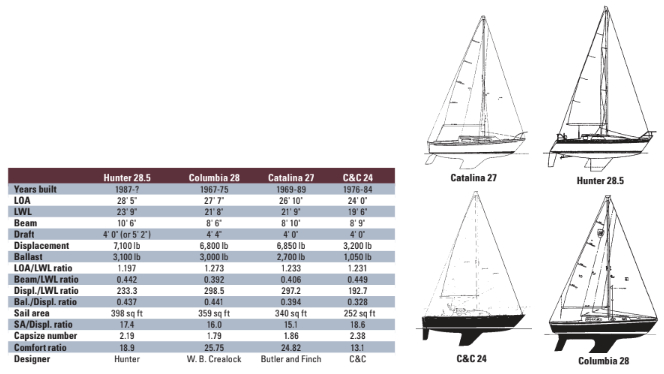
It is obvious from the capsize numbers that neither the Hunter nor the C&C was designed to be a bluewater cruiser. The beamy C&C 24, with its super-light displacement and very modest ballast ratio, is definitely an inshore boat. Its capsize number is about the highest I’ve ever seen. This can make a boat exciting and fun to sail until the weather turns foul; then it’s time to head for the nearest harbor. The Hunter is not far from the C&C in beam/LWL ratio and is also of fairly light displacement, so its capsize number suffers as a result. Its extra displacement and considerably higher bal- last ratio will provide some assurance when the weather pipes up. Still, both of these boats are inshore cruisers.
The Columbia and Catalina are considerably more able, due to their good displacement and moderate beam, both of which contribute to reassuring capsize numbers. Although neither was intended as a weather-be-damned world voyager, both were given good ballast ratios and should be quite capable of coastwise passages and reasonable bluewater voyaging.
Motion comfort and the capsize number seem to go hand in hand, as narrower beam and heavier displacement improve both figures. So it is obvious that the Catalina and Columbia will have the easiest motion in a seaway. The Hunter will be quite a bit bouncier, as its wide beam could contribute to a snappy roll in leftover beam seas when the wind lightens. The C&C 24 will bounce around in a leftover chop like a cork in a bathtub. Bear in mind, though, that all boats will behave more comfortably under sail in a decent breeze as the wind pressure tends to steady and slow the motion.
As to performance, the C&C 24 would be a grand little boat for club racing. Its very light displacement, wide beam for stability in medium air, and a high sail area/displacement ratio all add up to speed. Indeed, it would not surprise me at all if the boat could get up to semi-planing and even planing speeds under spinnaker in a good breeze. The Hunter will not be a slouch either, with its generous sail area, light displacement, and long waterline. However, a skipper keen on windward performance would be wise to look for a 28.5 with the optional 5-foot 2-inch draft fin if he doesn’t sail in waters where the bottom is close to the top. The Catalina and Columbia will be fairly well matched, but their more moderate sail area will count against them until the breeze picks up.
My vote goes to the Columbia 28 due to its general characteristics and keel-stepped rig. I’ll be interested in learning how Warren rates them.
Thank you to Sailrite Enterprises, Inc., for providing free access to back issues of Good Old Boat through intellectual property rights. Sailrite.com