It takes fortune, fortitude, and a well-stocked pickup truck
Issue 80 : Sept/Oct 2011
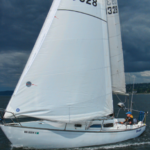
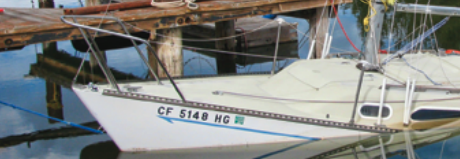
My friend Tony, who owns a nice Ranger 23, called one day last spring to say he had a problem with his boat. He asked if I would please come down to the marina and have a look. A really sad sight greeted me on my arrival.
As we chatted, he told me he had docked the boat where we sail on Lake Tahoe the previous fall and had not revisited it until April 14. In the meantime, Lake Tahoe experienced one of the 10 most severe winters on record. Apparently, snow piled up on the boat until its weight forced the cockpit scuppers to work in reverse and fill the boat with water.
“OK,” we asked each other, “What do we do now? Give up and call in the pros to put airbags under it and send you a bill for two grand?” That was not an option for these two sailors, one old geezer and one younger guy. Instead, I went home and loaded up the truck with equipment.
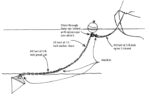
We were fortunate that the boat was right next to a pier with substantial 12-inch posts that could be used as anchors. We attached a pair of come-alongs to one of these posts and hooked them onto the toerails close to the primary winches, where the fastenings were most likely to be the strongest. Next, we rigged a five-part block and tackle to the spinnaker halyard to provide forward lift, taking advantage of the leverage provided by the mast and the fact that the keel was resting on the bottom. Now came the part that required some critical judgment. We had to be sure we didn’t allow the come-alongs to pull the toerails right out of the boat!
Up she rises
Knowing what forces can be expected when a spinnaker fills in a gust of wind, I was not particularly worried about my five-part block on that purchase. So with patience and perseverance, we slowly brought the stern up until the cockpit coamings were above the waterline. We then put two sump pumps (the type used in basements) to work in the forward cabin. It helped that the hatchboards were tight.
A 5-gallon bucket can move water a lot faster than a sump pump, so Tony went to work in the cockpit area, only to discover that the cockpit drains were allowing water to enter almost as fast as he could toss it overboard with a bucket. The solution to that problem was easy: two kitchen sponges weighted down with ingots of lead. Everybody has those items “at the ready,” right?
With more patience and perseverance, and by taking up on the two come-alongs and the spinnaker rig as needed for this balancing act, we had the boat fl oating within an hour. After a sinking, of course, that’s not really the end of the story. First the engine required attention after being under water for about four months, and we needed a pressure pump to clean up the interior.
I left Tony (he’s the younger guy) to take care of those jobs while I went sailing and contemplated what to do about the other Ranger 23 that sank 6 feet straight down nearby at the same dock.
All in all, this was a very satisfying project.
Jim Hildinger has been sailing on Lake Tahoe for 51 years, first in an O’Day Tempest 23, Rubato, then on his Catalina 27, Cadenza. He was president of the International Catalina 27/270 Association for a few years and remains active in the national organization. Although technically, at 80, Jim’s an old geezer, his passion for helping other sailors has not diminished.
Thank you to Sailrite Enterprises, Inc., for providing free access to back issues of Good Old Boat through intellectual property rights. Sailrite.com