An automatic bilge pump for the dinghy solves that sinking feeling.
Issue 129: Nov/Dec 2019
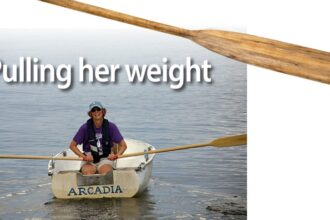
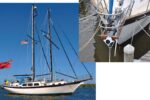
For the past couple of years, I’ve kept my dinghy at the dock, butter side up. It’s easy to stow it and use it this way, unless it rains. An inch of rain results in foot-deep water inside the dink. Arriving at the boat one morning after a tropical deluge, I found my dinghy barely afloat, just inches of freeboard remaining. After scooping 100 1-gallon Clorox bottles’ worth of water, I came up with a better plan for the next rain.
I dug up a spare automatic bilge pump, one that claims to pump 650 gallons an hour while drawing 3 amps. Because the mothership has three solar panels feeding two group-27 batteries, I wasn’t concerned about power supply.
To work automatically, the pump periodically turns itself on and senses for resistance (something to pump). If it detects resistance, as it would when pumping water, the pump continues running until the resistance ends (no more water to pump). A check valve keeps water in the hose from back-filling. The check valve unscrews, so if it clogs, it’s easy to clear.
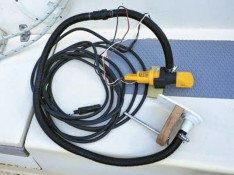
To complete my dinghy bilge pump, I bought 5 feet of ¾-inch hose, a through-hull fitting, a ¾-inch check valve, 25 feet of #14 3-wire appliance cable, and a cigarette-lighter-type 12-volt receptacle. A little solder, heat-shrink tape, electrical tape, and liquid tape (very important, that) and I had what I needed.
Whereas most 12-volt appliances feature two leads, red for positive and black for negative, my bilge pump has three leads attached: a black wire for negative, brown for the auto-on feature, and white to turn the pump on manually. I choose to ignore the white wire and the manual-on functionality, but I connected it to the unused wire on the 14-3 appliance cord to add mechanical strength to the assembly. I’ll note that the appliance cord I used is made of stranded wire. Only stranded wire should be used aboard boats, never solid. Not only does stranded wire conduct electricity with less resistance, it isn’t as susceptible to work hardening as solid wire, which is approved only for use in buildings.
I long ago learned the importance of soldering connections, from an uncle who had been a ship’s radio officer. My approach with all onboard connections is to solder them up carefully, wait until the solder cools, then slide the heat shrink over the joint after it cools. Next, I use the hot soldering iron to carefully tack down the heat shrink before holding the connection over a hot electric stove burner to get the whole fitting snugged up tight. After that, I paint the joint with liquid tape. Then I wrap all the coated wires with a single wrap of ordinary electrical tape and paint over that with another coat of liquid tape, especially at the ends. The object is to keep the water out, and the extra coat of liquid tape can’t hurt.
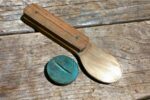
As the pump needs a base to keep it from capsizing in the dink, I dug up a scrap piece of heavier-than-water G10.
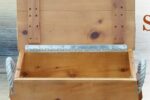
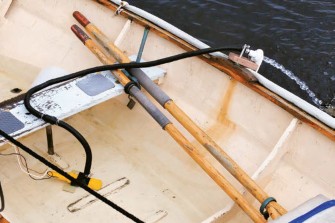
For the output end of the hose, to which I attached the through-hull fitting, I made an assembly comprised of scrap heavy-density plastic, a chunk of walnut, and a bit of 5⁄16 stainless steel rod left over from another job. I mounted the through-hull to the heavy-density plastic, screwed the plastic into the walnut as a base, and bore a hole through the walnut to hold the stainless steel rod. The rod then slides into the hole where the oarlock would ordinarily fit, holding the entire assembly in perfect position for the through-hull to hang over the side and the water to go overboard.
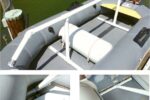
I keep the dinghy lashed along- side the big boat at the dock. I drop the pump into the dink when I leave, making sure the hose outflow is correctly fitted in one of the oarlock holes. Then I plug the cord into the power jack on board, after snaking the wire through the hatch boards. When I return after any period of time, I remove the pump from my dry dinghy and stow it in an old milk crate.
Cliff Moore is a Good Old Boat contributing editor. His first boat was a Kool Cigarettes foam dinghy with no rudder or sail. Many years and many boats later, he’s sailing Pelorus, a 26-foot AMF Paceship 26 he acquired and rebuilt after Hurricane Bob trashed it in 1991.
Thank you to Sailrite Enterprises, Inc., for providing free access to back issues of Good Old Boat through intellectual property rights. Sailrite.com