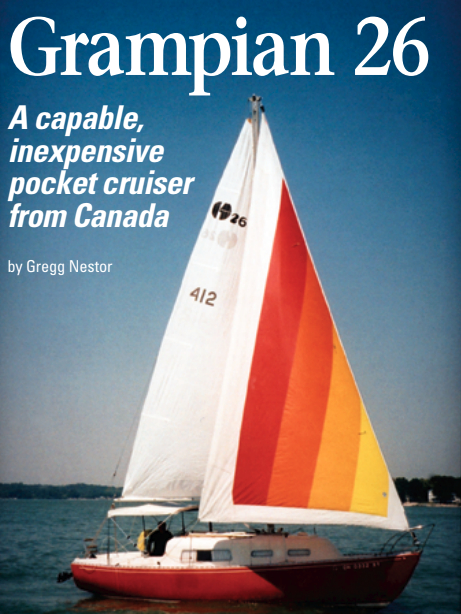
A capable, inexpensive pocket cruiser from Canada
Issue 65 : Mar/Apr 2009
In the early 1960s, Jim Bisiker, in collaboration with Dirk Kneulman and John Burn, formed Canada’s first production sailboat company — Grampian Marine Limited. The name came from the Grampian Mountains near Aberdeen, Scotland, where Jim’s grandmother lived. At their new facility in Oakville, Ontario, they began making fiberglass sailing dinghies and small motorboats. After learning the techniques of fiberglass fabrication from The Anchorage, the Rhode Island builder of Dyer dinghies and larger craft, they began building Dyer boats under license. And for a brief period of time Grampian imported and sold Shearwater catamarans that were manufactured by Fairey Marine in Hamble, England.
As time went on and the company’s expertise and reputation grew, Grampian Marine began manufacturing boats for a host of companies, including Triangle Marine, US Yachts, Fairey Marine, and O’Day. Grampian also built two traditional full-keel yachts, a 31-footer designed by Peter van Dye and a 37-footer by Sparkman & Stephens. It wasn’t until the late 1960s, however, that Grampian Marine began building its own designs.
In-house designs
In 1967, Alex McGruer II became Grampian’s first in-house designer. Having grown up within the confines of McGruer and Company (the family’s boatbuilding business that was established in 1911), Alex was an experienced yacht designer. Upon joining Grampian, his orders were to design simple, comfortable boats that sailed well. More specifically, his first assignment was to develop a seaworthy boat large enough for a family of four, with 6-foot headroom, yet small enough to be trailerable. This mandate resulted in the popular Grampian 26.
Grampian’s line of cruising sailboats soon ranged from 23 to 46 feet and they built a 17-foot daysailer as well. Since much of Grampian’s production was destined for the U.S. market, they also opened a plant in North Carolina.
The company grew and things went well until 1977, when the weak Canadian dollar, coupled with competition from U.S. builders, drove the company out of business. Price Waterhouse, acting as receiver, liquidated the company’s assets before it declared bankruptcy. Tanzer Industries took over the North Carolina facility; the Oakville assets were sold to several buyers. By the fall of 1977, Grampian Marine was no more.
Design
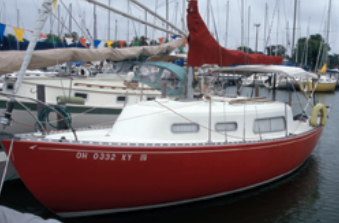
The Grampian 26 has nice lines with its spoon bow, delicate sheer, and flat counter stern. Unfortunately, its ample freeboard, especially the high sides and boxiness of its cabin trunk, can overshadow its more delicate features. The somewhat ungainly cabin structure, however, is exactly what made this boat so popular. With 6-foot standing headroom and a sense of spaciousness below, the Grampian 26 became the company’s best seller. Its popularity was nearly instantaneous, and 200 boats were ordered the first year. During its 8-year production run, which began in 1969, nearly 1,000 hulls came off the line.
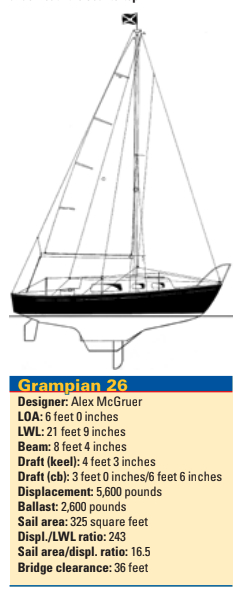
Although most Grampian 26s have deep fin keels, some were built with a keel/centerboard combination. These shallow-draft centerboard boats are trailerable. Both keel configurations were fitted with spade rudders and tiller steering. The Grampian 26’s displacement/LWL ratio of 243 is moderate and suggests a seakindly coastal cruiser. Its ballast/displacement ratio of 47 percent makes for a fairly stiff boat. On the performance side, PHRF rates the fixed keel version at 213 and the centerboarder at 222. Both numbers suggest respectable performance for a family cruiser. For comparison, a similar vintage Columbia 26 rates 228 seconds per mile and a Pearson 26 rates 210 to 222, depending on the fleet.
Construction
Like many of the boats built during the early years of fiberglass production, the Grampian 26 was heavily laminated. Its hand-laid hull is thick and solid and its deck is cored with balsa.
A fiberglass pan bonded to the inside of the hull functions as a foundation for interior features, such as berth flats. The pan does not extend over the entire hull. Instead, it terminates at hip height. Those remaining portions of the hull, from hip height to deck level, are covered with a foam-backed fabric. Overhead, a second fiberglass liner covers the inside of the cabin trunk down to deck level. This combination of fabric and liners conceals all the boat’s unfinished interior fiberglass surfaces.
The hull-to-deck joint is an inward-facing flange. It is bonded with an adhesive and mechanically fastened every 6 inches with stainless-steel bolts. The bolts also secure slotted anodized aluminum toerails along the full length of the boat.
In both configurations, the keels are made of cast iron. They are fastened externally by means of 1-inch iron bolts, although stainless steel would have been a better choice. The fin keel draws 4 feet 3 inches and the centerboard model has a 3-foot fixed draft (with the board down it’s 6 feet 6 inches). Both the centerboard and rudder are made of solid fiberglass. The rudder stock and the metal skeleton inside the rudder’s fiberglass body are constructed of stainless steel.
The joinerwork is acceptable and consists mainly of plywood veneered with a plastic laminate and trimmed with solid teak. Most of the panels are faced with a wood-grain patterned laminate. The one exception is the head, which is white laminate. The cabin sole is painted plywood.
Deck features
While the Grampian 26’s foredeck is reasonably spacious, its 7-inch wide sidedecks are extremely narrow. This encourages sailors to take the cabintop route when going forward. Fortunately, the combination of the teak handrails flanking the cabintop and a good quality non-skid make this adventure somewhat less daunting. On the bow, a stainless-steel pulpit and single lifelines add to the feeling of security.
Of the three fixed portlights on each side of the cabin trunk, the two forward ones are quite small while the aft one is quite large. On the cabintop, in addition to the teak handrails, there’s an opaque fiberglass forward hatch, a Dorade vent over the head, and the companionway’s sliding hatch. There is no sea hood.
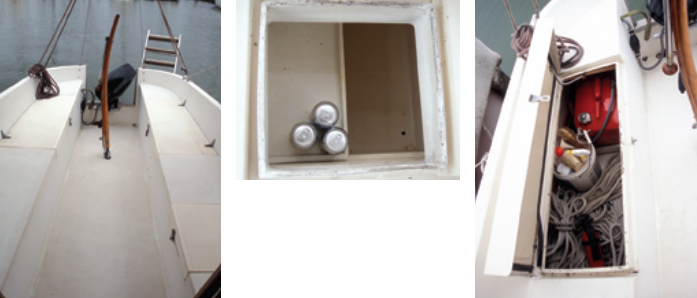
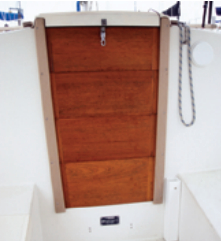
After the Grampian 26’s high-sided cabin, the boat’s other notable exterior feature is the cockpit. It’s a generous 7 feet 10 inches long with reasonably high coamings and comfortable seats. Tiller steering makes it seem even more spacious, and a removable cutout in the transom reveals a mount for an outboard motor.
Storage is provided by port and starboard seat lockers, plus a cockpit-accessible icebox The starboard locker is shallow. In addition to housing the gas tank for the outboard motor, it’s best suited for stowing docklines and emergency gear. The cavernous port locker is home to the manual bilge pump, among other things. The icebox is deep and has a sliding shelf for easy access. It is marginally insulated, however, and drains to the bilge. To facilitate good drainage, the cockpit sole slopes noticeably aft, directing water to a pair of 1 1/2-inch through- transom drains. There is no bridge deck and the companionway sill is quite low.
Belowdecks
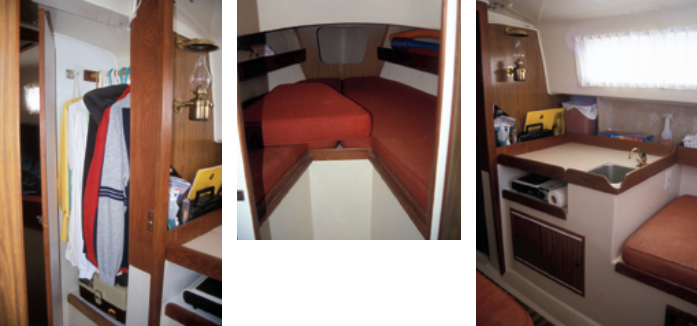
By today’s standards, the interior of the Grampian 26 may seem Spartan, but in 1967 its 6-foot headroom, berths for four, head, and galley were extremely appealing and well received by the buying public. The layout is straightforward and consists of a V-berth, followed aft by a head and a convertible dinette to port, and a hanging locker, galley, and quarter berth to starboard.
The V-berth is large enough for average-sized adults. Full-length shelves are installed above. Several stowage bins, plus the potable water tank, are located beneath the V-berth. There is no deck fill for the tank. If the boat is fitted with the optional marine toilet, this area will also house the holding tank.
Aft and to port is the enclosed head with a hanging locker across the way to starboard. The standard head facilities consist of a portable toilet and stowage outboard. The doors of the head and hanging locker swing to close off the passageway and provide fore-and-aft privacy. Four small portlights illuminate this area. The forward hatch and Dorade vent add ventilation.
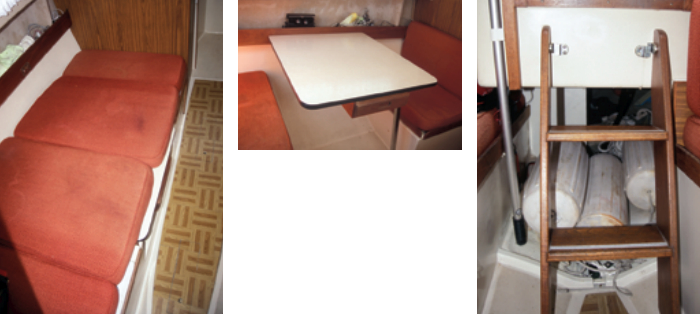
The portside dinette seats four adults and converts into a narrow double berth. In addition to a bookshelf outboard, stowage compartments are located beneath the seats. A convenient cutlery drawer is fitted to the underside of the table. The tabletop is covered with a no-nonsense plastic laminate for easy maintenance.
Amidships and to starboard is the galley, which has a single deep stainless-steel sink with hand pump, a recessed shelf designed to accommodate a single-burner cooktop, and a good-sized counter area. A perimeter shelf and cabinetry beneath provide stowage for galley gear and provisions. The remaining two large portlights and the companionway hatch provide light and air circulation to the galley and dinette.
Continuing aft, behind the galley is a large quarter berth, measuring 6 feet 4 inches by 30 inches. Several stowage bins, the battery box, and a dedicated fire extinguisher compartment are beneath this berth.
Because the overwhelming majority of the Grampian 26s came with outboard engines, the area behind the companionway steps and dinette lacks mechanical systems and is cavernous as a result. One gains access to this space through the port cockpit locker or by removing the companionway ladder.
The rig
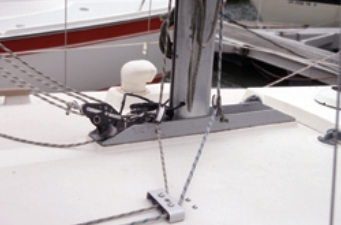
The Grampian 26 is a masthead sloop with a sail area of 325 square feet. Its sail area/displacement ratio is 16.5, in the range of a conventional cruising sailboat. The boat’s aluminum mast is stepped on deck in a shoe in which it can be adjusted to correct for weather or lee helm. A support truss is employed in lieu of a compression post. This athwartship structural member is positioned just forward of the forward bulkhead and is supported by the cabin sides. The mast has a bridge clearance of 36 feet. The single-spreader rig is supported by a pair of cap shrouds, fore and aft lowers, a forestay, and a split backstay. The chainplates are bolted to knees glassed to the hull.
On Chip Hessler’s Fire Flies, which served as our test boat, double-braided polyester halyards run through external sheaves and belay to cleats on the mast. A pair of single-speed halyard winches are mounted on the mast. The boat has no headsail sheet tracks. Sheets are led through snatch blocks positioned on the slotted toerail and then aft to primary winches mounted forward on the cockpit coamings. Originally equipped with British-made Gibb single-speed winches, Fire Flies had her primaries upgraded to Barient self-tailers.
The main is sheeted end-boom to the transom in a triangular configuration often referred to as a Crosby rig. The fiddle block is mounted to the starboard corner and can be awkward to use on all points of sail. As was common in its era, the Grampian 26 came with roller reefing. Other sail controls include a topping lift and downhaul.
Under way
Contrary to Grampian’s marketing claims, the Grampian 26 is not a performance boat. It is a cruising sailboat that is stiff and reasonably well balanced. The boat is not particularly close-winded nor is it a light-air performer, and its off-the-wind performance is considered only average. While the boat can carry a full set of sails in a near blow, it’s best and more comfortable to reef earlier, say between 15 and 20 knots.
Most of the 1,000 or so Grampian 26s were fitted with outboard motors. The standard Chrysler outboard in the 20- to 25-hp range was heavy for this boat. A 9.9-hp is a better fit. For an additional $2,000 or so, an inboard engine was available as an option and, during its 10-year production run, a variety of power plants were used. These included the gasoline-fueled Atomic 4 and Palmer and the single-cylinder Volvo and Yanmar diesels.
When it comes to seaworthiness, the Grampian 26 is quite capable of ocean sailing. At least one has crossed the Atlantic and several have cruised from the Great Lakes to the Caribbean and back.
Things to check out
As is the case with most any boat that has celebrated at least 30 birthdays and possibly closer to 40, any issues with the Grampian 26 are well documented. Prior to making an offer, several potential problem areas should be noted and investigated by a competent surveyor:
- Osmotic blistering
- Gelcoat cracking and crazing
- Portlight leaks (rubber seal failure)
- Deck delamination
- Cracks in aluminum stemhead fitting
- Splitting of the rudder
- Rusty keel bolts and backing plates
- Loose keel that needs tightening
- Deck compression around mast base
- Aluminum electrical wiring
Conclusion
The once very popular Grampian 26 is a strongly built and roomy cruiser. The boat is easy to handle in a variety of conditions and has proven itself on at least one ocean. Generally speaking, the boat has probably reached its terminal depreciation. Its age, how it has been maintained, and any upgrades that have been made over the years will be the main factors influencing the price of any individual boat. On the used-boat market, the Grampian 26 represents a good buy. Expect to pay less than $10,000 for an outboard model. The rare inboard boats run about $1,500 more.
Gregg Nestor, a contributing editor with Good Old Boat, developed a keen interest in sailing while growing up on the southern shore of Lake Erie. His third book, The Trailer Sailer Owner’s Manual: Buy-Outfit-Trail-Maintain, will soon be released. When he’s not writing about sailing, Gregg and his wife, Joyce, cruise aboard Raconteur, their Pearson 28-2.
Thank you to Sailrite Enterprises, Inc., for providing free access to back issues of Good Old Boat through intellectual property rights. Sailrite.com