This unconventional two-master boasts speed and simplicity
Issue 24 : May/June 2002
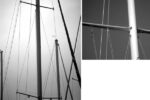
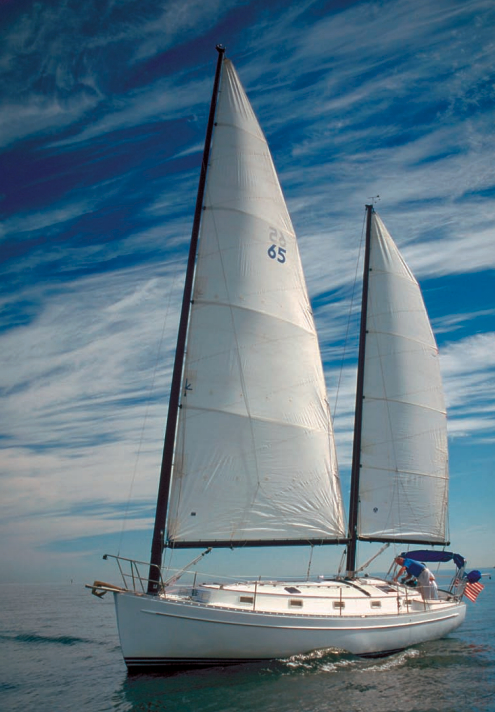
The first thing you notice is the freestanding masts. Next you see the wide sidedecks, which are clear of chainplates and stays. It just gets better from there.
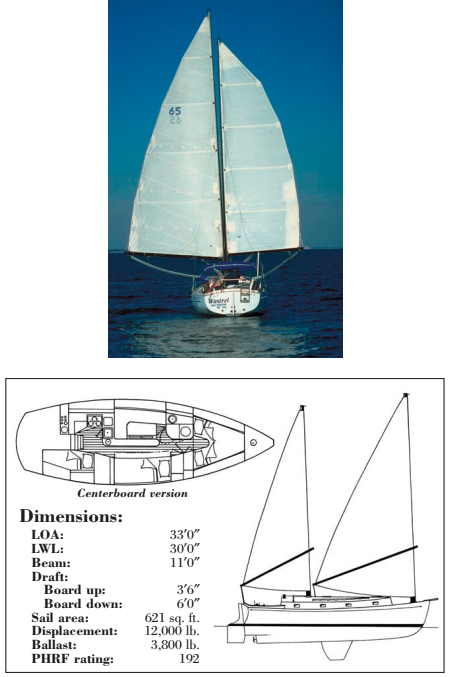
The Freedom 33 is one of the series of Freedom sailboats created by Garry Hoyt and built, beginning in l978, by Tillotson Pearson Inc. (TPI). The boat was available with two cabin structures, three internal layouts, and three drafts: a deep fin-keel version with 6-foot draft, a shoal-draft keel version of 5 feet 3 inches, and a centerboard version with a 2-foot 9-inch draft.
I sailed on Wastrel, which originally had a deep-fin keel but has now been modified to a 5-foot 3-inch draft. The boat did not seem to mind, although the deeper keel would go better to windward. That said, the Freedom 33 is no slouch; we sailed at 7 knots in l8 knots of apparent wind . . . beats my sloop any day!
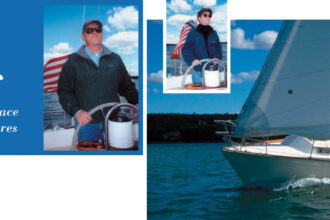
Jim Schmitt is a good friend who was in the process of purchasing this boat. He asked me to do a survey of the boat for him and to conduct sea trials. When we went out for the sea trials, Jim lost his favorite hat overboard. Without thinking, I put the helm over and jibed the boat to recover the hat. No headsails to tack through, no winches to grind. Just turn the wheel, and she reverses her course. Really grand! For those who want additional strings to pull, an easily set staysail can be flown. This will certainly increase off-wind speed.
The sails are large (621 square feet) with plenty of roach, but as there is no backstay, in fact no stays of any kind, there is plenty of room for sail area. Wastrel’s masts are carbon fiber with a conventional track bolted to them. She also has conventional booms with rigid vangs. Originally as built, the sails wrapped around the mast and had A-frame (or wishbone) booms, but somewhere in her life Wastrel’s rig was modified. The newer plan is easier to reef. Lazy-jacks complete the rig and make dropping the sails a breeze.
No hobbyhorsing
The boat comes about smartly with no reluctance. Motion is steady and businesslike with no tendency to hobbyhorse. When going to windward in a chop, the decks stay dry. In light air, the boat sails well but is no 12-Meter racer. A little leeway is noticeable, although this might be due to Wastrel’s shortened keel. She will point at least as well as (or better than) any sloop her size. She tacks through 90 degrees and can point to within 45 degrees of the wind. Weather helm is not a problem as you can balance the sails to create a very light feeling on the wheel.
The design is really a big canoe-bodied hull with a bolted-on fin and outboard rudder. The combination works, but it is hard to make her selfsteer. The boat just doesn’t want to sail herself. Under sail, a wheel-mounted autopilot handles the steering duties quite nicely.
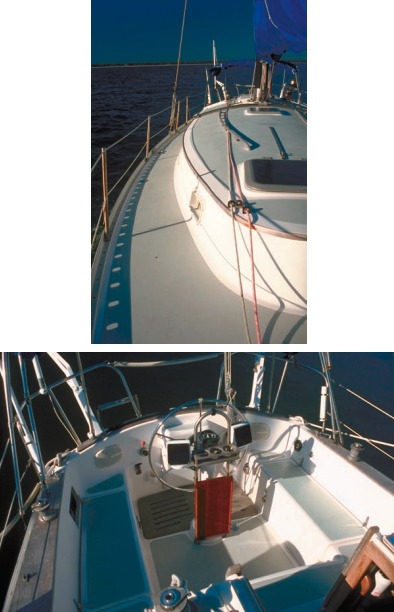
The deck layout is unconventional in that the mainmast is mounted all the way in the bow, and the mizzenmast is about two-thirds of the way aft. The cockpit is all the way aft without an afterdeck or stern lazarette. The helmsman’s seat forms the stowage space for two propane bottles just inside the transom. The cockpit is open through the stern under the quadrant of the rudder. As a result, any water that may wash into the cockpit can easily drain overboard. Water from a following sea might enter the cockpit through this opening, but it will drain quickly. This shouldn’t be a problem in normal conditions.
The two-stateroom design has a deckhouse that takes up the middle of the cockpit, creating a forward-facing, U-shaped cockpit. The single-stateroom version does not have this intrusion so you have a nice square cockpit, which I prefer. The wheel either mounts on the aft face of the deckhouse in the U-shaped cockpit or on a stand-alone pedestal in the square cockpit. Side seats are molded into either design with lazarette stowage accessed through seat-top lockers. The coaming on either side of the cockpit is wide, teak capped, and comfortable for sitting with your back against the lifelines. Six to seven sailors will fit in the square cockpit while only four to five can manage in the U-shaped cockpit. More would be a squeeze.
Great layout
Combine a comfortable cockpit and all lines led aft to that cockpit with wide unobstructed sidedecks, and you have a great deck layout. Be careful when going forward, however, as there are no shrouds to grab.
Belowdecks, the first thing you notice is the high crown of the cabin overhead. This height is well camouflaged on deck but is apparent down below. There is 6-foot 1-inch headroom on the centerline with less to either side. As these are the areas of the settee, navigation station, and double quarterberth, people will usually be sitting down when they use this space.
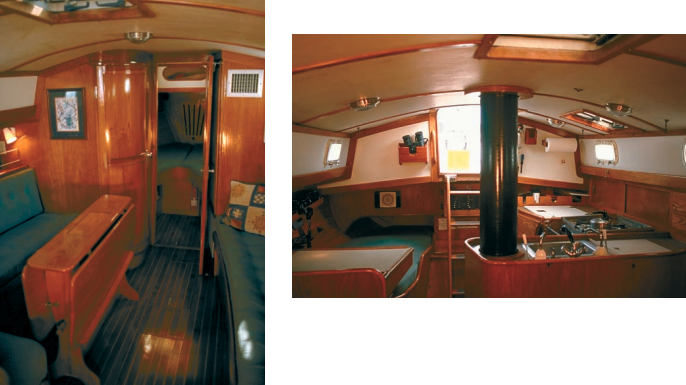
One of the first things my wife noticed when going below was the head door. It is curved, varnished oak, a really nice touch. And the rest is in keeping with this high standard. Wastrel’s interior is finished in white with light oak trim, giving the cabin a light and airy feeling. Other models have ash or teak trim, but I particularly like the oak with the white paint for contrast. Wastrel has dark green upholstery with gold flecks and, combined with the varnished wood trim, the interior is very elegant indeed.
The galley is outboard of the mizzen-mast. To port there is a double sink athwartship, the stove and oven are farther aft on the port side, and the refrigeration unit is all the way aft to port, outboard. The icebox is well insulated, but the top is two layers of Corian. An assist from a pneumatic cylinder is required to open it and keep it open.
Starting from forward, there is a wide V-berth, followed by the head to port and a hanging locker to starboard. The main saloon in the keel version has a removable drop-leaf table on the centerline. There is a settee to starboard and an L-shaped seat to port. People seated either to port or starboard can reach the table. In the centerboard version, the centerboard trunk has table leaves port and starboard. The centerboard trunk forms a permanent divider of the main cabin and is high enough that short people seated on a settee would have trouble seeing over it.
Not for two
Moving aft, the galley is to port, and the navigation station is to starboard. The quarterberth on the starboard side makes a seat for the navigation station and extends under the cockpit for a full-length berth that is wide but not quite large enough for two.
The auxiliary engine is under the companionway ladder. Removing this ladder provides engine access. Most sailboats have an access problem here, and the Freedom 33 is no exception. The Yanmar 3 GM 30 is shoehorned into the space with the electric water heater aft of it. I am not sure how you would service or replace the water heater. In the two-cabin version, the engine and heater are in the aft cabin. It must be interesting to work on either one of these in the heat of summer! With a bit of effort, the engine on Wastrel could be disassembled and removed. The shaft would have to be disconnected by lying over the top of the engine. You’d need a small, but very strong, person with extra-long arms. In Singapore, I had a mechanic who could literally sit next to the engine on my 32-foot ketch. This is what is needed here, but we tend to grow them too big in North America!
Construction is robust, as befits an Everett Pearson-built boat. Hull and deck are balsa-cored for lighter weight. Wastrel has no evidence of water intrusion into the hull or deck laminate, but it is possible to have a problem if a carelessly drilled hole is not properly sealed. The bilges are acceptable but not deep (remember the canoe hull). There is a sump over the top of the keel, but it is limited. All through-hulls have bronze ball valves on them and good backing blocks. All hardware is first-class with Schaefer and Nicro predominating. Steering is by Edson with an emergency tiller as standard.
No interior liner
The interior is built up, not a liner, and well attached by tabbing to the inside of the hull. The 12-volt and l10-volt systems are well done and well tied off. Wastrel has a 12-/110-volt refrigeration system as well as 110-volt reverse-cycle heat and air conditioning. This is nice for making use of the boat on those hot or cold days at the dock.
Fuel capacity is 25 gallons and water tanks hold 83 gallons plus 6 more in the water heater. There is a shower and sump in the head, but it is easier to shower in the cockpit using a sun-shower (in the summer, of course). Wastrel has pressure fresh water and manual salt water supplied to the large galley sink. The current owner would like to convert the saltwater system to a foot pump at some point. Right now, it has a manual rocker-type pump mounted outboard of the sink.
Conclusions
If you want to turn heads in every port you enter, the Freedom 33 is the boat to do it. There are not too many negatives to address with the boat. Engine access is a problem, as it is on most sailboats. Interior headroom is limited to 6 feet 1 inch. If you are taller than that, you’ll be doing a lot of ducking. The cockpit is comfortable on the single-cabin version, but it would be a little small on the aft-cabin version if you do much entertaining, as the aft cabin really winds up in the cockpit. Construction and outfitting are to Everett Pearson’s usual high standards.
The boat sails much better than the average 33-foot sloop or ketch, and it is easily handled. This is a fast, comfortable, and capable sailboat.
As you can tell, I’m very partial to the Freedom 33 and enjoy the chance to sail on her when invited.
Thank you to Sailrite Enterprises, Inc., for providing free access to back issues of Good Old Boat through intellectual property rights. Sailrite.com