A talented aristocrat
Issue 29 : Mar/Apr 2003
A Contessa 32 named Assent was fated to go down in nautical history when she was the only yacht in her class to finish a race marred by a storm so bad that five boats sank, 19 were abandoned, and 15 competitors were drowned. It was the infamous Fastnet Race of 1979, in which 303 yachts were overwhelmed by 65-knot winds between England and Ireland.
Assent’s success assured her, and her British designer, David Sadler, of instant fame. Sales of the already-popular racer/cruiser soared, and the boat became the subject of intense scrutiny by safety committees and experts interested in finding out what made her so seaworthy. The fascinating fact was that the Contessa 32 was a fin-keeler with a detached rudder set on a skeg, not the kind of full-keeled design traditionally associated with good seakeeping.
She turned out to be a very moderate boat, a clever transition between the traditional heavy-displacement Bristol Channel cutters or Falmouth Quay punts and the modern light-weights which were designed to the IOR rule, with lots of beam and high centers of gravity.
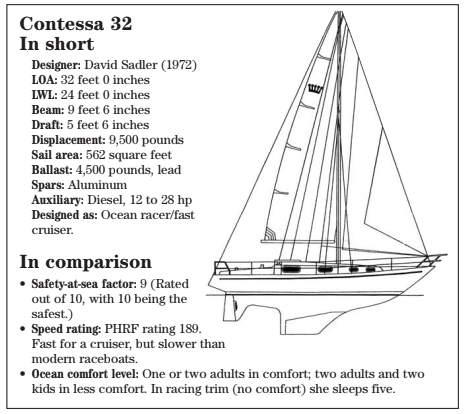
David Sadler created a boat with a displacement-to-length ratio of 310, which placed her firmly in the medium-displacement class. Her beam was quite narrow — 9 feet 6 inches on a 24-foot waterline — and her center of gravity was kept low by a draft of 5 feet 6 inches and a ballast keel weighing 4,500 pounds. That’s a whopping 47 percent of her total designed displacement.
So the Contessa 32 ended up with a very wide range of positive stability, plus the promise of a quick recovery in the event of a 180-degree capsize. And, as competitors in that ill-fated Fastnet Race discovered, even the most seaworthy of yachts can be turned upside down by a plunging breaker that is big enough. Under survival conditions, ultimate stability, (the speed with which a boat will pull herself upright after a capsize) becomes of more importance than initial stability, which storm waves can and do overcome.
It was difficult in those days for the traditionalists to accept that a fin-and-skeg boat could be as seaworthy as a full-keeled Colin Archer or a pilot cutter. In fact, to this day there are people who won’t have it. But what Assent proved in practice, Tony Marchaj and other marine researchers proved in theory, namely, that there is nothing inherently unseaworthy about a correctly-designed fin-keeler.
The difference between a Contessa 32 and most other fin keelers, of course, is that she is deep and narrow, whereas they are shallow and wide. Shallow and wide usually translates into more speed than deep and narrow. It also provides more room down below. It’s lighter, and cheaper. So, naturally, it’s more popular with the builders and the public who buy from them. Most people, after all, are happy to trade a bit of seaworthiness in return for more speed and accommodation. Only those who want to cross oceans or sail in all conditions with an easy mind will appreciate the extra seaworthiness the slower, more cramped Contessa 32 provides.
Basic design
This boat was touched by magic from the start. When she was introduced to the public at the International Boat Show in London in 1973, the Contessa 32 walked away with the coveted Boat of the Show Award. Her builders, the Jeremy Rogers Boatyard, in Lymington, prepared for the rush, and between then and 1982 they turned out more than 700 boats.
At the same time, however, the Contessa 32 was being built under license in Canada by the J. J. Taylor company in Ontario. Their production run ended in 1990, by which time 87 Contessa 32s had been built. Many of them have since found their way to the United States.
She was designed to do well in offshore races organized by the British Royal Ocean Racing Club (RORC) and, while her fin-and-skeg underbody made her reasonably fast, it was her reputation for seaworthiness that really got the attention of long-distance cruisers. It has been calculated that she will heel over to 157 degrees from the vertical before she loses the ability to right herself.
Besides finishing the 1979 Fastnet Race, Contessa 32s have been used for a singlehanded circumnavigation and a double-handed rounding of Cape Horn the “wrong way” — against the prevailing storm winds.
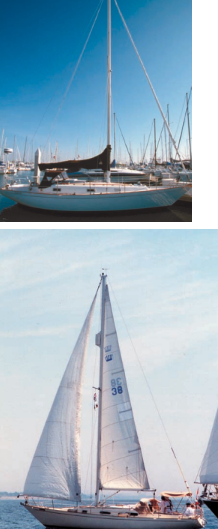
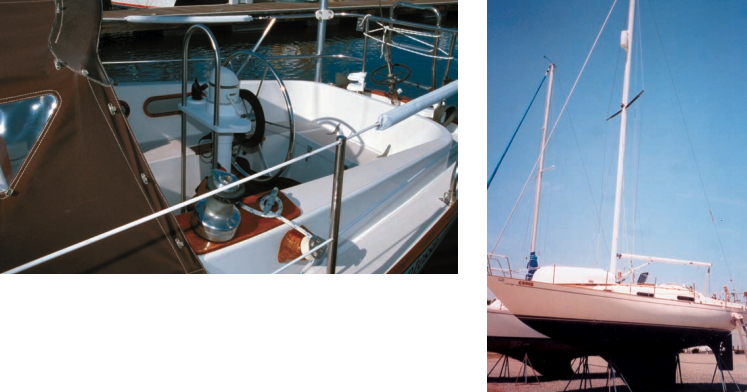
Although she is technically a fin-keeler, the Contessa 32’s fin is quite large in area by today’s standards, and extends a long way fore and aft. It’s as if one of Ted Brewer’s trademark “bites” had been taken out of the aft end of a full keel, leaving a truncated long keel and a stubby little skeg. The skeg runs the full length of the rudder, making it a very strong installation, and the rounded, cut-away forefoot of the keel makes her reasonably easy to manage downwind. The bottom of the keel is flat for several feet, so she can dry out against a harbor wall or post without too much fuss.
She appears to have a straight sheerline but in fact there is just enough spring to the sheer to prevent her from looking humpbacked, and the lowest part of the gunwale lies slightly forward of the cockpit.
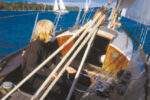
The Contessa’s cockpit is quite long and comfortable. High coamings provide excellent shelter at the helm, and a strong bridgedeck separates the cockpit well from the main saloon. Access to the clear foredeck is reasonably easy, thanks to wide sidedecks.
A tiller was the standard fitting, but a wheel was offered as an option, and most owners seem to have taken the option, not because steering with a tiller was difficult but because a wheel frees up more cockpit space.
Accommodations
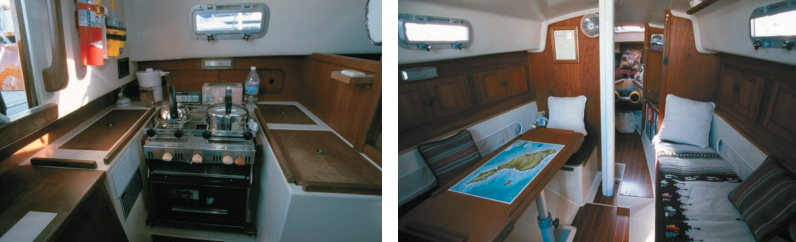
You’ll notice the difference between a British-built Contessa 32 and a Canadian-built one in the accommodations. Both used the same basic layout, but while British boats were finished completely in wood down below, the Canadian manufacturer used white fiberglass moldings trimmed with wood.
The interior is cramped by modern standards, although trading interior space for seaworthiness is not a bad plan in a long-distance cruiser. In any case, this is a boat for one or two people, no more — except, of course, for weekend sailing.
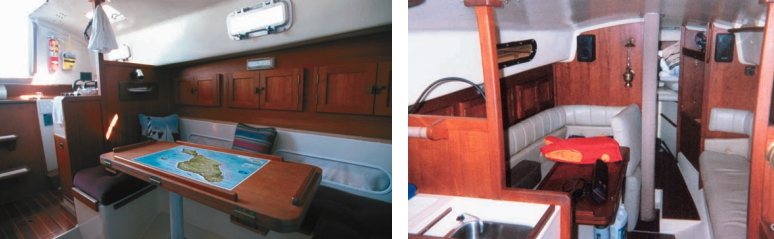
Headroom varies from 6 feet 1 inch to about 5 feet 10 inches. There’s a chain locker and V-berth up forward, followed by a head to port and a hanging locker to starboard. The main saloon has a narrow double-berth to port and a single to starboard. The U-shaped galley lies to port, and opposite there is the luxury of a dedicated chart table, although the navigator must sit on the head of anyone sleeping in the quarterberth tucked in behind it. Incidentally, that makes six berths in all — four too many for long-distance cruising if you wish to retain your sanity.
Most Contessa 32s were fitted with diesel engines of decent size, starting with the 24-hp Farymann, and changing over at intervals to the 20-hp Bukh, the 28-hp Volvo, and the 27-hp Yanmar. Owners of Contessas with engines of 12 hp or less complain about lack of reserve power.
The rig
She has a single-spreader masthead sloop rig that could be converted to a cutter for cruising or rule-cheating purposes, but is otherwise unremarkable. Her mainsail has a high aspect ratio, efficiently tall and thin, and her foresail area is large, so you’ll need powerful, easily managed sheet winches in the cockpit.
It’s obviously a strong rig. Several Contessas sailing in marginal conditions have dipped their masts under water and survived with the rig standing, but you’d want to replace the whole gang of rigging as a matter of principle before leaving on an ocean voyage.
The main boom is short, barely overlapping the forward end of the cockpit, which results in an awkward sheeting position just aft of the companionway entrance. On a cruising boat, a longer, heftier boom might enable the mainsheet track to be set up well aft, clear of the helm and crew.
Performance
Good all-round performance is the hallmark of this Sadler design but, as already noted, she gets an A+ for heavy-weather work.
Declan Mackell, who sailed Sean-Ois around the world singlehanded between 1979 and 1983, reported a day’s run of 186 miles between the Canaries and Barbados. She really shouldn’t have done better than 157 miles, because her theoretical maximum hull speed is 6.56 knots, but sometimes there’s a little magic that helps the Irish do better than other mortals. In any case, this boat is no mean performer under twin running sails in the trades.
Known weaknesses
- You’ll need to figure out how to carry more fresh water, since the water tank encapsulated in the keel holds only 15 imperial gallons.
- The double berth to port is really a wide single. Don’t get any fancy ideas.
- Check the chainplates. There have been reports of failures.
Owner’s opinion
British physicist Alex Nichol owned a Contessa 32 called Royal Crescent with a partner for 18 years, sailing Royal Crescent out of Parkstone Yacht Club in Poole, Dorset. His cruising grounds encompassed the English Channel and the French coast from Cherbourg to the mouth of the Loire — an area known for sudden storms and short choppy seas.
“It’s a very strong and seaworthy basic design,” he says, “but for long-distance heavy work some reinforcement of the bow is required. We had a pair of extra foam stringers molded in from the head compartment forward.”
He advises buyers of used boats to check and possibly strengthen the shroud plates. “The other point of weakness is the forestay tack fitting — this is a 3⁄8-inch stainless-steel U-bolt, and ours just broke one day in quite moderate weather. It was what the metallurgists call a ‘corrosion crack,’ where a tiny superficial crack at deck level corroded and then failed. We had a new fitting made to wrap over the stemhead and bolted it through.”
Royal Crescent’s mast developed corrosion under the fittings just above deck level after about 12 years and was replaced as a precaution.
Alex detected no sign of osmosis in the hull, even when the boat was approaching 20 years of age. “The rudder is on a very heavy skeg and should give no worries. We had some work done at 16 years, but that kind of thing is to be expected. A point to note, however, is that if you do have to do anything to the rudder or engine shaft, you have to start by cutting off the bottom tip of the skeg, where it wraps around below the bottom of the rudder, so as to get at the deeply embedded lower pintle.”
Royal Crescent points well, tacking through just under 70 degrees with the original #1 genoa. She starts to get weather helm at about 15 knots of windspeed, Alex notes, but it’s easily cured by reefing. “You should reef the mainsail first. Then she will re-balance and go faster. A second reef in the mainsail, with a suitable foresail, makes her easy to handle in any wind up to Force 7.” He once beat 70 miles across the channel in a Force 7 wind. That’s 28 to 33 knots, and officially described as a “near-gale.”
“We got caught in Alderney by a northeasterly blow that came up from nothing, and we had to get back to Poole. We hoisted a double-reefed main and a small jib. She just loved it, and we were sailing past other boats of similar size which were wallowing — probably because they were overcanvassed.”
Alex feels it pays to reef the Contessa early. “Indeed, our boat would sail to windward very happily on just a foresail — a flat-cut, rather heavy #2 genoa designed for roller reefing.”
The Contessa’s performance under headsail alone is exceptional.
“One day we were going from Treguier to Lesardrieux through the Passe de la Gaine and Moisie channels. It was a dead run down the Gaine, so rather than have the mainsail blanket the foresail, and have the mainsail jibe back and forth, we put up just the #2 genoa. It was then a nice reach into the Moisie under just that sail, so we left it. We came around into the Grand Chenal to Lesardrieux and I said: ‘Let’s see if she’ll lay it.’ And she did — overhauling a lot of French boats that were beating and wondering how on earth we were doing it.”
According to Alex, the Contessa’s galley is adequate for extended cooking while living on board, and well placed for use at sea.
He also feels the cockpit is about the right size for ocean work, although it gets rather wet during a beat to windward in a blow. “By modern standards, the Contessas are low in freeboard.”
Royal Crescent had a Yanmar, single-cylinder 12-hp diesel engine, which Alex found a little lacking in power. “I would prefer a little more power in reserve and two cylinders. The 18-hp Bukh is reckoned to be the best of the various ones installed as standard. The Yanmar’s great merit was an incredibly low fuel consumption — about 4 or 5 hours to the British gallon.”
Finally, one of Alex’s favorite cruising anecdotes:
“We were sailing in the Morbihan (northwest France) between the two major islands, where the direction of buoyage is not obvious. We knew where we were and had a large-scale chart. Halfway, near a channel buoy, we came upon a large French yacht on the wrong side of it, hard aground — and apparently trying to haul himself even further aground with a kedge.
“As we came up, he made great gesticulations, pointing at the buoy and waving us to pass well on his side of it. As we complacently slid by on the other side, realization hit him. A great cry of ‘Merde!’ came across the water.”
Thank you to Sailrite Enterprises, Inc., for providing free access to back issues of Good Old Boat through intellectual property rights. Sailrite.com