Sheathed wreck of the wooden Ulysses still going strong
Issue 29 : Mar/Apr 2003
Since becoming a subscriber to Good Old Boat in 1999, I have enjoyed two articles on the subject of sheathing wooden boats in plastic. The first, in the July 2000 issue, was a one-page piece that mentioned some drawbacks of the practice as well as successful applications with the use of mechanical fasteners or applications over relatively stable plywood construction.
The second article, in July 2001, was a description of work done on Mustang, a Sparkman & Stephens New York 32 that included refastening of the hull and complete sheathing in a cold-molded “second skin” before the final covering in what amounts to a fiberglass moisture barrier. Good Old Boat technical editor Jerry Powlas, commenting on the controversy of the Mustang renovation (between those who saw the application of plastic to a wooden boat as sacrilege and more pragmatic souls who saw it as a means to extend the life of the vessel) noted, “the fundamental problem is to keep the water out of the boat.”
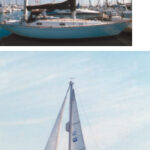
This fundamental was the stated goal of another project to save what amounted to a wreck by cladding it in plastic. The work, in which I assisted, lasted from 1974 to 1977 in Berlin, Germany, while my wife and I were living there. The boat, Ulysses, still sails on the Baltic and North Seas from ports in Germany some 25 years later. In view of the well-known German insistence on inspections and licensure, this should indicate that the goal was met.
Third sinking
The story begins in what used to be West Berlin. Ulysses (her previous name is unknown) was salvaged from her third sinking in the Wannsee, one of a chain of lakes stretching along the western border of Berlin. Since her owner, a businessman with little boating experience, almost lost his life in the third sinking, he was eager to part with the boat. She was thus purchased by the present owners for “the salvage value of the lead keel.”
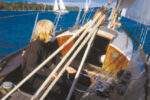
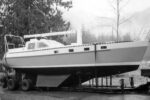
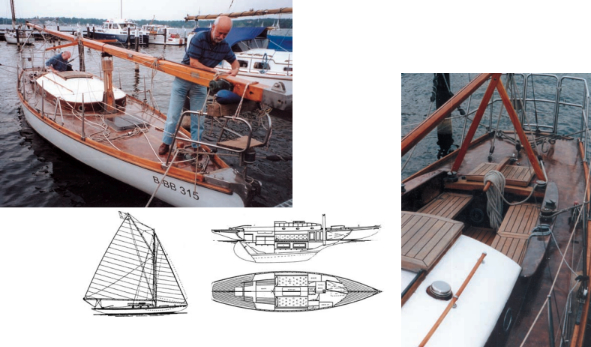
She was a one-design created in Germany, known as a Nationale Kreuzer 45, with her lines superficially resembling a Dragon-class sloop. The first of her type was built by Abeking & Rasmussen in 1912. She is 10.3 meters (34 feet) long on deck and sports a 12-meter (40-foot) timber mast. The present owners, my brother-in-law and a partner, think she was built and launched in the mid-1920s. She was originally gaff-rigged, but she was Marconi-rigged at the time of the sinkings and to this day. She was engineless; her cockpit sole was a grating over open bilges.
The sinkings were caused by the poor condition of the vessel, specifically by the thrust of the mast under load on the keel timbers. This opened her seams, since the bulkheads and ribs were too rotten to resist the downward thrust.
The rot in the structural members was so extensive that the keel would actually deflect, or sag downward, when the boat was pushed hard and heeling. The resulting inrush of water necessitated rapid bucket bailing by at least two crewmembers. In a word, she was old, tired, and in very poor condition.
Long dry-out
In 1974 she was hauled out and put under cover for the entire restoration. She was, therefore, able to dry out for two-and-a-half to three years before the application of glass.
After 25 years, I no longer recall the exact specifics of the renovation — the numbers or weights of glass cloth and matting applied, the species of wood used to replace the rotten timbers, the materials of the screws and other fasteners — but the general procedures and sequences were as follows:
1. The entire structure (hull, deck, cabin) were stripped of finish and the interior was gutted to provide full access to any rotten wood, which was then removed. We used rasps and coarse sandpaper to remove paint and varnish and to roughen the wood in preparation for the application of polyester resin. At this time, all rubstrakes, moldings, fittings, railings, through-hulls, and equipment were removed.
2. The removed planks and other rotten components were used when feasible as patterns for replacement parts. The work was extensive and at one point involved the removal and replacement of the entire stem timber from the keel to the bow. I recall it being a good 12 feet long. The bow planking was spread apart, leaving a gaping hole that made me skeptical about the prospects of ever putting it all together again. Ribs were laminated to a pattern and not simply laid up in place or sistered. I don’t know why this was done “the hard way.” Keel timbers were so rotten that entire portions could be scooped out by hand. Several bulkheads were also replaced entirely with what must have been at least 1-inch marine plywood. As a rule, the new owners bought the best of all materials that needed replacing. We built a solid cockpit with an engine-access hatch in the sole at the same time.
Numerous layers
3. The entire boat was covered with glass matting followed by glass cloth in numerous layers applied with polyester resin. The concept was to create a monolithic continuous envelope covering the cabin, decks, cockpit, and topsides, and encapsulating the keel.
4. The usual fairing, sanding, and painting took place. We installed a diesel engine and reinstalled or replaced flexible tankage, through-hulls, ports, moldings, hardware, and other items that, while interesting, have no real bearing on the plastic sheathing process.
5. As a final measure, we saturated the entire interior of the boat with a mixture of turpentine and linseed oil to preserve the wood. One of the owners recently admitted that the smell was initially objectionable and that there may be better wood preservatives available today. However, I sailed on the boat a year or so after completion of the work and do not recall any objectionable fumes.
6. The reinstallation of the interior was carried out in a Spartan manner with pipe berths and open shelving in lieu of cabinets and such to ensure air circulation to the interior wood surfaces and avoidance of dead spaces that could lead to the formation of rot. The idea was that if any rot was found the entire wood member would be removed and the resulting void filled with reinforced polyester. This has not yet been necessary.
As with most boats, the refitting and improving of Ulysses is continuous. The solid timber mast was recently replaced with a modern, hollow, laminated spar and a teak-veneer deck and other improvements are pending. But these modifications have nothing to do with the question of whether sheathing in polyester resin is a viable method of “keeping the water out.”
The fact that the boat is now more than 75 years old, has been sheathed in fiberglass for a quarter of a century, is actively sailed, and shows no ill effects from the procedure should speak for itself.
A few years ago the addition of some piece of equipment or other necessitated the installation of some through-hull fittings. The boring of these provided some beautiful core samples of the wood-polyester glass bond. I examined these carefully looking for any evidence of separation and found none.
Thank you to Sailrite Enterprises, Inc., for providing free access to back issues of Good Old Boat through intellectual property rights. Sailrite.com