Thirty years, 7,000 boats, and still going strong
Issue 57 : Nov/Dec 2007
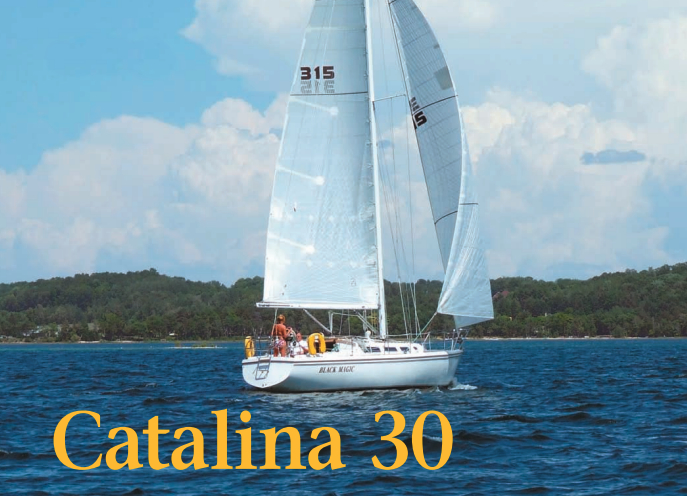
The Catalina 30s have turned 30. These fine coastal cruisers are fun, family oriented, relatively cheap to maintain, easy to handle, and responsive. Anyone in search of more boat for less money should look them over. The Catalina 30 is the great in-between boat. Not the boat to sail away forever, perhaps, but a good boat to own and sail until then. And this boat has a price and resale history that will allow those sailaway goals to remain as a solid plan, instead of just a daydream.
An early Catalina 30 offers many advantages, but number one is value. A 1970s-era boat needing a bit of care is usually available for less than $15,000, with many around $12,000. How cheap you should go depends on how handy you are . . . and how lucky.
There are three basic areas to consider when looking for a boat of this vintage: sail-ability, repair-ability, and resale-ability. The early Catalina 30s measure well in all three.
Sail-ability
You have to look at sail-ability in a 30-foot cruiser as part of compatibility. Every boat does something better than some other boat . . . and something worse. You need to know what you want and what kind of sailing you’re going to do. Then mark your personal spot on the balance beam between performance and comfort, heavy weather and light air, liveaboard cruiser and racer, and so on.
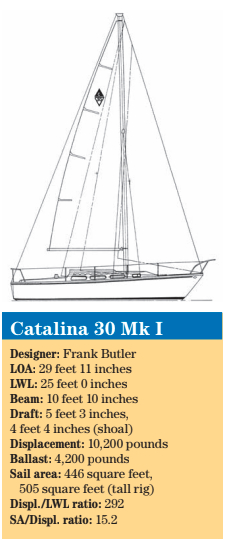
The Catalina 30’s reputation as a large boat has overshadowed its performance characteristics, especially when matched against its peers. The first Catalina 30s introduced in 1974 and ’75 won victories at the popular Marina del Ray-to-San Diego and Newport-to-Ensenada races. At the time it was built, the boat had it all: big and fast. Over the next two decades, production designs by its competitors eventually moved the relatively unchanged Catalina 30s to the less sprightly side of the performance line. However, the boat’s room below was still the standard to beat. Now, 30 years and 7,000 boats later, no one lists the Catalina 30 as an extremely fast boat, but it is still considered a big boat for its size and your money.
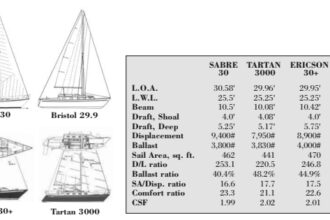
When it comes to comparing good old boats, you have to stir the waters lightly. Every sailor loves his baby, and there always exists one perfect set of conditions and sail plan that somebody’s baby can hold better than most. The Tartan 30 that came out in 1979 was a faster cruiser than the Catalina 30, but it was also 10 inches narrower and a ton lighter with a smaller, less comfortable cockpit. The Catalina could beat the 1970s-era Hunter 30s. I’ve solidly beaten Islander 30s and Pearsons of similar vintage with my old Catalina, just as I have been beaten by them. I would also consider Dufour and Seidelmann boats of the period to be peers in performance, though I would give advantage to the Catalina 30 in ease of management and stability.
After reading a dozen or so reviews of the Catalina 30’s sailing characteristics, I find the common elements are these: a solid boat in heavy weather, doesn’t want to heel, slow in light air, good in a strong breeze, designed to have a spinnaker for running off the wind (in review code this means that without a spinnaker she doesn’t run so great), points surprisingly well (especially with a bit of a blow), handles well in the marina, no prop walk.
In my own experience, I have found that the boat sails well when rigged well, it does indeed point much better than I expected, and its inherent stability makes cruising spinnakers easier to fly.
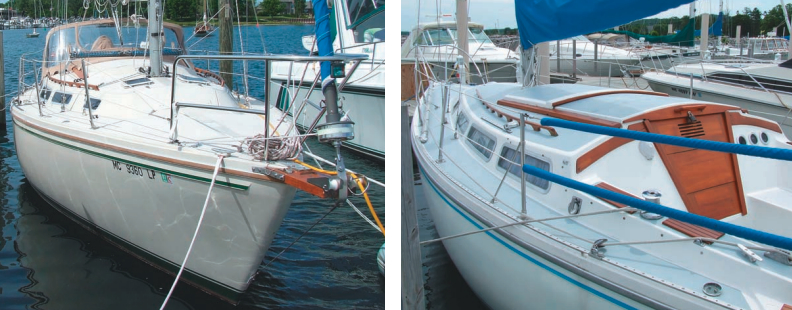
Repair-ability
Repair-ability is one area that grows in importance with time. The new boat buyer seldom looks at an engine compartment and wonders how much fun it would be to yank the devil out or whether a glassed-in gas tank would have to be moved to replace the water hose fitting beneath it. However, the suitor for an old boat must add extra weight to the repair-ability factor and consider its three variables: upkeep, upgrades, and major repairs.
All boats need upkeep; the older they get the more they need. The Catalinas have pluses and minuses in this area and, by my math, come out about even. The old gelcoat is a minus. It cracks at corners and gets porous, making it hard to clean. The bilge is not finished particularly well and has many nooks and crannies to trap bilge crud. Windows are a minus: the frames are lightweight and annoying to remove and re-caulk. The electrical fittings and wiring are a slight minus. The fittings were cheap and hard to get at. Worse, over the years add-ons and re-routes have made the whole mess a mystery, as it is in most old cruisers.
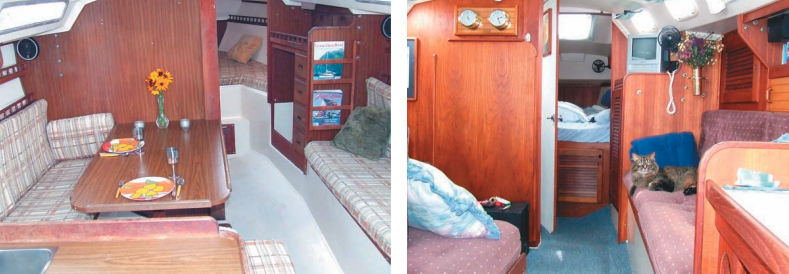
Engine accessibility is a powerful plus. No matter which engine you have, it’s fairly easy to get at. Try replacing a distributor on the Atomic 4 in an Erickson 32 of this vintage or its equivalent and you’ll really appreciate the Catalina 30’s engine accessibility. The battery compartment is a plus; it’s big and sturdy and easy to work with. No marine head deserves a plus rating, but I’ve had fewer problems with my old Catalina 30’s head than with the other cruisers I’ve owned. Interior wood scores even — the mahogany drawers, shelf rails, and trim are nice, but the table, counter, and bulkhead are pretty blah. I might be too hard on the Catalina 30 by scoring it even overall on upkeep. The minuses are pretty minor and mostly cosmetic. Good engine accessibility is more important.
Ability to upgrade is a big plus for the Catalina 30, due mostly to its unprecedented production run. Need a gate stanchion? A screened hatch-board? A dodger frame? A cockpit table? No problem. You can buy many items right from the manufacturer. With 7,000 boats produced and many active owners’ associations, many new and used parts are available.
Larger bolts
The factory upgrades that came out in the early boats include stainless-steel keel bolts starting around October 1977 and larger chainplate bolts and a new rudder in December 1978. Many of the early boats were tiller-steered but most have been modified to wheel steering.
The upgrade that most affects a boat’s value is a diesel engine over the Atomic 4. However, be careful. To buy a boat with an Atomic 4, replace this with a diesel, and expect to make coinage on the resale is a pleasant fantasy that can lead to disappointment. If the block is good on an Atomic 4, there’s no reason not to keep it. The engines are dependable and very fixable. If the block goes, consider replacing it with a diesel and try to get a decent used or rebuilt one. Even then, don’t expect to get every penny back unless you can do the installation yourself and do well finding a used replacement.
Major repair is the scariest part of repair-ability. I have found that sometimes a boat sagging on a cradle with soft decks, a hole in the bow, and a grapefruit growing out of the keel is just too cheap to resist (see “Confessions of a Bottom Feeder,” May 2006).
When you calculate major repair into a boat project, you are always taking a gamble. But if the boat is a Catalina 30, your odds improve. The main structural joints and glasswork — hull, deck, propeller-shaft strut seat, toerail joint, keel joint, and so on — were solidly built. Its glass is heavy and it’s not prone to blister. Need a new keel, rudder, or mast? The 7,000 boats that have been built greatly increase the chances of finding major repair components in salvage or new.
Wondering if anyone has ever fixed what you’re about to attempt? They have, and a bunch of them are more than ready to talk about it. Tech support archives, owners’ forums, even the company itself will provide you with more information than you will know what to do with. But wade carefully; just because someone writes something on the Internet doesn’t make it true. For the well-researched information on sailboat restoration, stick to magazines like Good Old Boat.
Resale-ability
The name Catalina is one of the few still left from the 1970s. Many will argue that the name of the manufacturer adds value to a boat, though I would generally argue that such value should be highlighted by the seller and ignored by the buyer.
However, a Catalina 30 has name recognition beyond the company because, in no insignificant way, the boat is one of the reasons the company has stayed at the top while others faded. Looking for another endorsement? In 2001 the Catalina 30 was inducted into the American Sailboat Hall of Fame. This honor mentioned excellent design and production ingenuity . . . a boat whose “sheer excellence has made the sport of sailing better.” This is certainly a marker worth mentioning in any sales pitch.
In 2006, NADA put a 1976 Catalina 30 with gas engine and minimal equipment at a low retail of $11,000 and an average of $13,000. When running these numbers, however, you must remember that no matter what you tell your significant other or even yourself, boats are not really investments. The wise money doesn’t truly expect to grow; the goal is to minimize expense and have as much boat as possible for every dollar spent.
With this more realistic philosophy in mind, buying an older Catalina 30 offers reasonable hope that you might actually do something spectacular. You could get back what you put in when you sell. While it may not sound like a very impressive accomplishment, just try it with a boat built in the last 10 years.
The only downside to Catalina resale is competitive comparison. Anyone looking at a Catalina 30 will easily have the opportunity to look at several. If you’re selling, you’ll want yours to stand tall with its peers. Shine the brightwork, oil the teak, clean the bilge, and have the boat primped for every showing.
Cruising course
Last summer I was allowed to take a four-day American Sailing Association (ASA) cruising course for free. My classmates fl ew in from around the country and abroad to take this course. My impressive classmates included two PhDs, a well-known clergyman, a former Olympic wrestler, even a vegan musician. The captains were sailing legends. But when I arrived at the dock my heart swelled to see some old friends. All four boats used for this fairly intense accredited cruising course were Catalina 30s.
The Mark III my group sailed on looked like a very different boat than the much earlier version I own. The cockpit was sleeker with a walk-through transom. It had built-in catbird seats. The diesel was shiny and new, the woodwork was fabulous, the hanging glass rack added class, the extra deck hatches added light and air. But the boat sailed the same, which means it sailed great. And I think my old front V-berth trapezoid with its 1970s-era gold-and-brown twill would have fit right into the Mark III’s luxurious blue crushed-fleece V-berth cushions.
Bottom line: The difference between a fine 30-year-old Catalina 30 and a fabulous newish Catalina 30 Mark III isn’t as much as you think, unless you’re thinking dollars.
So if you’re looking for a loving relationship with a good old boat, make a few dates with an early Catalina 30; it might just be your perfect match.
What to look for
If you’ve read its profile, like its picture, and now want a personal meeting to see if the boat holds any magic for you, here are some things to look for:
Before you check out any boat, try to get all the information you can. Find out if the rig is tall or standard or has a bowsprit. The early boats were sold in all configurations. Ask for the hull number. If it’s below 400, find out if the icebox is front- or top-loaded, whether the keelbolts are stainless or mild steel, and if the rudder has been upgraded.
With a hull number, you can go online to the Catalina 30 Yacht Owners Association and learn where other boats of the same vintage are today, who owns them, how they’re equipped, and what their owners think of them. Expect some bias.
Now it’s time to meet the boat. I always start on the deck. Do the soft-shoe two-step slowly around the top deck; shift your weight and look for movement, especially near add-on fittings. However, don’t expect to find much deck rot on a Catalina 30; the boats weren’t prone to it. Also check the deck for stress at the shroud and chainplates; some owners claim the seats underneath were a little weak. You can expect some gelcoat cracks at the corner molds, especially in the cockpit. And the cockpit lockers had weak hinges, which have either been replaced by the time the boat is 30 or are broken/about to break.
After the deck, I check the rigging. A Catalina 30 is as likely to have chafed shrouds and bad turnbuckles as any other oldish boat. Look the mast over but don’t worry too much about it. It’s basically an aluminum tree trunk; don’t expect that you and your buddy will be able to move it. The split backstay is usually adjustable; check the rigging and rope carefully before you erect that tree trunk.
Give a tug
In the cabin give a little tug on the wooden shelves and cabinets to see if they move. If the owner is not watching, tug hard. Make sure to check whether the glassed-in gas tank looks like it has ever been removed, verify metallurgy of the keel bolts, and look for leak chase, especially aft of the bilge and around the gas tank, even more particularly if the gas tank looks like it has been removed and reseated. (Leak chase is the odd placement of various epoxies along the glass edges of the bilge, strut post, glass seams, or any odd place. Like gum under a school desk, the color and placement may seem random, but it’s all a bad sign.)
You want to hear the engine run from a cold start. Check the engine before the test to ensure the block is cool. Check that the Atomic 4 doesn’t run hot, idles well, and doesn’t stall under load. The diesels are all about compression, but it’s a good sign if it’ll start cold with relative ease. Take note of excessive run-on at shutdown.
Below the waterline, look for blisters, bad through-hulls, keel bulge, loose strut fittings, and the Catalina smile, a condition of cracking glass making a line forward on the keel at the keel/hull joint. Don’t worry too much about the smile, but don’t buy a boat with a keel bulge. If the strut’s obviously loose, get the price lowered at least $500. You shouldn’t find many blisters or bad through-hulls; if you do, point them out as possible price reducers.
You never know what you’ll find in an old boat; that’s part of the mystery, so check everywhere. Mine had a very cool two-bottle wine rack hidden in the recess of the port cockpit coaming, above the aft galley counter. If the boat were not in such disrepair that I had been forced into every odd nook and cranny, I never would have found it.
“30-year-old Catalina 30, easy going, good values, loves the water. In search of caring owners full of TLC and FUN.”
Treat it well, and it’ll do the same for you.
Bob Brintnall is a teacher and writer who sails in the neighborhood of Traverse City, Michigan, and beyond. These days he’s sailing Windancer, a Catalina 30, but he’s always stalking the boatyards, classified ads, and rumor mills for the next great adventure.
Thank you to Sailrite Enterprises, Inc., for providing free access to back issues of Good Old Boat through intellectual property rights. Sailrite.com