A modest finkeeler that grew up on a river and sailed around the world
Issue 27: Nov/Dec 2002
HERE WE GO AGAIN. YOU ARE BEING asked to accept the premise that a boat designed to be sailed on a freshwater river in the Pacific Northwest can legitimately be considered a “salty dog.” Furthermore, you’re being asked to agree that despite its origins as a do-it-yourself project conceived by a group of tuckered-out yacht-clubbers — perhaps influenced by a hot sun and chilled beverages — a Cascade 29 is as seaworthy today as when first launched.
Lest there be any confusion, my evaluation is not based on appearance. This boat bears no relationship to the likes of a double-ender with high gunwales, ratlines in the rigging, and a bearded gentleman smoking a pipe at a spoked wooden wheel. In fact, the Cascade is a rather ordinary-looking vessel not typically described as a classic.
Do-it-yourselfer? That may be an unfair characterization, a misnomer, although Yacht Constructors, Inc., of Portland, Oregon, was never in the same league as the “major manufacturers.” Yacht Constructors was founded by five men with full-time professions (read: real jobs) who spent their spare minutes in the construction of the first fiberglass boats produced in the United States. The furthest thing from investment types who managed from a safe distance, this quintet operated where the resin meets the gelcoat. (You can expect to read in a forthcoming issue of Good Old Boat a more detailed history of the company entitled, “How Five Gents from a Small Metropolitan Area in the Northwest Converted a Casual Conversation into a Boatbuilding Company that Outlasted Many of Its Contemporaries, Including Those with Large Bank Accounts that Eventually Disappeared into the Ionosphere.” That’s only the working title, mind you, but you get the gist.)
Second generation
The Cascade 27- to 44-footers, designed by Robert Smith, were the second generation of boats to roll off what can euphemistically be termed a production line at a small manufacturing plant (a rented warehouse actually) near the Columbia River. Their predecessor, dubbed the Chinook 34, was a Frederick Geiger-designed sloop intended to achieve four objectives: boats were to be constructed of fiberglass so owners could spend more time on the water and less time in the company of a varnish bucket; they were to have a turn of speed; they would be lightweight; and they would be affordable.
“When the first 34s were produced in 1956, you could buy a hull and deck for $2,300,” says Wade Cornwell, now 88, the surviving member of the five founders. To put the price in perspective, in 1953 you could become the proud owner of a new Chevy BelAir coupe for about the same outlay, plus tax. The coupe, however, would have seats, a dashboard, heater, and a glovebox. The interior of the boat would look more like a fiberglass-lined tunnel; hence, the do-it-yourself element of the process.
“You could finish a boat for about $7,500,” Wade says, which upped the ante to the Oldsmobile category. Wade has been the proud owner of several of the company’s products over the years and is the current owner of a 27-footer.
The combination of a low-maintenance hull and low acquisition cost made the first Chinooks an immediate success in the region. As a consequence, the company responded to requests for a smaller boat by hiring Bob Smith to draw lines for the 29-footer. This one was called the Cascade to distinguish her from her older sisters.
Set up shop
By then, Bob, who apprenticed at Sparkman & Stephens where he was a member of the team that designed Dorade, had relocated to Portland and set up shop. He eventually designed the Cascade 27, 29, 36, and 42.
“I think the design of the Cascade 29 partially follows the design of a 28-footer that Bob owned at the time,” Wade says. During a long and successful career, Bob Smith was involved in the design of many noteworthy West Coast yachts.
An example of the designer’s dry wit indicates that he was an excellent choice to undertake a commission that involved hands-on builders. On the occasion of an opening-day ceremony on the river with the requisite boat parade, he declined to participate. He was overheard telling another sailor he thought the event “an ostentatious display of wealth, usually followed by conversations in the bar that focused on excessive tax rates.”
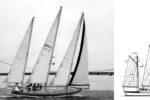
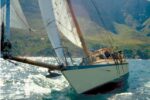
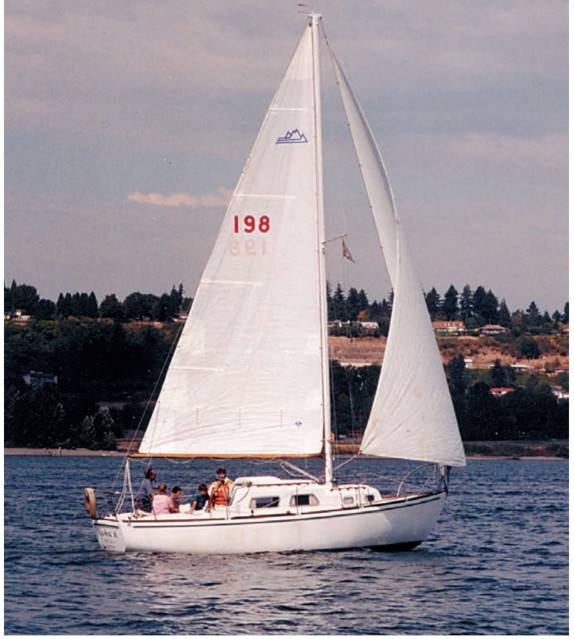
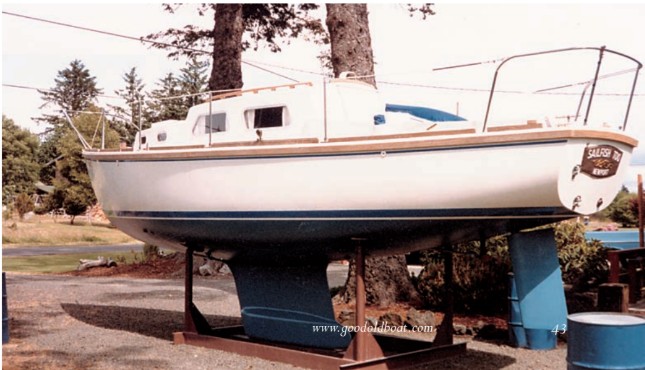
Compared to the plumb-bow, reverse-chine, round-cabintop look of modern production boats, Bob Smith’s 29-footer is a plain Jane. Her bow has a modest overhang, the sheer line is relatively flat, and her cabintop is just low enough amidships to avoid looking chunky. But she sails well.
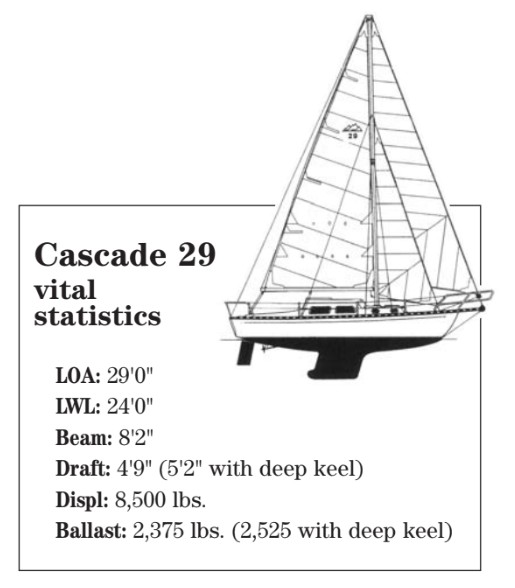
The Columbia River near Portland flows east to west and varies in width from a quarter to half a mile. Winds blowing 10 to 15 knots are typically from the northwest. However, 50 miles upstream the river narrows, creating the Columbia Gorge, one of the most popular and challenging boardsailing areas in the world. On warm summer afternoons, it is not unusual to have 20- to 30-knot gusts blowing across the deck. To produce a manageable yacht, Bob designed a masthead rig of moderate height that allows for speedy reaches when headed upstream and comfortable sailing to weather on the return trip. She was designed with 224 square feet of canvas in the mainsail and jibs of 138, 246, and 309 square feet.
Interior configurations
Attempting to acquire specific information from current owners about interior configurations is as challenging as trying to elicit accurate cash flow figures from an accountant at Enron. I’m not casting aspersions on the honesty of the owners; rather, the exact design and location of galley, furniture, and berths was a function of personal taste.
Since most prospective owners had families, the boats were designed to sleep at least four. In most cases, the skipper and first mate’s quarters are in the bow; crew may be relegated to quarterberths in the stern, on settees amidships, or both. In the case of Gavotte, our test boat, the only berth is in the bow.
Yacht Constructors offered three interior plans from which owners could fashion spaces, and in rare cases the company produced a finished boat.
Galleys were typically outfitted with a wood stove (this was the 1950s, remember). Most were located to port until one owner discovered that, considering the prevailing wind direction, a stove placed to starboard would more quickly evacuate smoke from the main saloon. Pity the crewmembers who developed hunger pangs on a starboard tack.
Such thinking presents a good argument for locating the head to starboard as well, though balancing weight may factor in that decision.
The location of the icebox was, in the words of one owner, “tricky.” If it was located on an aft bulkhead, you could access it more easily from the cockpit.
Solid construction
The entire Cascade fleet enjoys a favorable reputation for solid construction among current and former owners for two reasons: conservative construction methods and the hulls’ resistance to blistering, despite being pioneers in the use of fiberglass.
“We had a short period when the gelcoat manufacturers changed their formulation without telling us, and a few boats had dime-sized blisters. Once we realized that, we began recommending that owners add a barrier coat of epoxy to the hull, and the problem disappeared,” Wade says.
That the first hulls and decks were constructed for use by the builders themselves became a tremendous benefit to the future crop of buyers. From the outset, the builders were committed to building boats that were, if anything, overbuilt. Along with Wade, the other founders, by the way, were Tom Green, Merle Starr, Jarvis Gould, and Henry Morton.
“These boats were designed to go over the bar at Astoria,” Wade says, describing the intersection of the Columbia River and Pacific Ocean, which can be rowdier than a lumber camp on Saturday night. Long considered one of the most treacherous entrances in the Lower 48, it is a frequent location for Coast Guard tests of the durability and seaworthiness of ocean rescue vessels. During the tests, boats are often rolled 360 degrees. (Wouldn’t it be comforting to know that the people designing and building the boats manufactured today are testing them in those conditions?)
Wade’s example of the hull layup method illustrates the early state of fiberglassing: “A hull was all hand laid from resin poured into #10 paint cans we scavenged from paint stores and a special holder we designed. We had two guys on the outside slopping on resin and two inside with squeegees who were smoothing it. Then we would repeat the process,” he says.
Not as strong
The builders disdained the use of chopped fiberglass at the outset “because it is not as strong as woven cloth,” Wade says, proving his point by displaying a piece of fiberglass from the failed bottom of a newer production boat. “You will get voids between the strands of chop, even when it’s hand laid.” He contends that the condition is exacerbated when chopped glass is shot from guns like Quaker Oats.
The Yacht Constructors’ method involved spraying gelcoat on the mold and adding layers of 8- and 10-ounce cloth, followed by 20-ounce woven roving.
Then, to further assure void-free bonds, 44-inch wide layers of fiberglass were overlapped 22 inches. Similarly, bulkheads were tabbed their full length with five layers of cloth. “That adds to the cost, but fiberglass is cheap, compared to the alternative,” Wade says.
Unlike most seagoing yachts of the era, the mast was stepped on deck, for several reasons. “A shorter mast costs less,” Wade says, “and does not produce leaks in the cabin. Plus, if there’s a dismast in the ocean, a keel-stepped mast could produce a larger hole in the deck, which could fill the cabin with water. Our method worked on the boats we built, and we never had a failure.” Like most of the boat’s components, the standing rigging also was oversized.
The rest of it
Does all of this justify the designation “salty dog”? Not necessarily. But here is, as Paul Harvey says, “the rest of the story.”
Gavotte is owned by Don Ferrell, a retired Portland fireman who spends his spare time delivering boats to ports on the West Coast. Since her christening in 1977, this sturdy, white-hulled, sloop-turned-cutter has put more than 12,000 miles under her keel. Most of those miles were recorded away from the friendly confines of the Columbia River. Her name has its origins in the world of ballet, and can loosely be translated as “an old French dance in moderately quick quadruple meter.”
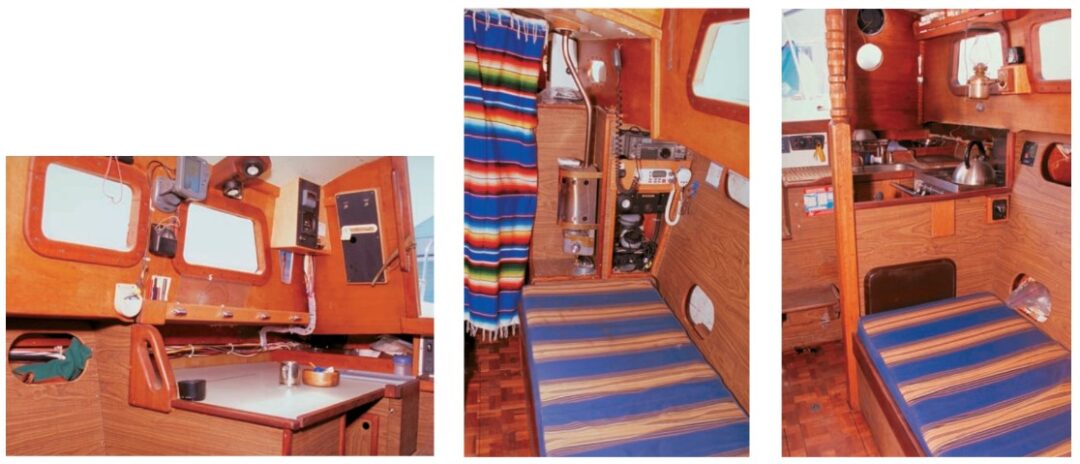
After purchasing the hull and deck, the skipper began the process of producing an interior that best suited his needs for offshore cruising. To that end, he enclosed aft compartments with a bulkhead and converted some of the space to storage for propane tanks and other gear. A chart-sized counter located at the foot of the companionway to starboard serves as a nav station; the galley is to port, and settees amidships. The main saloon is devoid of a table.
“I think they’re a nuisance. Eating off a tray is just as functional and avoids having the main saloon cluttered,” Don says, while retrieving a cafeteria-sized piece of plastic from behind a cushion.
On most 29s, the galley is located amidships along the hull to starboard. That arrangement allows space to port for the location of a dining table that doubles as a nav station. Since most sailing was on the river, the lack of a proper space for the navigator was of little consequence to most owners.
Short settees
Settees on Don’s boat are 5 feet 6 inches long, too short for an average adult to stretch out for a snooze, but long enough for laptop dining. A cubby below a bookshelf mounted on the port bulkhead adds space into which feet can be tucked while attempting a nap. Don has located electronics, a VHF radio, a stereo system, and a heater on the starboard bulkhead. Compared to the short settees, the V-berth is spacious, with space for two six-footers to stretch to full length comfortably.
Consistent with his taste for simplicity, the head houses a toilet in a space measuring 22 by 30 inches. A washbasin would be convenient. Clearly, Don’s boat is about sailing, and he has recorded the miles to confirm that attitude. Gavotte completed her first trip to Mexico in 1988, then meandered to Hawaii and Alaska on the return trip to Oregon. The dream of a lifetime for most of us, that voyage reflects a small fraction of the 70,000 miles he has accumulated on his many deliveries.
Gavotte’s sail inventory is restricted to a mainsail, a 125-percent jib, a staysail, and a 2.2-ounce nylon drifter designed for light-air work. While rummaging in a stern locker Don points out “a spinnaker I’ve never had to use.”
During Don’s singlehanded adventure, Gavotte averaged 117 miles a day while at sea. “She provides a wonderful sail,” he says. Describing her motion in 12- to 15-foot seas, he says “She is better than tolerable, but just shy of comfortable. She is not as sea-kindly as a 50-footer, but she’s OK.”
Downstream or up?
I was invited to experience Gavotte’s sailing characteristics firsthand. We poked her nose out of the Rose City Yacht Club marina and into 12- to 18-knot winds blowing up the Columbia River on a sunny summer day. At that point we had a choice: beat downstream or reach upstream.
Choosing the latter, in 8 to 9 knots of wind, our boatspeed hovered between 4.5 and 5 knots relatively easily and comfortably. Little chop contributed to Gavotte’s smooth ride. Don has placed 150 pounds of chain in the anchor locker to induce weather helm. The weight also puts the bow down and contributes to a smoother and more powerful ride when cutting through waves.
Since we had to beat downstream to the marina, I learned two things: boats that sail close to the wind make fewer tacks, and good mainsail controls ease the burden.
In 18 knots of wind, I estimate that Gavotte pointed to within 45 to 50 degrees of the apparent wind, even with an aging set of Dacron sails, though her speed dropped by a knot, as could be expected. She heeled comfortably at 20 degrees, her rail well above the surface of the river. Mainsail controls are out of the way at the end of the boom, and deadeyed outside the cockpit coaming, close enough to the helmsman to ease sail trimming. Seated just forward of the helmsman, a jib trimmer can control headsail shape from the weather side of the cockpit.
The clincher
Still not convinced she’s a “salty dog”? Here’s my final argument: John Hart, at the time 64 years old, completed a 3 1⁄2-year circumnavigation aboard the Cascade 29, Hooligan, in 1997. After purchasing the used boat for a pittance, he made unbelievable finds at distress sales acquiring a new engine, sails, stove, and rigging. His total expenditure: $10,000.
During the trip John suffered the usual unpleasantness you might expect on such an adventure. Bad weather. A near dismasting. Bad people. A near-mugging. And also hundreds of days under blue skies with trade winds blowing in the 20s.
His most frightening experience was a collision on the Pacific coast of Panama with a 600-foot bulk carrier. The incident removed the bow roller and headfoil and destroyed the jib and the upper section of the mainsail.
John continued to Hawaii, a 54-day ordeal under double-reefed main and storm jib. Of the incident, he says, “Tell that guy who said that Cascade 29s are the worst boat he sailed on, that not many other 29-foot boats would survive a collision with a 600-foot ship and make it back to port on their own.”
Despite being on the cutting edge of the age of fiberglass, the Cascade 29 is a strongly built vessel. She’s an excellent coastal cruiser and daysailer that will sail at 5 knots as long as she has 8 to 10 knots of breeze. Though her interior will reflect the taste and needs of her original owner, odds are she will have accommodations for a crew of four. And if you are a do-it-yourselfer, redoing the interior may provide many pleasurable hours.
Thank you to Sailrite Enterprises, Inc., for providing free access to back issues of Good Old Boat through intellectual property rights. Sailrite.com