Issue 19 : Jul/Aug 2001
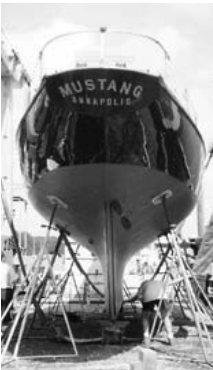
Should you consider doing this work to a wooden boat? A 1996 editorial in a sailing magazine I rather like, spoke favorably of the sheathing and glassing of Mustang’s hull and drew a lot of fire for it. The criticisms were philosophical, emotional, and technical. So were the remarks in support of the work.
It is fortunate that we live in a time and place where the maintenance and repair of pleasure boats is not highly regulated. Without regulation, the range of quality in the work will be wider, and the methods and materials employed will be more numerous. All this allows more room for innovation, but at the price of a wider range of quality in the outcome. Good.
Along with the manuscript for this article, the Kings sent copies of many letters responding to the 1996 editorial. At one end of the philosophical and emotional spectrum were persons who thought that a traditional plank-on-frame wooden boat should only be repaired using traditional methods. They offered philosophical, emotional, and technical reasons for their position. Their bias toward traditional plank-on-frame wooden boats was clear. At the other end of the spectrum were those who would consider any method of boat construction or repair using any materials that could be effective. Their philosophical, emotional, and technical reasoning tended to be quite different.
External to the Mustang controversy, and in a more general case, is the same spectrum of attitudes. There are those who only fix boats because they want to go sailing. This issue is all about biases so I must inform you, Dear Reader, that your technical editor is one of those. I begrudge no one, purist or pragmatist, that position. Indeed, in reviewing the comments this controversial modification evoked, some of the plank-on-frame advocates asserted that traditional repair is, in fact, the most pragmatic repair. Also, while I claim that I only fix boats to sail in them, I must acknowledge that without the emotional and philosophical content, there is little point in sailing at all.
The technical aspects of this modification will be confusing unless you clearly state the goal of the work. Even then it is critical to remember that a traditional plank-on-frame boat is only watertight because its planking is swollen with water. In contrast, the kind of modification made to Mustang will only work if all the wood planking and sheathing is kept dry. This contrast in technique and method makes it difficult for the two groups of advocates to find common ground.
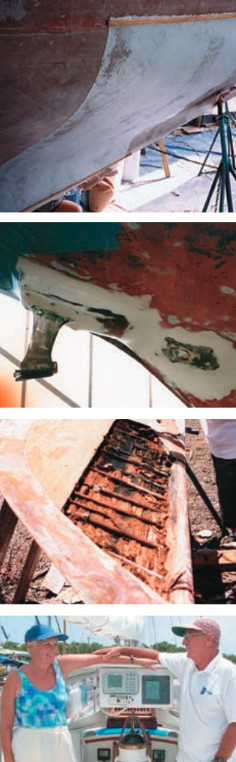
This was not a restoration in the strictest sense. The boat is now different. It was, instead, a modification thoughtfully chosen by the owners of the boat to keep her in service. They chose to do much of the work themselves and probably chose methods they were comfortable using. Their sweat, their boat, their choice. They have taken some heat for their choice, but they can handle it. Will it work? Will it produce a functional boat that sails well and pleases those who sail in her? So far, yes. It is difficult to argue with the seven years of liveaboard cruising the Kings have enjoyed since this modification was made. Brian writes: “The bilges are sweet; there is no sign of rot; and the hull is as fair as when we completed the restoration.
I asked a naval architect, whom I respect, what he thought of the process. He said it made sense to him. I said I didn’t think they needed to nail the sheathing to the planking. He said it probably was an OK thing to do. I asked about their choice of metals for the fasteners and the possibility that the original bronze fasteners, new stainless screws and ring nails, and the galvanized staples would form an electrolytic cell, and he said the sheathing has to keep the wood dry or that might be a problem.
So in the end it goes back to some fundamentals in the relationship between mankind and boats. Throughout most of the history we know of, man has built boats using local methods and local materials. The real validity of these traditional designs was that they were built “to a price” in terms of valuable labor and precious materials “to do a job.” Designs and methods evolved against these tough criteria. Better solutions were adopted as they were discovered. The process may have been slow but it was not static. Still, for all that, the fundamental problem is to keep the water out of the boat.
Thank you to Sailrite Enterprises, Inc., for providing free access to back issues of Good Old Boat through intellectual property rights. Sailrite.com