An ever-popular daysailer approaches 50
Issue 103 : Jul/Aug 2015
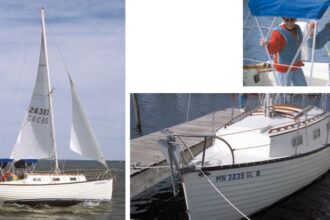
Let’s face it, some boats just tug at a sailor’s heartstrings at first glance. Call it love at first sight if you will, but some designs just have that “look” that no true sailor can help falling for. The Cape Dory Typhoon, designed by Swedish-born Carl Alberg, has always been such a boat for me: neither glamorous nor fancy yet with simple flowing lines that hint at an easy nature and make me want to get to know her better. Cape Dory Yachts built more than 2,000 Typhoons between 1967 and 1986, making it one of the company’s most successful models. Although small in stature, these charming little boats offer a yacht “feel” in a daysailer package.
For this review, I met John Bremer, who berths his Typhoon at my marina. Together we spent a pleasant afternoon aboard his Misty.
Design
Several popular New England boat-builders, including Pearson, Bristol Yachts and, of course, Cape Dory, built many boats to Carl Alberg’s designs. While he is perhaps best known for his Alberg 30 and Pearson Triton, the little Typhoon remains one of his most successful designs and brings a larger feel to a small boat.
The Typhoon, often referred to as “America’s littlest yacht,” was offered in three models, the most popular being the 18-foot 6-inch Weekender, of which more than 1,800 were built. Similar to the Weekender was the Daysailer, using the same hull but with a larger cockpit. The Typhoon Senior, a larger cousin at 22 feet 5 inches, was not as popular and only 60 or so were built.
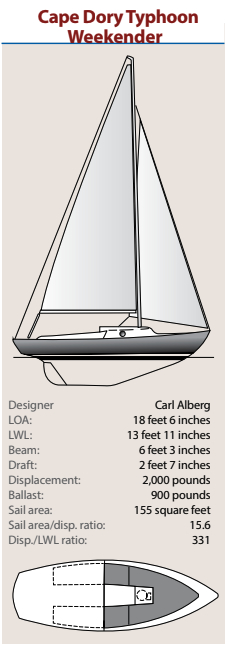
The Weekender and the Daysailer measure 18 feet 6 inches LOA, with a beam of 6 feet 3 inches, a draft of 2 feet 7 inches, and a waterline of 13 feet 11 inches. Displacements of 2,000 pounds for the Weekender and 1,900 pounds for the Daysailer do not make them the most dainty ladies in the harbor, but they carry their weight well.
A full-keel boat with a displacement/length ratio of 331, the Typhoon is not likely to win any races against today’s similarly sized boats, but neither will she work you as hard to get around the marks. But then, that is not the point of the Typhoon. Carl Alberg once wrote, “In my designs I go for a boat that you can sail upright without scaring the life out of your family or friends.” This is certainly true of the Typhoon.
The Typhoon’s sweeping sheer, long overhangs, and gently curved transom are reminiscent of a time when designers understood that form and function were closely related. Interior space and speed alone were not as important as comfort and grace under sail. Her full keel with its 900 pounds of ballast enables the hull to carry her sail well even in a bit of a blow. The rudder, hung from the keel, gives the helmsman just enough weather helm and feel to sense her moods and react to them. Unlike many daysailers of this size, the Typhoon does not require the helmsman to maintain a death grip on the mainsheet, ready to pay out with every gust. Her stability and forgiveness make her the perfect boat for both new sailors and old salts wanting a relaxed ride.
Deck and interior
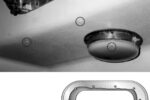
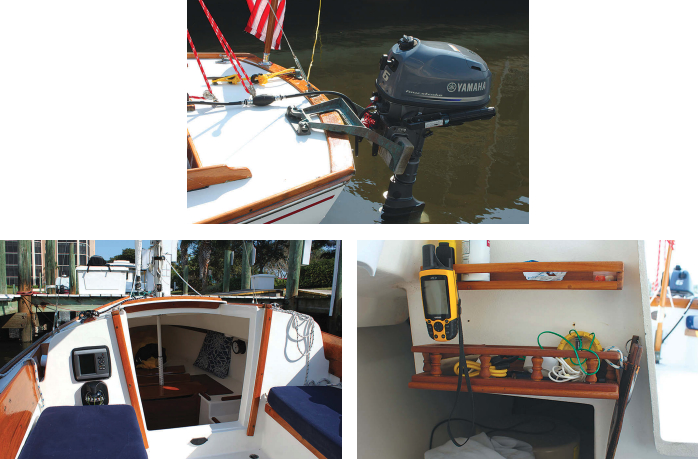
The Daysailer and the Weekender can be quickly told apart from a distance by the Weekender’s distinctive round ports in her petite cabinhouse. The Daysailer, with its larger cockpit and smaller cabin, does not have these ports. A few Daysailers were built without the little cabinhouse and are open all the way to the foredeck. These open boats have a molded cockpit with teak-slat seats where the Daysailer has only molded seat structures. The Daysailer’s little cabin or cuddy is primarily used as stowage for sails and gear, but some are fitted with a head or portable toilet.
The Daysailer’s cockpit drains into the bilge, so a good bilge pump is needed. Although it’s not as safe as a self-bailing cockpit, the boat’s stiffness under sail makes up for this drawback.
In the Weekender, as the name implies, there was an effort to create a sleeping cabin. This model has a V-berth and two quarter berths under the cockpit seats. The thought of four people sleeping on this boat is a bit scary, but a young couple with small kids could get by in camping fashion. The small cabin does, however, provide a private head and has plenty of room for gear. It is also a place to duck into during a passing rain shower. The ventilation is a bit limited but the addition of a fan or two will help. Many owners have fitted a boom tent to extend the livable space when overnighting.
Very early Weekenders had a wooden cabin bulkhead and cockpit similar to the Daysailer. Most have a molded self-bailing cockpit, which is a safer setup in the event of a knockdown.
Both models have large cockpits with plenty of room for four people. You do not sit on her, as you would many boats this size, but rather in her, which further adds to the small yacht feel. Although the seats are not the most comfortable, the cockpit proportions allowed me to brace myself with my feet while the boat heeled without feeling cramped.
In Cape Dory tradition, there is just enough teak on the deck — toerail, cockpit coaming, and some accent trim — to lend character without becoming a maintenance headache. Another feature that adds to her saltiness is the distinctive bronze hardware. Most of this hardware was custom-made by Cape Dory’s spinoff company Spartan Metals. Whether polished bright or left with a green patina, the bronze fittings add a feel of yacht quality not found in most other boats of this size.
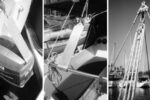
The sail-handling lines all lead aft to the cockpit. This was a bit of an innovation at the time and makes sailing her easy, even when singlehanding. Tracks are mounted on the cabintop for a working jib and additional tracks are fitted on the toerails for a larger headsail. The sheet winches are mounted along the teak coamings with bronze supports. While they are really more practical as snubber winches, they sure do look good. The end of the boom is aft of the tiller so the mainsheet is close to the helmsman.
Rig
Both the Weekender and the Daysailer came with an aluminum mast and boom. A tabernacle mast step on the cabintop allows the mast to be lowered for trailering. Although neither model was shipped with a compression post, many owners have fitted them to prevent the deck from sagging. The Weekender came with a fractional rig while the Daysailer has a masthead rig. Their sail areas are almost identical, with the Weekender having 155 square feet and the Daysailer 157 square feet. The mast height on the Daysailer is slightly greater at 25 feet 2 inches than the Weekender’s 23 feet 9 1⁄2 inches. Halyards are internal and led aft to the cockpit. The chainplates for cap shrouds and lower shrouds are through-bolted to the deck. A forestay and backstay complete the standing rigging.
Although the rig is fairly simple and easy to sail, many owners have fitted roller furling for the jib. The boats originally had boom roller reefing for the mainsail but, as this system never was satisfactory, most have been converted to slab reefing.
Construction
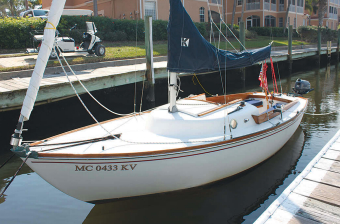
The Typhoon was likely overbuilt for a vessel of its size. The traditional hand layup of mat and woven roving exceeds the scantlings of many modern 30-footers. The deck is set on an inward-facing flange with bonding resin and screwed in place. More fasteners are added with the installation of the teak toerail. The deck has a balsa core with plywood reinforcing in highload areas, such as under cleats and chainplates. The ballast is internal, cast into place with low-shrink resin and then glassed over, so there are no keel bolts to worry about. Glassed-in floor members provide additional support and stiffening. The fiberglass rudder is built in two halves with a foam core and welded metal frame.
Under way
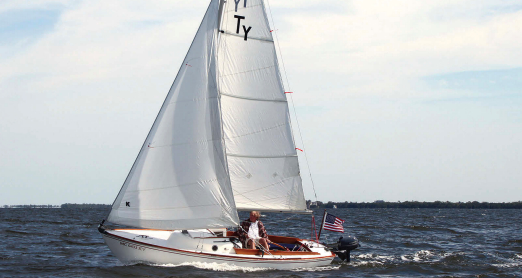
The day we took John’s Misty out for a jaunt across Charlotte Harbor it was blowing a pleasant 5 to 10 knots with a small chop of 1 foot or less. We easily motored the short distance to the bay with his 6-horsepower Yamaha 4-cycle outboard. This is about the size of motor most owners report is needed for the Typhoon.
Once out of the channel, we quickly set the sails and Misty set off on a gentle tack a bit off the wind.
Although by no means a sport boat, the Typhoon is still a fun boat to sail and can handle wind and waves that would keep other boats her size in port. This does not mean she cannot go out in light air as well. Her weight can be an asset in light and heavier air as she will carry her way through waves that would stop many boats of her size in their tracks. She does not point as high as some, about 50 degrees or so off the wind, and with her full keel needs some way on before you round up and tack, but she is forgiving of a helmsman’s inattention on most points of sail. You can feel a little weather helm but not so much as to make you work to keep her from rounding up. Set right she will even sail herself. Downwind she tracks well and, again, will almost sail herself; a beam reach will require just a bit of pressure on the tiller.
John enjoys sailing Misty solo and has made a few modifications, including roller furling on the jib, to make this easier. John likes knowing that he can take her out in weather that would keep many at the dock. He describes her as a cork on the waves. Misty is not just a heavy-air boat, he says, but also does well in lighter air. For a small boat she is surprisingly comfortable and that, after all, is what Carl Alberg wanted.
What to look for
Anyone thinking of owning one of these little yachts should be aware of a few things to watch out for when shopping. The biggest issue would be the balsa core in the deck. Core rot is a problem on many boats of this vintage and the Typhoon is not immune. Sounding with a surveyor’s hammer or a moisture meter will help. Also, the gelcoat may be in poor condition and this is particularly true on the deck. Look for stress cracking around high-load areas such as the chainplates. If the boat has been outside most of its life, the decks may need painting. The chainplates should be inspected for looseness, damage, and corrosion, and the rigging may need replacing. Check the cabintop for signs of deflection under the mast step. When checking below the waterline, be sure to look carefully at the rudder and its fittings for signs of damage or swelling.
Typhoons currently sell for as little as $1,500 to as much as $12,000, depending on condition and whether a trailer is included.
Conclusion
The Typhoon’s graceful lines and timeless beauty will please the eye of a landlubber and will melt the salt-encrusted heart of a hardened sailor. If you are looking for a small boat to introduce your family to sailing or a boat on which you can enjoy some easy relaxed time, the Typhoon may just be your lady.
Wayne Canning lives on his Irwin 40, Vayu, in Fort Myers, Florida. A marine professional for more than 35 years, and accredited marine surveyor, he’s now a full-time surveyor, freelance writer, and consultant/project manager on major repairs. He also runs websites for those restoring project boats. For more information, visit www.4ABetterBoat.com and www.projectboatzen.com.
Thank you to Sailrite Enterprises, Inc., for providing free access to back issues of Good Old Boat through intellectual property rights. Sailrite.com