Like its distinguished owner, this boat makes stirring melodies
Issue 45 : Nov/Dec 2005
What does a Cape Dory 25 have in common with a cello? For starters, they are both simple, strong, classic, beautiful, and graceful. How about melodic? Well, in the hands of Carter Brey, both the boat and the cello issue forth stirring melodies. The bubbling foam breaking the silence on a beautiful day on Long Island Sound is not unlike the wafting harmony of Schubert’s Symphony No. 8 (“the Unfi nished”) in B minor. The performer in both instances is consummate and skilled.
This lucky sailor is able to make music in either case, thanks to his skills, perseverance, concentration, and sense of timing. For one thing, his “day job” is mostly a “night job.” He is principal cellist for the New York Philharmonic, a job that takes him from Lincoln Center’s Avery Fisher Hall around the world to play in front of audiences expecting only the best of performances. On board Mary Ellen (named for his mother), it’s as if there is also an audience demanding only the best in classical performance. Every line or sheet is tied neatly in shipshape fashion, every piece of mahogany or teak is carefully varnished, and every move the captain makes is orchestrated for minimum wasted movement yet maximum performance.
Whereas we have Mozart, Schubert, or other composers to thank for the music Carter plays — either in solo performances or with the orchestra — we have George Stadel to thank for the Cape Dory 25, although many attribute its design to Carl Alberg. Carl did design the majority of Cape Dory boats — the Typhoon (Jr. and Sr.), the 22, 25D, 26, 27, 28, 30 (Mark II and the 300 Motorsailer), 31, 32, 33, 36, 40, and 45. And they all share a common theme: full-length cutaway keel, relatively narrow beam, a gentle pleasing sheer, and modest overhangs forward and aft.
In the same camp
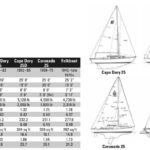
However, the Cape Dory 25 is based on George Stadel’s Greenwich 24, built by the Allied Boat Company in Catskill, New York. George was very much in the same camp as Carl Alberg and is well known for many seaworthy designs, especially schooners and pilot boats.About 845 Cape Dory 25s were built from 1973, when Cape Dory bought the design and tooling from Allied, to 1982, when production ceased. They were built in East Taunton, Massachusetts. The early boats in the nearly 10-year run were markedly different from the later ones (1979 and on). They had plastic or aluminum non-opening ports, no bridge deck, and a lower-aspect rig.
The 25D that followed (the D stands for diesel auxiliary) is an entirely different design. This 25-footer was designed by Carl Alberg, which certainly adds to the confusion over who designed the Cape Dory 25. When it was introduced in 1982, the 25D had a larger interior with 5-foot 11-inch headroom and a head in the area where the V-berth was traditionally located. Meant as a coastal cruiser rather than a weekender, it was 1,000 pounds heavier. The 25D sells for almost three times the price of a 25.
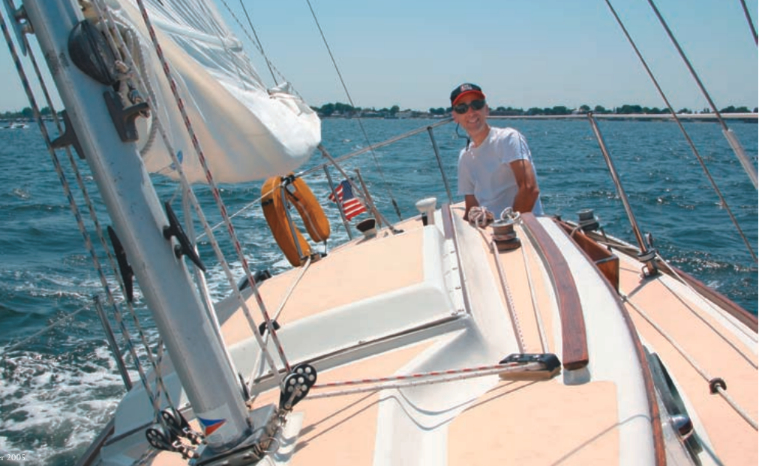
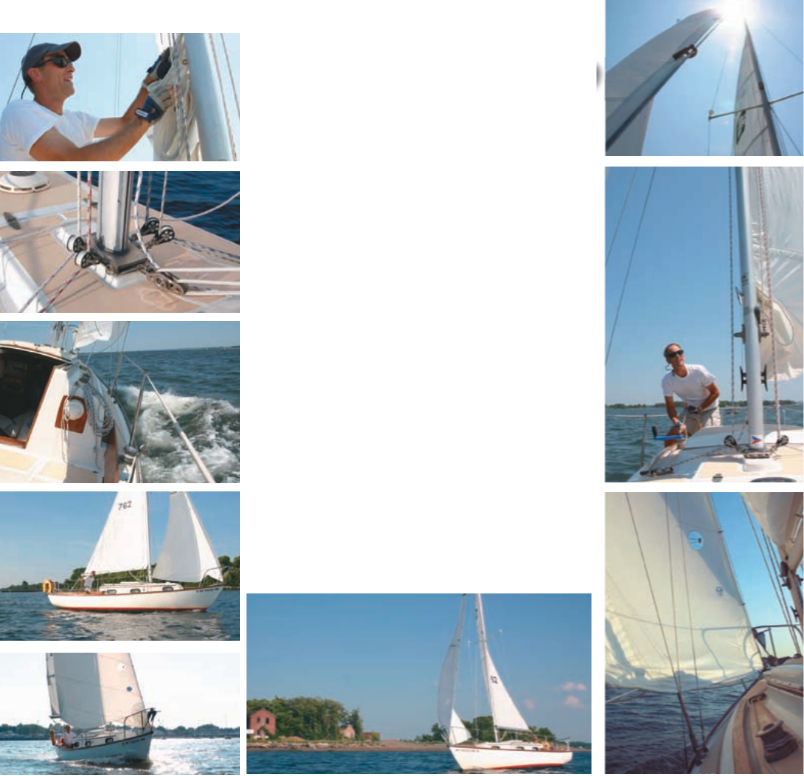
We sailed Mary Ellen on as perfect a day as one could wish for. It started out with 15 to 20 knots of wind that later in the afternoon dropped to 10 knots. Not a cloud in the sky. There was an ample supply of ice, soft drinks, and beer in the box. And we had smiles on our faces. What more could you ask? With a reef in the main and just the working jib (Carter insists he is probably the only sailor on City Island who uses hanked-on sails, and he’s not far off the mark), she heeled immediately to 15 degrees or so. But then she stuck there like a knife in peanut butter. A tad of weather helm disappeared when we released the traveler and, from then on, Whoohoo! A number of 30-foot boats eyed us enviously as we kept up. What a beautiful sail on a beautiful boat.
Pocket cruiser
George Stadel was known for his eye-catching, graceful boats, and the 25 is a fine example of his idea of a pocket cruiser. Displacing 4,000 pounds, 1,700 of which is ballast, she has a sail area of 264 square feet. With a beam of 7 feet 3 inches, she is initially tender, but once heeled over can take almost any kind of wind, provided the sails are appropriately reefed. Her motion underway is solid with very little hobby-horsing. She heaves to handily and is generally mild-mannered on most points of sail. With a capsize ratio of 1.83, a sail area/displacement ratio of 16.76, and a motion comfort factor of 21.87, it’s easy to see why owners feel comfortable in almost any kind of weather Mother Nature hands out.
She is typical of the Cape Dory quality, with a solid, hand-laid fiberglass hull; six bronze opening ports; a private head; a galley with a sink, icebox, and stove area; a hanging locker; and rich teak trim. Carter first came across the Cape Dory look when he returned with a friend from a daysail. There, sitting by the driveway, as he recalls, was “this sexy little boat, with round bronze portholes and a gorgeous shape. I was struck by the lines and the aesthetic look, and I thought, ‘Wow, this is affordable. Why not own one?’ ”
Neither he nor the friend knew what kind of boat it was, but it stirred Carter’s imagination enough to go home and start researching boats on the web. The boat turned out to be the famous Cape Dory Typhoon Sr. From there, he decided to look for the same kind of boat, only a little bigger. Hence the Cape Dory 25. “It’s not the fastest boat in the world,” he adds, “but it sure is beautiful. If I wanted to get somewhere in a hurry, I would buy a personal watercraft or a fl oat plane.”
Classic lines
Mary Ellen wasn’t all that beautiful when Carter bought her, although she had the basic classic lines he was looking for. Built in 1980, the teak had weathered to the usual rough gray appearance. Hours and hours of sanding brought back the rich warm glow, and Star brite Premium Golden Teak Oil did the rest. (He was unhappy with the finish after the first season, switched to Epifanes Wood Finish Gloss, and has been a happy camper ever since.)
In a description on his website at <http://pws.prserv.net/cbrey/maryellen.html> that belies his sophisticated, international recognition as an erudite cello player, Carter says, “The wood grain came alive as it greedily absorbed the first oil it had known for, I don’t know, probably years. Application was almost ridiculously easy. I laid it on unstintingly, using the narrow side of the brush to scrub it into the deeper crevasses, anticipating with the tack cloth a few centimeters ahead. With the color change, the boat seemed to change character; she gained gravitas, a kind of maritime seriousness. I talked to her under my breath the entire time to keep her relaxed and happy: ‘You look fabulous, baby, oh yeah. Uh-huh. Lookin’ good.’ I finished the second coat . . . oiling had taken about two-and-a-half hours. I smelled like a cabinetmaker.” This is a good old boat sailor who knows his priorities.
Soon the list of priorities grew but was manageable. A new Nissan 6-hp four-stroke outboard wouldn’t fit properly in the well (you couldn’t close the lazarette cover), but the “lethal attack of a half-bastard file and some sanding” did the trick. A sailing friend who is an electrician at Lincoln Center installed an alternator on the Nissan. Carter ordered new 4-inch hunter green interior cushions accented with burgundy piping, making the simple interior more beautiful. He installed a depth finder with mineral oil in a well. (We joked about how on Long Island Sound a depth finder is there to tell you at what depth you went aground.) He also laid on a coat of Interlux nonskid paint to portions of the coachroof and deck.
Experiencing the beauty
Next came mast-top improvements: VHF antenna, anchor light, and a Windex. He frequently sails solo (“It’s not that I don’t like other people, it’s just that I really love being out on the water alone, experiencing the beauty of sailing all by myself,” he says). Leading the main, jib, spinnaker halyards, boom vang, and topping lift back to the cockpit was a huge improvement for safety and convenience. The Cape Dory website was always a valuable resource. He picked up a full-length Fairclough winter cover for less than half the new price. The day we sailed he had just purchased a used #2 genny that fit perfectly and should prove to be a good all-around jib for Long Island Sound. His classic no-gadgets approach is challenged by only one modernity: a tiller autopilot and solar panel to help keep the battery charged up. The autopilot is actually used to get away from the “roar” of the already quiet Nissan. Carter takes the remote control up on the foredeck and is at peace with the world. Nice.
It’s not always easy and peaceful. Sometimes he gets caught up in a brisk sail eastward, only to realize he has to turn around and make good to weather, get back to the mooring, then hop a bus, subway, and taxi to Lincoln Center. The closest he’s cut it was one just-in-time arrival 15 minutes before curtain time.
On another occasion, scheduled for a series of chamber-music concerts on Long Island’s East End, he had a friend sail the boat to Shelter Island, where Carter lived aboard for the duration of the series. Since he had to hang his white dinner jacket in the minuscule hanging locker, he always appeared a bit rumpled looking. “Spartan accommodations, eh?” his colleagues would joke. The sail back to City Island was worth it, however. He and Mary Ellen covered the 100-mile journey in just two days, with a brisk northerly wind and an overnight stop at Connecticut’s picturesque Charles Island.
Rents a boat
Since his work involves traveling to the major cities and cultural centers around the world, Carter will occasionally rent a sailboat and see the local sights from the water’s perspective. On a particularly windy day in Germany, while trying to rent a 20-foot sloop, the rental agent asked to see his sailing license (they have such things over there). The best he could produce was a U.S. Sailing card, which was accepted. He often travels to San Diego and does some rent-a-sailing there as well.
Another activity Carter continues even when traveling is running. He’s a marathon runner, and that means keeping up an energetic training program no matter where in the world he is performing. A recent issue of Runner’s World profiled his running activities. Just reading it left me, well, breathless.
If you go to the New York Philharmonic website (<http://www.newyorkphilharmonic.org>), you will see a lengthy biography of Carter: the awards he has won, the masters he studied under, the prestigious schools he attended. If you ask him what his favorite cello piece is, he replies that it’s a simple question but a complex answer: “It’s easier to say who my favorite composer is [Mozart]. The honest answer is to say that I love whatever I’m playing at the moment.”
He also compares sailing and playing for a major orchestra to being an airplane pilot. “There are long periods of boredom, interrupted occasionally by moments of sheer terror,” he says. “They all require a balance between art and science. When you are out there and the sails are adjusted just right, and you can steer the tiller with one finger, there is the same kind of ‘in the groove’ feeling I get when playing a musical piece.”
Martini country
Born and raised in Westchester, New York, a suburban county north of New York City (“Martini country,” he quips), Carter learned to sail with his father. They owned a series of old wooden one-designs. Carter jokes that he was hijacked into indentured servitude to help maintain the boats.
“All of my childhood memories are of boats on stands in our front yard, which we sanded, varnished, painted, and so forth,” he says. “It’s a good thing there weren’t child labor laws.” Nonetheless, he learned the ropes well, later attending two U.S. Sailing certification programs to hone those skills. As a result, he performs shipboard duties with the same finesse and exactitude as he displays on the orchestra stage.
When I hopped into the inflatable for a photo session, my only instructions were to “come at me under every point of sail, from every direction.” Nary another word was said. It was a photographer’s dream.
Carter currently lives in Manhattan with his wife, Ilaria, and two children, Ottavia, 12, and Lucas, 9. They sometimes accompany him on board Mary Ellen, but often the kids get bored with the long, uneventful tacks that adults have come to treasure. His only regret is that his father’s health is too frail to allow sailing. He still visits his dad in Michigan and the stories of Mary Ellen continue to pique interest. As does Carter’s music.
Thank you to Sailrite Enterprises, Inc., for providing free access to back issues of Good Old Boat through intellectual property rights. Sailrite.com