It’s a classic beauty, but plenty tough
Issue 45 : Nov/Dec 2005
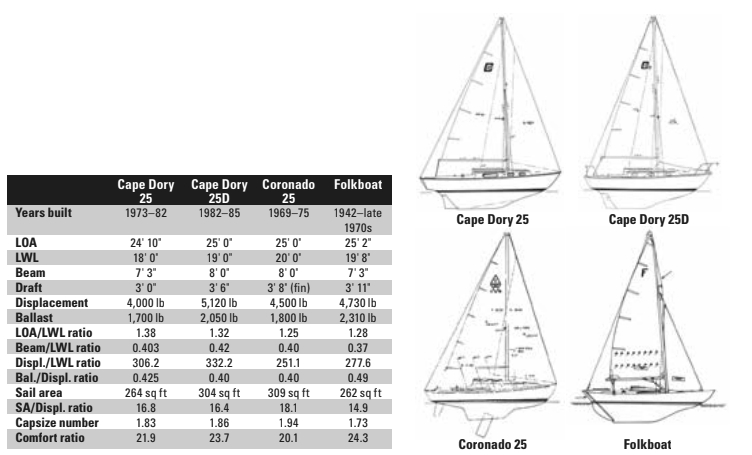
I didn’t feel it fair to compare the Cape Dory 25 to today’s fin-keel/spade-rudder offerings, so I included the venerable Folkboat. Despite passing its 60th birthday, the old Folkboat has a lot going for it. The design for the wooden, clinker-built Folkboat was created in Scandinavia in 1942. However, it was not until after World War II that the boat was introduced to North America. In the late 1960s and ’70s, the design was converted to fiberglass, and eventually the original transom stern was lengthened with a counter to produce a 27-footer.
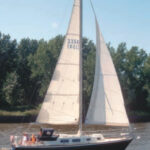
The Cape Dory 25 is another small classic that deserves more recognition than it usually gets. It has the same beam but is considerably lighter than the Folkboat. However, being designed for our East Coast waters, rather than the more rugged Baltic and North seas, it was given the same sail area. The result is a sail area/displacement ratio close to 13 percent higher. This will definitely enhance performance in light-to- moderate winds, of course, and its sail area/displacement ratio is on a par with other good designs of its era. Like too many small boats, it could use a few inches more draft to enhance windward ability. That’s often a decision of the builder rather than the designer, and I’m sure George Stadel, like most designers, used every inch of draft on the Cape Dory 25 that the builder allowed.
The late Bill Tripp’s Coronado 25 design compares very favorably with the Cape Dorys and the Folkboat, but in all probability could outperform them over a triangular course. The Coronado has the advantage of good draft, moderate displacement, and a generous sail area, which, along with Bill Tripp’s reputation for designing fast boats, should give the Coronado the edge. However, in my opinion George Stadel’s Cape Dory 25, with its well-proportioned overhangs and handsome sheerline, still wins hands down in the aesthetics department.
While the Cape Dory 25 and the Cape Dory 25D compete closely in aesthetics, I prefer the longer stern of the 25. It’s amazing what a difference a few inches of overhang can make. Within the total group, however, the Folkboat, with its classic sheerline and low freeboard, is far and away the handsomest to my eyes.
Any of these yachts would be a fine choice for coastal waters and the bigger lakes. Do remember, though, that the Folkboat is a product of an earlier era of wooden yachts and iron men. The low freeboard and narrower beam will provide neither the interior space nor the creature comforts of the other three designs in this comparison. Its accommodations, although quite good by 1950 standards, will appear very tight and uncomfortably Spartan when compared to any of the three newer designs.
For offshore ventures I would select either of the Cape Dorys or the Folkboat. The Folkboat’s very high ballast ratio will be very reassuring to many. Bear in mind that the ballast casting is iron, not lead, so the Cape Dorys’ ballast ratios are probably almost as effective for stability. The Folkboat has a proven record of Atlantic crossings, though, and the mast is keel-stepped.
All of these boats have a good capsize screening factor and reasonable comfort ratios, considering their size. Any one of them would make a grand cruiser for a sailing couple or a super singlehander for the adventurous.
Thank you to Sailrite Enterprises, Inc., for providing free access to back issues of Good Old Boat through intellectual property rights. Sailrite.com