An unconventional catboat with the advantages of small size
Issue 46 : Jan/Feb 2006
Allow me to interject an opinion in search of a premise: it is easier to travel from the cockpit to the bow on a 25-footer than on a 70-footer. And it is easier to tack or furl a 150-percent genoa on a 25-footer than on the same Big Boat, especially when the wind is blowing more than 15 knots.
I could go on, but you get the drift: most tasks are more easily completed on small boats than on big boats. And one more thing: getting from Point A to Point B when they are 500 miles apart is more easily accomplished at 55 miles per hour with a boat on a trailer when compared to spending the time necessary to outfit the boat, make the passage via water, and work out the return trip.
So small boats are more easily handled, boats with small headsails are easier to sail, and trailerable boats may present the opportunity to explore faraway vistas.
Garry Hoyt was making these points in the late 1970s, just prior to introducing the Freedom 25, a catboat that makes sailing easy, even for beginners.
Of overlapping headsails, Garry says, “Genoas are one of the major reasons that sailing is more difficult than it need be. Their size makes them difficult to trim. Their size often doesn’t match wind strength, which requires cumbersome sail changing. Off the wind, their shape is necessarily poor.”
Hoyt brainstorms
Among early (patented) brainstorms that became reality are the Hoyt jib boom, a rotating bowsprit, and the single-line reefing system that’s been pirated by anyone who can buy four blocks and some string.
Garry defied convention when he introduced the Freedom 40 in 1977. Designed by Halsey Herreshoff, the long, skinny ketch featured unstayed masts, nothing new to East Coast fishermen. As a pilot, Garry asked, “If old airplanes had wires supporting wings, but new ones don’t, why doesn’t the same logic apply to masts?” Good question.
The result: production models of Garry’s Freedom 40 and 44 with unstayed carbon fiber masts and wraparound sails. The boat had no engine. Garry called an auxiliary engine a “Freudian fixation, a petroleum boo-boo.” Instead, he fitted the boat with 16-foot sweeps. He was not alone in his thinking. Hinterholler Yachts produced more than 850 Nonsuch catboats between 1979 and 1991, and Tom Wylie’s WylieCat 30 has been produced in limited numbers since the mid-1980s.
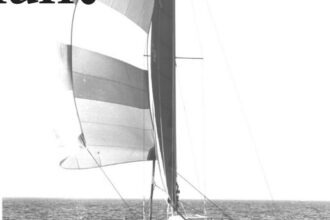
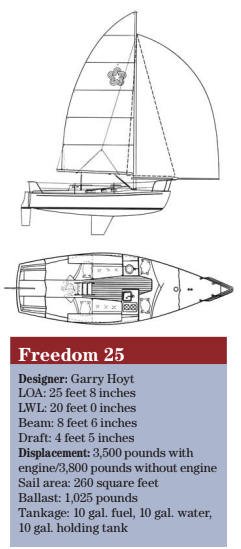
It was therefore no surprise that, when Garry introduced the Freedom 25 catboat in 1981, it also featured an unstayed rotating airfoil mast, a fully battened mainsail, a fin keel, and a spinnaker that shoots from a tube with a pole that mounts like a gun on the bow pulpit.
Garry says, “The airfoil wing was aerodynamically engineered to produce less drag than conventional stayed masts and to optimize airflow over the sail. Its ability to rotate freely means maximum power on every point.” Under sail, it did require a bit of tinkering, however. Catboats are best sailed with the mainsail sheeted with the leech to weather to overcome weather helm. To achieve that, the boom is sheeted to weather while the mast rotates to leeward where — when properly aligned to the elements — it is sheeted in place by a “mast tiller,” a line led aft to a cleat.
The power of the rig, however, eventually became its undoing. “It was more troublesome,” Garry says, “because, even with sails down, the mast would make way, which wasn’t always desirable. So they were more difficult to dock. And they would sail when on a moorage. So we came up with a more customer-oriented, fixed mast.” These were built into more than 50 percent of the boats produced.
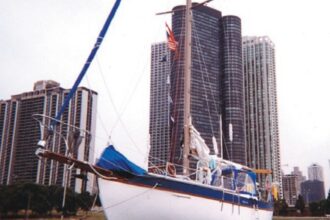
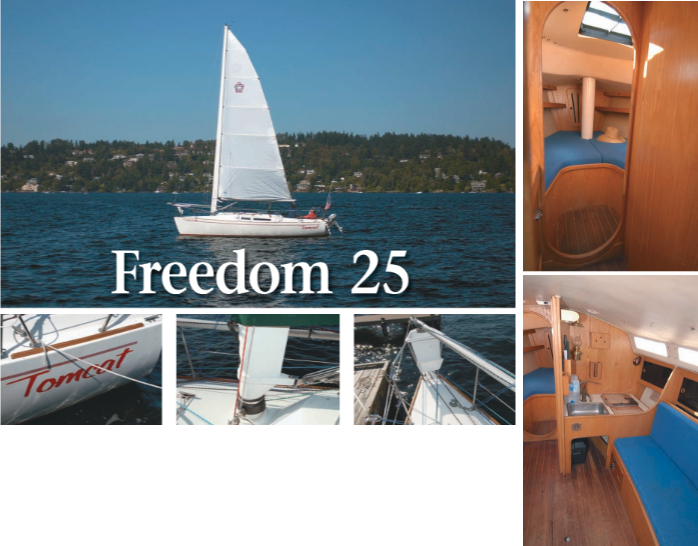
Often overlooked in the dialogue regarding the perceived idiosyncrasies of the Freedom (and those of her designer), is that the Freedom 25 is a looker. Her tall rig, matched with an aft-sloping cabintop and sheerline, along with a nearly plumb bow and a plumb stern, combine to produce a good-looking sailboat. She’s a sweetheart.
Deck layout
Without a forest of wire supporting the mast; minus a genoa and its halyard, sheets, and furling lines; and with the mainsail halyard and controls led to the cockpit, there’s not a heckuva lot involved in sailing the Freedom 25. In fact, given a tiller manager of some sort or an autopilot, the crew’s major time-filler may be agreeing on a menu or watching for traffic.
Comfortable seats that provide room for two bodies on each side of the footwell are 20 inches deep, and have 20-inch-tall backrests. The mainsail traveler is mounted atop the companionway, so it does not compromise the space.
The tiller can be secured out of the way, allowing the dining table to be relocated to the cockpit for dining under the stars.
Since there’s little reason to go forward, the 10 lines on the bow that manage the spinnaker and patented Hoyt Gun Mount are of little concern. Nonetheless, while going forward I learned that I’d have to become used to not having shrouds available as handholds. No matter, she’s fitted with lifelines and 24-inch-long teak handrails on both sides of the cabintop.
Belowdecks
For the same reason that it is not necessary to move 40-some feet from cockpit to bow on this 25-footer, crew won’t become short of breath belowdecks when traveling from the companionway to head and V-berth.
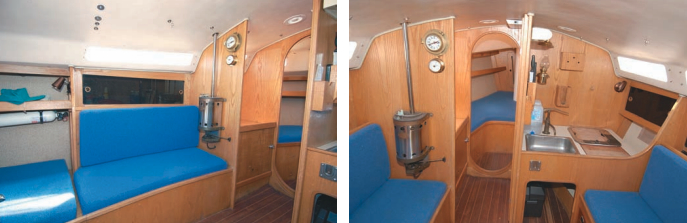
Interior spaces are highlighted by ash joinery accented with oak trim. The cabin sole is teak-and-holly plywood. The highlights of the main cabin, one not-so-vast space with enough headroom for a five-footer, are settees port and starboard long enough to seat four adults in a very upright position. In use, the portable dining table is fastened to the companionway steps. That complicates movement to the cockpit at mealtime, but the table is sturdy enough to support the weight of an adult.
Surrounded by wood joinery and accented by a bronze freshwater pump, the galley looks particularly yachty, despite being Lilliputian. An 11- x 13-inch stainless-steel sink provides a place to store dirty dishes and a two-burner alcohol stove provides a place to heat beans. A cooler is stored at the companionway.
The aforementioned settees extend aft under the cockpit and widen into quarter berths measuring 6 feet 6 inches that could be used as double berths if the occupants were paying very close attention to their caloric intake or were very well acquainted. At the least, she’ll sleep four, with skip- per and bunkmate in a 6-foot 6-inch V-berth in the bow.
Garry Hoyt’s reputation extends to holding portable potties in great disdain. To that end, he fitted the Freedom 25 with an enclosed head plumbed to a holding tank with overboard bypass for use offshore. It would be unfair, however, to compare this space to a head on a 70-footer.
Construction
Freedom sailboats were constructed by Tillotson-Pearson Inc. (TPI) to which Garry eventually sold his company. TPI has been on the cutting edge of fiberglass construction for the three decades that began in the 1970s. As a result, these boats have aged gracefully.
The hull is finished with gelcoat, under which is a hand-laminated fiberglass structure. Both hull and deck are cored with balsa, which offers a lighter structure than solid fiberglass, with similar rigidity but a quieter ride. The hull-to-deck joint is an inward-turned flange sealed with 3M 5200 adhesive and bolted through the teak toerail. That’s a method still being used by most manufacturers in 2005. Her outboard rudder is fitted with pintles and gudgeons beefy enough for a 30-footer.
The external fin keel is bolted into a deep sump, using the same method TPI employed on J/Boats. While she’s lightweight and easy to haul on a trailer, the Freedom 25 is a fin-keel boat which must be hauled and launched by a lift or crane, limiting her utility as a trailerable weekender.
Like any boat constructed in the era, she’s worthy of close annual inspection and maintenance. That deck fittings may leak is a reality to be faced, so cored sections should be examined for sponginess. The bedding compounds used in 1981 are not of the quality found in a chandlery today, so there’s always the possibility of leaks at ports and the hull-to-deck joint. However, owners of 25-year-old boats report few failures.
Performance
Ultimately, the Freedom 25 is about Garry Hoyt’s desire to produce a boat that sails quickly and easily. This she does. With the assistance of the new owner, Tim Blanchard, and former owner, Tom Cawrse, I was aboard for a short sail on Seattle’s Lake Washington in dying breezes.
No problem. She was underway seconds after removing the sail cover and marched smartly across the lake in 4 to 5 knots of wind. My guess is that speed ranged between 4.5 and 5.5 knots on a tight reach. Owners say she’ll maintain speeds of 4.5 to 6 knots comfortably in up to 15 knots of wind, at which point they tuck in a reef.
Lacking jib sheets, tacking and jibing are as simple as putting the helm over. The major shortcoming of a catboat, however, is an inherent inability to point close to the breeze. Garry’s solution: “Hoist a vestigial triangle-shaped sail on the spinnaker halyard, and performance will improve measurably.” I’ll take his word for it.
Sadly, many casual sailors view hoisting a spinnaker as an action akin to going to sleep on a railroad track. In
most cases that fear can be eliminated by a competent instructor, two or three additional crewmembers, and practice.
Garry describes this condition as “spinnakerphobia,” a condition that “has kept more shorthanded cruisers clutching the stern than mal de mer.” The alternative, he says, is his Gun Mount, “which is drastic, but utterly painless.”
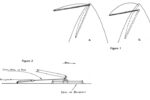
Taking this medicine requires removing from your memory banks the vision of a spinnaker pole, spinnaker sheets, and guys. The replacement is a 16-foot pole that slides through a swiveling sleeve (the mount) atop the bow pulpit.
Setting the spinnaker is a simple matter of attaching the tack and clew of the spinnaker to sheets at each end of the pole and hoisting the sail. To accomplish this you don’t leave the cockpit.
Once aloft, the sail is trimmed or doused by merely pulling the pole into the proper position and releasing sheets or guys from the cockpit. Get it? It is ingenious and perhaps easier to deal with than a bowsprit and asymmetrical sail. I’ll admit that it took me a few minutes to fully understand the concept but, having done that, I’m convinced.
Conclusion
So in the final analysis we have a boat that’s easy to sail under main alone, even in light air . . . a boat that will go to weather with the addition of a Dacron napkin in front of the main . . . a boat that will go very fast under spinnaker … a boat that can be easily singlehanded or sailed by grampa and gram.
Thank you to Sailrite Enterprises, Inc., for providing free access to back issues of Good Old Boat through intellectual property rights. Sailrite.com