English boatbuilders boast a 220-year history of doing things right
Issue 37 : Jul/Aug 2004
One of the oldest and most enduring boatbuilders in the world is the English company Camper & Nicholsons. Its impact on sailing has been immeasurable, from the design and construction of folding canoes and dinghies for an afternoon’s club racing to the mighty J Class yachts, from small offshore racers to elegant steam yachts and the largest cruising schooners. For more than 220 years, “Camper Nic,” as it is affectionately called, has influenced boating in all its facets.
In terms of fiberglass sailboats, Camper & Nicholsons’ heyday was the 1970s and 1980s, when it built more than 20 models of sloops and ketches, ranging from the Nicholson 27 and a 29-foot Half-Tonner to the C&N 70. First, and well-loved, was the Nicholson 32, introduced in 1963. Before telling her story, let’s recount the history of this most famous of English yards.
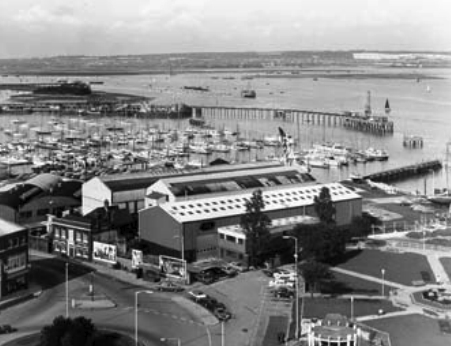
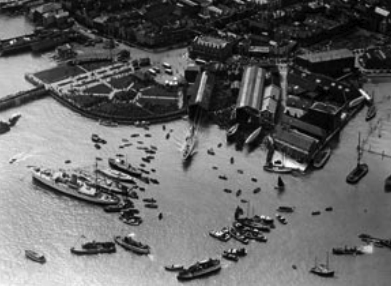
The company traces its roots back to Francis Amos. Almost nothing is known about his early career beyond the fact that he came from London and arrived in Gosport, situated across the harbor from the Royal Naval Dockyard at Portsmouth, in 1782. There, he leased a small plot of land to set himself up as a boatbuilder. The beginnings were modest, probably confined to building and repairing small, open boats for local watermen and fishermen. The venture prospered and by 1821 Amos had expanded into the building of small trading ships. Amos had no children to succeed him, and in 1824 his great nephew, William Camper, took over the lease of the yard and began trading in his own name.
Yachting flourished
In the time of peace and commercial optimism that followed the end of the Napoleonic Wars and fueled by the fortunes being made from trade and the burgeoning Industrial Revolution, yachting began to flourish. Due in no small measure to his carefully nurtured contacts with members of the newly formed Royal Yacht Squadron, William Camper was able to add yacht-building to his activities. His first known yacht, Breeze, a cutter launched in 1836 for James Lyon, whom he had canvassed for patronage and who was to become a staunch supporter, won the King’s Cup that year, furthering his reputation with the squadron. Buoyed by technical help from the Master Shipwright of Portsmouth Royal Dockyard and the close cooperation of the Gosport sailmaker, James Lapthorn, the demand for Camper’s vessels blossomed.
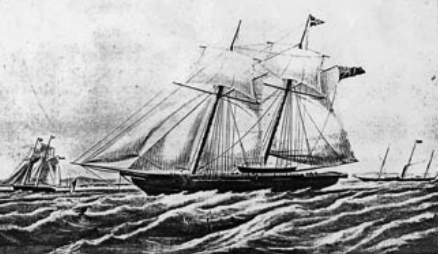
By the mid-1850s the Camper yard had produced a string of successful yachts, mostly schooners. The Nancy Dawson, built in 1847, recorded one of the first circumnavigations by a yacht and was the first yacht to visit the Bering Strait. The Marquis of Dufferin made a widely publicized voyage to Iceland and Spitzbergen in Foam, and the Wyvern recorded a fast passage to Australia to join the Gold Rush.
In 1842, 14-year-old Ben Nicholson joined Camper as an apprentice. The young Nicholson, after his successful apprenticeship and further studies in naval architecture, became increasingly involved in the yard’s design work and management.
Temporary decline
The outbreak of the Crimean War led to a temporary decline in yachting, and it was not until 1860 that Ben was able to demonstrate his true potential with the design and building of the innovative racing schooner, Aline. Aline’s outstanding success led to demands for a string of similar vessels. These, together with a smattering of cutters and yawls, were to be the yard’s main production for the next 20 years.
In 1863, William Camper retired, and Ben Nicholson — with the financial support of the Camper and Lapthorn families — took over the business and changed its name to Camper & Nicholson.
Underpinned by the success of the schooners, Ben launched into an ambitious program of expansion. By 1880 he had more than doubled the size of the yard — erecting sheds, joiner shops, and a sawmill — as well as expanded the laying-up and maintenance facilities. The arrival of his three sons in the firm occasioned a final company name change to Camper & Nicholsons.
New generation of Nicholsons
The emergence of Ben’s second son, Charles, as a talented designer heralded a further upturn of fortunes for the company. Charles’ design prowess took time to develop, but from 1887 onward he began to receive commissions for small racers. In 1892, the Dacia’s 14 first-place finishes in 14 starts propelled him to prominence. Charles’ burgeoning fame as a designer coupled with Camper & Nicholsons’ reputation for quality eventually brought the wheel full circle; by the turn of the century large yachts were once again being built to in-house designs.
Further expansion
The early years of the 20th century saw further expansion with the acquisition of a yard in nearby Southampton and diversification into the production of a series of large steam yachts. Further innovation came in 1914 with the world’s first large diesel-powered yacht, the Pioneer, which permitted a reduction in overall tonnage without reducing accommodation.
Capitalizing on this breakthrough, Camper & Nicholsons remained the world’s leading builder of motor yachts right through to the outbreak of World War II. The largest of these, Philante at 1,629 tons, was built for Sir T. O. M. Sopwith, owner and campaigner of Endeavour and Endeavour II for the America’s Cup. Philante later became the Norwegian royal yacht, Norge.
New thinking also continued on the sailing front with the introduction of a Marconi rig on Istria in 1912, Charles’ first and resoundingly successful attempt to design a 15-Meter. However, of even greater long-term significance was the boat’s lightweight, laminated-wood construction. This led to further developments and growing expertise in the use of lightweight materials that saw its fruition in the use of plywood in deck construction and in the building of high-speed boats and launches, minesweepers, and flying boats in both world wars. Among Camper & Nicholsons’ lesser known, but vitally important, contributions to the war effort in the 1940s were the modified motor gunboats, used as blockade runners for the import of high-quality Swedish ball bearings.
Hard on the heels of Istria’s triumph, Charles achieved a long-held ambition when he received the commission to design and build the next America’s Cup challenger, Shamrock IV, for Sir Thomas Lipton. Although his ultimate goal of winning the America’s Cup continued to elude him, he designed and built all the subsequent challengers up to 1939.
First Bermudan rig
Other innovations of this period included the first Bermudan rig on a large racing yacht and the three-masted staysail schooner rig on the giant 689-ton TM Vira, later renamed Creole. Vira was built for the famous American yachtsman Alexander Smith Cochran, who on his first visit to her took fright at the height of the masts and had 30 feet removed. At the conclusion of her first Mediterranean cruise, Cochran further ordered the removal of lead from the keel in compensation for her cut-down rig. But too much was removed, and her performance suffered. Later she was restored to her original condition.
It is for the J-class yachts that Charles Nicholson is best remembered. He designed and built Shamrock V, Velsheda, Endeavour, and Endeavour II. Two of his earlier designs, Astra and Candida, were altered to conform as closely as possible to the racing rules. In addition, Camper & Nicholsons undertook the alterations and re-rigging of King George V’s yacht, Britannia. It is quite a tribute to the standard of Camper & Nicholsons’ building quality that, with the exception of Endeavour II and Britannia (which was not originally built by the company and which was scuttled after the king’s death), all are still sailing.
This was an expansive era with larger-than-life characters and grand gestures. One commission illustrates this perfectly. At the end of a day’s racing, dominated by a Fife-designed schooner, Charles was approached by a prospective, titled buyer.
“Nicholson!” the man exclaimed, pointing at the fast schooner. “I want a boat to beat that one. I want all white paint and red upholstery. Good day!” Charles’ next glimpse of his client was on launch day.
It was also a period in which the courtesies were properly observed. In 1932, the new owner of a motor yacht, which had cost less than the quoted price to build, received along with his new yacht a check for the difference, handed over at the commissioning launch.
Art, not science
Charles’ predilection for the grand manner probably also cost him the America’s Cup. His conviction was that yacht design was an art, not a science. At the end of Endeavour’s America’s Cup challenge, defeated by management failure despite the agreed consensus that Endeavour was the faster boat, he initiated an exchange of plans with Rainbow’s designer W. Starling Burgess. Endeavour II, the next challenger, was simply a larger development of the original Endeavour. Ranger, the defender, designed by Starling Burgess in collaboration with Olin Stephens, was the end result of extensive tank testing and analysis, not only of their own concepts but also of the original Endeavour’s hull form. The result was, as the saying goes, “not pretty but highly effective,” and Endeavour II was comprehensively beaten.
Despite the glamour associated with the big racers, cruisers, and motor yachts, smaller classes were not neglected, and a number of successful racers conforming to the 6-, 8-, and 12-Meter rules were commissioned and built. The trend away from big racing yachts, accelerated by the death of George V and the disappearance of Britannia, was also mirrored in the world of offshore racing, where smaller boats sailed by amateur crews were coming to the fore.
Charles was also successful in this field. One of his cruising yachts, the 20-ton yawl Ilex, built in 1899, took part in every Fastnet Race between 1925 and 1939, winning the 1926 race.
It was during this golden period that the third generation of Nicholsons started to make its mark in the company. Charles’ son, John, began to help his father with his designs. In 1939 he sowed the seed for what was to become the next significant development, with the design and subsequent building of a “batch” of six 30-foot sloops. John remained under the shadow of his father, who never really retired and remained chairman until he died in 1954, aged 86. Not until then did John acknowledge that he had designed some of the yachts that had appeared under the Charles Nicholson design banner.
His cousin, Charles A. Nicholson (universally known as Young Charlie), who worked out of the company’s Southampton premises, did not suffer from the same shadow and launched his successful design career with the offshore racer, Yeoman, in 1937. After the war, he went on to produce a series of successful designs.
Frantic time
World War II was a frantic time with both yards working flat out. Southampton was engaged in repair work, and Gosport — despite the destruction of nearly 80 percent of its capacity in air raids — continued with prototype development, building motor torpedo boats, motor gun boats, landing craft, and folding canoes for commando units.
Immediately after the war, a shortage of wood precluded a swift return to yacht building, and the yards relied on repair work and government contracts. Gradually, restrictions were eased and new orders started to trickle in. In spite of racing successes and the production of such high-profile boats as the Queen and Duke of Edinburgh’s Dragon-class boat, Bluebottle, the company’s situation was precarious, and it received a further blow when the government’s demand for minesweepers and other small craft dried up in the late 1950s.
By this time, the fourth generation of Nicholsons was coming to prominence, with Young Charlie’s son, Peter, assuming a leading role. Peter was well aware of the looming dangers to the company occasioned by the tailing off in demand for large motor yachts, lack of continuity in orders from the defense sector, and the declining market for one-off boats. He fully realized the need for a range of standard boats, foreseen by his uncle John in 1939, and he clearly understood the potential of the new wonder material, GRP (glass-reinforced plastic, or fiberglass). Camper & Nicholsons, however, was not equipped to handle GRP construction, so, in 1960, Peter turned to Halmatic Ltd. for assistance.
The fiberglass era
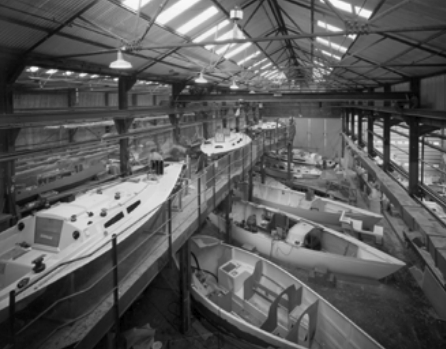
Halmatic, part of the Hunting Group, was an expert in the field of GRP hull construction and had already been approached by the American designer John Alden with a view to building hulls for the Alden 34, 36, and 38. Camper & Nicholsons’ first project with Halmatic was the Nicholson 36, the hull being molded by Halmatic and finished in wood to a very high standard at the C&N Gosport yard. About 20 boats were built, and such is their popularity to this day that whenever one appears on the market it is quickly snapped up.
The Nicholson 36 was only a first step. Halmatic needed an improved and smoother workflow, and Peter was wedded to the concept of a 32-foot yacht, which he termed “The People’s Boat,” to be built entirely of GRP and needing only final touches at the Southampton yard. The boat had to meet three conditions: it should be around 32 feet overall with 24 feet on the waterline, it should be easy to build, and it must cost no more than £5,000 (around $14,000 U.S. at the time).
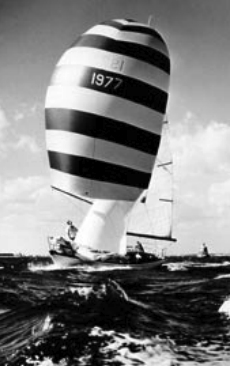
Thus was born the Nicholson 32. Her appearance was to prove a defining moment in the development and marketing of small sailing yachts at a time when the only other GRP production sailing yacht available was the Van de Stadt-designed Pionier (Dutch for pioneer) class, a concept that made no attempt to disguise or soften its “plastic” origins. Based on Peter’s design concept and accommodation plan and his father’s lines plan, he soon reached an agreement with Halmatic. Camper & Nicholsons would finalize the design details and market the finished boats. Halmatic would build the tooling, mold the hulls and decks, and complete them.
Design first
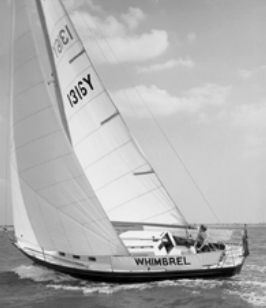
The head compartment was designed as a one-piece molding — another design first — and the wooden interior, cockpit coamings, and deck trim were built to a high standard. The lead keel was encapsulated within the hull molding. There was good headroom, and the interior was well ventilated and insulated. Five berths in two cabins (including a pilot berth) and adequate locker space, together with a usable galley, provided good accommodation. Much thought went into the sailplan, deck, and cockpit layout, making the Nicholson 32 comfortable and easy to sail. The 32 would also prove to be a magnificent sea boat and fast enough for Peter to comment later that, although the boat was conceived as a cruiser, “the trouble with Nic 32 owners is that they will insist on racing them!”
To finish the new boats, Halmatic turned to another company within the Hunting Group, Field Aircraft Services, which specialized in fitting out the interiors of executive aircraft. Brochures and sales literature were prepared, another innovation.
Many modifications
The first boat, Forerunner, was launched in May 1963, followed by a pre-production run of another five boats with mahogany joinery. Over the next seven years, a total of 236 boats were built with many modifications, including the switch from mahogany to teak woodwork, changes to hatches and ports, and relocation of features such as fuel tanks, anchor stowage, and battery boxes. Finishing work was transferred to a new Halmatic factory.
The year 1972 saw a major restyling program with a 3-inch increase in freeboard and a totally new deck, cockpit, and superstructure, as well as completely redesigned accommodations. When stock production finally ceased in 1981, 369 boats had been built, most of them finished by Halmatic and Camper & Nicholsons, although some were bought as kits and finished by other yards. A set of molds was exported to Australia as well, and at least 10 boats (possibly as many as 20) were built there. In 1976, when Camper & Nicholsons introduced the Nicholson 31, Halmatic withdrew the selling rights to the Nicholson 32 and marketed the yacht themselves.
Although shipwreck, fire, and neglect have taken their toll (10 boats have been lost), 320 Nicholson 32s are known to be sailing, and an active owners’ association has members in Europe, North and Central America, Australia, and Asia. The association has lost track of 39 boats, but it can be assumed that most of them are still in commission somewhere.
There were a few problems. Early boats had chainplates that passed through the joint between the hull and deck moldings, and remedial treatment was needed to eliminate the resultant leaks. Price increases in petroleum-based products in the wake of the 1966 Middle East crisis led to scantlings being reduced. This resulted in a few hulls having too much flexibility and, in hard conditions, damage to the furniture in the forward cabin. Minor design changes to the hull reinforcing solved the problem. When one takes into account the number of innovations involved in so many facets of the Nicholson 32’s emergence, the history of this traditional-looking boat has been remarkable for the lack of serious problems.
Wherever people get together to discuss “the ideal cruiser,” the Nicholson 32 is sure to be mentioned. For 40 years, the 32s have kept their crews safe on circumnavigations, Arctic explorations, transoceanic racing, and passage-making, as well as over the whole spectrum of smaller, unspectacular adventures that are the limit of what most of us care to face. Not bad for the first, real “People’s Boat” of the fiberglass age and not a bad milestone on Camper & Nicholsons’ 220-year journey through the history of yachting.
Design a year
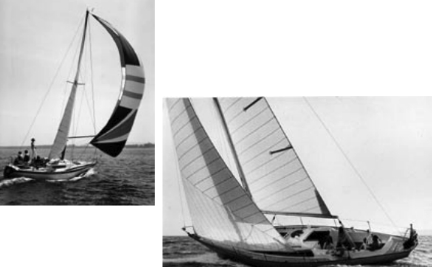
Further production boat designs appeared at a rate of roughly one per year, ranging in size from the Nicholson 70 down to the 27. The size and opulence at any given time mirrored the roller-coaster nature of the British economy. Highlights were the Nicholson 35 with 228 built; the Nicholson 38, based on the Alden Mistral design, with 134 boats; and the Nicholson 33, with 120 boats built. In all, more than 1,400 production boats emerged during this period, along with one-offs and a stream of prestigious restorations.
In spite of the unblemished high standing of the Camper & Nicholsons name and a continuing run of successful yachts, the company was struggling. At the end of WW I, even with 1,700 employees, the management structure had been adequate for the control of the two yards. Subsidiary companies such as the Gosport Aircraft Company, which were not crucial to the core business and which brought no profit, were quickly axed and by the beginning of WW II, there was only one subsidiary, a chandlery in Southampton.
After the war, the picture had become much more complex. On the positive side, the defense contracts of the 1950s had spawned C&N Electrical Ltd., originally set up under the Gosport yard’s foreman electrician, Roy Taylor, to fill a gap in the supply of control boxes for minesweepers. By the early 1970s, this had grown to employ 1,250 people in five factories and had spun off further developments such as Dialled Despatches, which manufactures pneumatic tube systems.
Separate company
Other successful acquisitions and startups were instigated, including the first marina, constructed on old Admiralty premises adjacent to the Gosport yard, which became a separate company, Camper & Nicholsons Marina Ltd. Set against such successes, the Gosport yard had come under intense pressure from the town to relinquish part of its premises for post-war redevelopment.
Through it all, Camper & Nicholsons Holdings Ltd. had remained a privately owned company and now found it impossible to raise sufficient investment capital to ensure its survival. In 1972, the company struck a deal with Crest Securities Ltd., a housebuilding company with ambitions to expand into the leisure industry. A new company, called Crest Nicholson, was formed. The timing was propitious and, initially, everything looked rosy: a successful London Boat Show, more than £2 million sold in exports, and much improved profit margins. C&N Electrical, which did not fit into the new mix, was sold for cash.
But prosperity was not to last. By the end of the following year, the country was crippled by strikes, subjected to spiraling inflation, and beset by IRA terrorism. The whole British market for new boats was stopped dead in its tracks when the government raised the VAT (value-added tax) on yachts from 8 to 25 percent. Crest’s shareholders panicked over the labor intensity of boatbuilding, and Gosport was under serious pressure to widen the client base with smaller, cheaper boats. A further setback occurred when a new bridge was built over the River Itchen, affecting access to the Southampton yard. In 1979, the yard was sold and the design facility closed.
Final ties broken
In 1981, a management buyout, financed initially by Tony Taylor, the then managing director of the yard, broke the final ties with the Nicholson family. He was given further financial and moral support by several of the yard’s clients, including Nick Maris, and the company became Camper & Nicholsons Yachting Ltd. Production of stock boats at Gosport continued until 1989, and the yard continues to build motor- and sail-powered luxury yachts. The following year, Camper & Nicholsons Yachting Ltd. (but not Camper & Nicholsons Marina Ltd.) was bought by the shipbuilding organization Cammell Laird, and in 2001 they sold it to the Nautor Group, whose ultimate owner is the Italian industrialist Salvatore Ferragamo. Stock production will start again in Gosport in 2004 with a 42-foot motor yacht.
Brokerage business
From the very earliest days, laying up, repairs, and brokerage had been an integral part of the Camper & Nicholsons activities. Most Mediterranean-based yachts returned to Britain at the end of each season. However, after WW II, cheap living, the Mediterranean climate, and the chance to avoid paying British taxes provided a powerful incentive for British professional crews to persuade their owners to keep their yachts in the Med permanently. The resulting loss of business persuaded Young Charlie to send his second son, George, to the south of France to help a family friend run a brokerage business there and to persuade the errant yacht crews back into the fold.
Given the quality of life on the Côte d’Azur, compared to the austerity of post-war Britain, this plan was never likely to succeed, but by 1961 George was generating enough business to be able to persuade his father to buy the brokerage, which became Camper & Nicholsons International. Over the years, other offices were opened and a very successful business was built up, both on the brokerage side and with a stream of prestigious building commissions for the Southampton yard.
Unhappy George
George, however, was not happy with the impending merger with Crest, so shortly before details were finalized, he resigned to form a separate company, Solidmark, which he also built into a successful business with brokerage, consulting, and yacht management as its principal activities. Then in 1992, in a further turn of the wheel of fortune, Nick Maris, by now the controlling shareholder in Camper & Nicholsons Yachting, proposed a merger between Solidmark and Camper & Nicholsons International, which resulted in George resuming control of the company he had left some 12 years previously. He has now retired, and Camper & Nicholsons International SA is part of the French Rodriguez Group.
Camper & Nicholsons Marinas Ltd. continues under the ownership of Nick Maris, specializing in all aspects of marina and waterside real estate development.
All three companies continue to uphold the name and, although no longer bound by formal ties, cooperate closely, each conscious of their responsibility to carry forward the unbroken tradition begun so many years ago when the young Francis Amos left his home on the banks of the Thames to seek his fortune.
Thank you to Sailrite Enterprises, Inc., for providing free access to back issues of Good Old Boat through intellectual property rights. Sailrite.com