Ongoing makeover for a Halsey Herreshoff racer/cruiser
Issue 43 : Jul/Aug 2005
Memory fails. Mike and Nancy Serozi can remember the highlights of their life together, of course. There were two sons, Reid and Brent, now 26 and 23. There were moves around the country from Connecticut to New York to California and back to Connecticut as a part of Mike’s work in information systems, primarily with Xerox. Then there was a final move to North Carolina. And interspersed over the years there were boats. Almost always there were boats.
But which ones when? Mike discovered sailing with a leaky wooden Lightning. Mike and Nancy are sure of that. “I had a ball that summer,” he says. Another leaky Lightning followed a bit later. A Sea Ox powerboat was in there toward the beginning. And a Catalina 25 was followed by a 21-foot Grady-White powerboat. There was a Chesapeake daysailer . . . more powerboats (for water-skiing when the boys were the right age for that activity) . . . and then more recently a 1978 Bristol 29.9.
Always their home was near a body of water. And usually there were boats. On this point Mike and Nancy agree. Absolutely. They may not have been in agreement on the purchase of some of these boats. In the Serozi family history, the story goes that Nancy had flown home to Michigan when Mike got it into his mind that they really should buy a sailboat. So without discussing it with his wife, Mike became the owner of The Moody Blue, a Catalina 25 in need of a new home and caretaker.
As he drove to the airport to greet his returning wife, Mike’s conscience was working overtime, aided by two small voices from the back seat that pointed out, “Mom’s going to kill you.” She didn’t, of course. Instead she was pleasantly surprised and enjoyed overnighters around the Norwalk Islands of Long Island Sound.
But that was then, and this is now, or so they say. The Serozi union survived a few minor indiscretions of the boating variety.
Got the urge
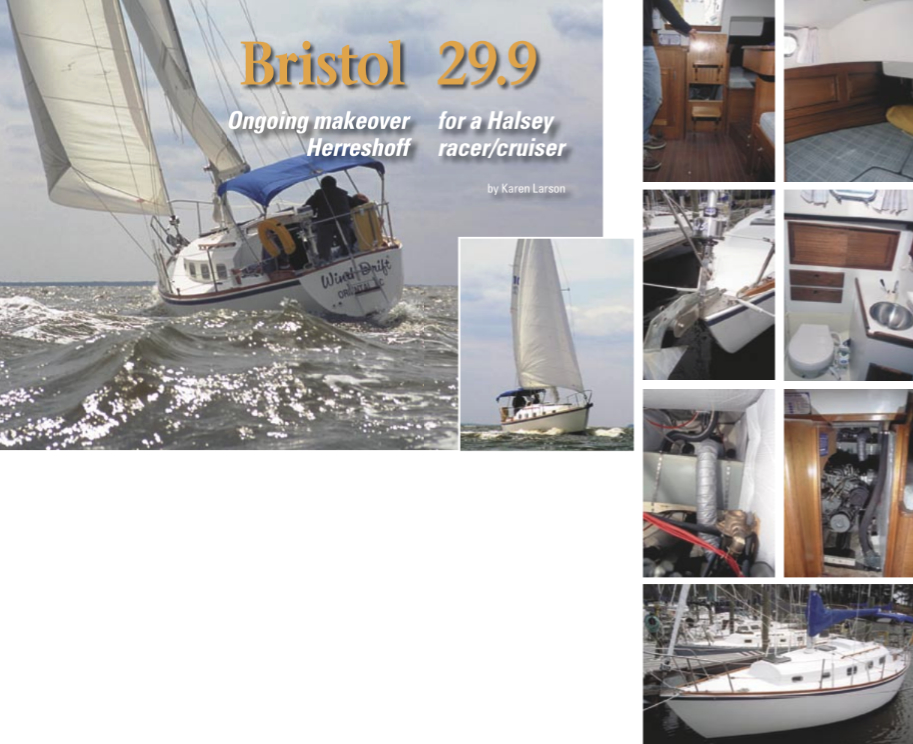
“Two years ago, I got the urge again,” Mike says with a sweeping gesture that encompasses the spacious cabin of Wind Drift, their Bristol 29.9. “We found a sad-looking Bristol in Oriental. It had been sitting for more than two years as a part of an estate settlement. It was structurally good. It just needed some cosmetic work.”
Oriental, North Carolina, is a lovely town on the In tracoastal Waterway, a real sailors’ paradise. The Serozis, whose home is about two and a half hours away in Cary, North Carolina, adopted a boat, a community of sailors in the Sea Harbour Yacht Club, and a small sailing-oriented town for their weekend getaways. (For more on the town of Oriental, particularly its sailors and visiting boats, visit . The website’s harbor cam is of particular interest. You can see what the weather’s doing right now, or you can have a look at a shot of Hurricane Isabel, tropical storm Gustav, and other significant events archived there. Keith Smith and his wife, Melinda Penkava, co-host the site.)
In some ways, Bristol Yachts is an offspring of Pearson Yachts, founded by Clint and Everett Pearson in 1956 (see Good Old Boat, November 1999). After Pearson Yachts was purchased by Grumman Allied Industries in 1966 and the inevitable conflicts of founder and new owner occurred, Clint went north to Bristol, Rhode Island, and started a new boat-building operation. The earliest models were the keel-centerboard designs: Bristol 27, designed by Carl Alberg; the 35, designed by John Alden; and the 32 and 39, both designed by Ted Hood. The Bristol 29.9, drawn by Halsey Herreshoff, was introduced in 1977. More than 200 were produced before they were discontinued in 1985 or 1986. Bristol Yachts went into receivership in 1998 and the assets purchased by H. F. Lenfest. The new company, a full-services boatyard located on the site, is called Bristol Marine.
Better cruiser
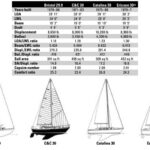
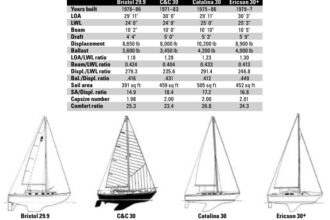
The 29.9 was designed to race under the International Offshore Rule (IOR) and Midget Ocean Racing Club (MORC) rules, but people soon realized that it made a better cruiser than racer. At 29 feet 11 inches with a 10-foot 2-inch beam and displacing 8,650 pounds with 3,600 pounds of ballast, it was called “less-than-sprightly” by Practical Sailor. The waterline is 24 feet, and it spreads 391 square feet of sail.
As a group, the Bristols are known for their quality construction, and the 29.9 is representative, with superior interior construction and hull-to-deck joints. A few were built with a centerboard, offering drafts of 3 feet 6 inches (up) and 7 feet 6 inches (down), but Wind Drift, as with about 75 percent of the 29.9s, has a fixed keel of 4 feet 4 inches. Since the channel to the Neuse River from her slip at Sea Harbour is often silted, Wind Drift’s shallow draft is an advantage. The day we went sailing, early in the season before dredging had been done, Wind Drift’s keel dredged sand for 10 or 20 feet as the Yanmar 15 provided the necessary propulsion to move it to deeper water.
While briefly neglected, Wind Drift is prospering once more under Mike Serozi’s care. He and Nancy list work they have done along with work that they have hired. They have replaced: hoses and clamps, the battery charger, the steel fuel tank, all lines, the knot meter and depth sounder, the interior cushions, steering cable, the head, the roller furler, and genoa. “We’ve been chipping away at it for a few years,” Mike says.
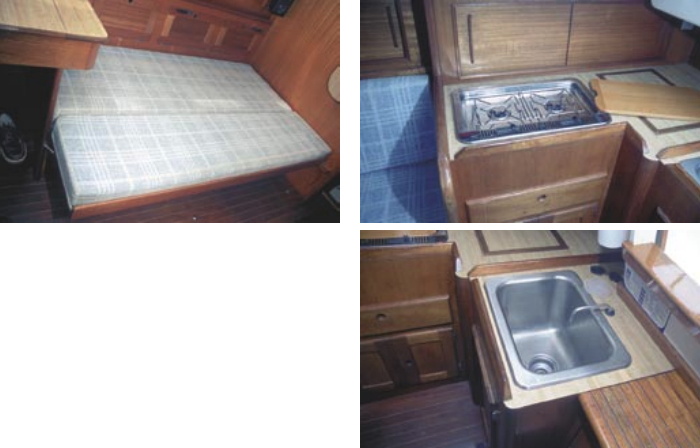
They removed the original pressure alcohol stove and replaced it with an Origo non-pressurized alcohol stove, added a binnacle guard and cockpit table. They also had the Yanmar completely overhauled, cleaned, and painted, and they soundproofed the engine compartment. They added a second manual bilge pump. One of Mike’s innovations is a Y-valve on the engine raw-water seacock that allows for pumping water from the bilge, a good way to get the antifreeze in the engine each winter. Mike also added a heating coil to the air intake for the diesel to make it start more easily. And they had the exterior teak shaved and now keep it bright.
There’s always more to do, of course. This summer the chainplates and stanchions are on the to-do list as rebedding candidates.
“What really attracted us to this boat,” Mike says, “was the interior wood, the incredible amount of storage, and the reputation of Bristol Yachts. We love sailing this boat; we feel safe in it.”
The cabin feels spacious, since the table folds away and is stowed on the bulkhead. The port bunk slides out to offer a fairly large double; there is a quarter berth to port with the typical navigation table at the head of the berth and a large cockpit locker to starboard. The galley is to starboard also. The head is to port across from a hanging locker.
Mike and Nancy rave about the capacity of the two connected water tanks: 63 gallons. The fuel tank holds 19 gallons, and the holding tank contains 20 gallons.
Wind Drift is a pretty and capable boat that Mike and Nancy Serozi are making more capable as each season passes. The plan, as they see it, is to go to the Bahamas some day. Watch for them there.
Thank you to Sailrite Enterprises, Inc., for providing free access to back issues of Good Old Boat through intellectual property rights. Sailrite.com