Living in a work zone tests patience
Issue 44: Sept/Oct 2005
WELL, WE’RE AT IT AGAIN: beefing up our hard-working 1950s racer in the hope she’ll sail onward for another hundred years. The job this time is replacing Siandra’s aft saloon bulkhead, which was thrown in by some cowboy calling himself a boatbuilder in the early ’70s after the original bulkhead disintegrated in a gas explosion.
It’s a job long overdue. Crossing the Pacific last season, the partition continuously reminded us of its inadequacy by shrieking and groaning as the hull twisted around it. It was such a poor fit to the surrounding frames, we would stuff the gaps with multiple paddle pop sticks in our quest for a quiet offwatch. We knew the bulkhead was flimsy, but only when my partner, Jamie, dismantled it did we find it was hanging from the deck beams by a few household nails.
For the first time ever, I have no practical involvement in the work. I’m chief wage-earner, bill-payer, part-time project consultant, and sounding board for Jamie’s ideas. Most importantly, I’m the dog who gets kicked on bad days.
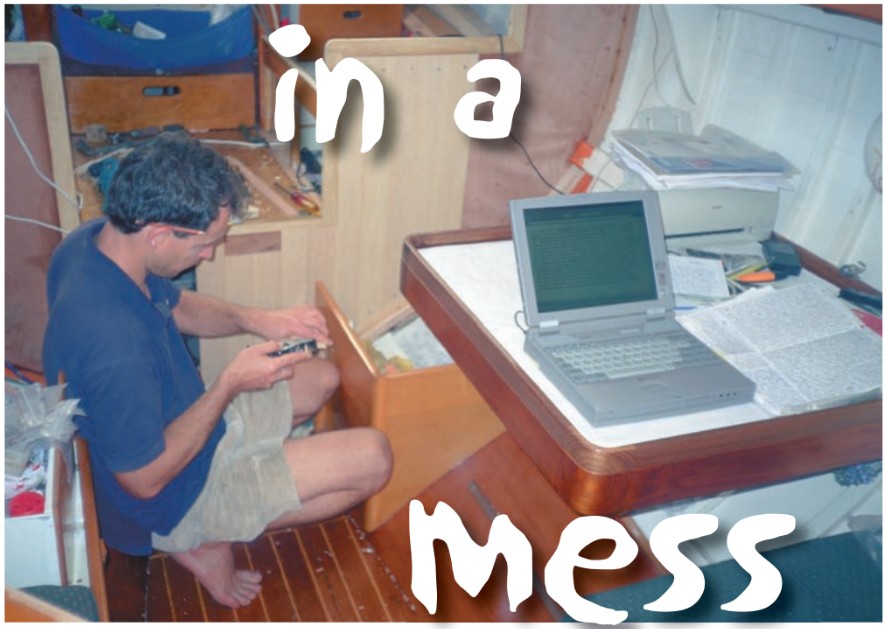
All of this I do just a couple of feet from the work zone. It’s a little like setting up office in the middle of a farmer’s field with someone plowing around you: peculiar when you’re accustomed to driving the tractor yourself. While I try to keep my mind on words and my fingers tapping at the keyboard, the smell of wood dust has me hankering for a chisel, a sanding block, or a paintbrush.
Living aboard while rebuilding the interior is taxing enough. Add the office, and it’s a nightmare. Aft of the saloon table (including cockpit, lazarette, quarter berths, engine-box, companionway, and aft saloon seats) has become a miniature boatbuilding workshop. Ever seen a joinery bench, wood store, machine room, paint shed, and laminating department squeezed into an area smaller than your car?
Vying for elbow room
The office smothers the chart table plus a chunk of saloon berth. Forward, vegetables and pasta vie for elbow room with homeless books, the sextant, and that vital sparkplug of productivity, the espresso machine.
Our “living area” is a joke. We have a single comfy seat, so at mealtimes one unlucky butt has to perch among the tools. Visitors stay in the cockpit. We eat meals on our laps, as there’s nowhere to shove the office. Wood shavings surface in cups of tea as if by magic.
Every night before climbing into bed we perform the Great Gear Shuffle, passing aft a ton of displaced equipment that spends its days on top of our bunk. At night, it litters the cabin sole — a minefield for sleepy souls who need a pee in the small hours. In the morning we shift it all forward again.
I’d be lying if I gave you the impression that we’re tolerant, flexible people who can take all this in stride. We’re not. The invisible demarcation line between workshop and office is hotly disputed daily. I have to vacuum my keyboard and printer to remove the dust that rains down constantly. Jamie, against natural urge and his belief in creative chaos, is forced to be a tidy worker. We both simmer at one degree above cranky.
Biting her tongue
As I write, I hear furious cussing from the workshop. Could be that the block plane has fallen into the bilge or that, in the middle of a batch of fast-cure epoxy, he has coated the wrong face of the wood. It’s better not to ask, I’ve learned. Just bite my tongue and pretend I’m 300 feet away in a room with soundproofing.
Meanwhile, Jamie has figured out that if my face is screwed into a frown and I’m thumping the keyboard as if it deserves a good thrashing, it might not be the right moment to tell me his dad’s latest joke, mention an interesting boat he just spotted, or suggest I put the kettle on.
But there’s one advantage of living aboard a restoration project: you never run out of incentive to complete the job. Despite irritations, work proceeds apace. Balks of New Zealand kauri and Australian silver ash have metamorphosed into a strong, well-fitting bulkhead. Jamie is in the final stages of rebuilding the surrounding furniture, my efforts have kept us financially solvent, and we’re still speaking to each other.
It’s a miracle, when you think about it.
Thank you to Sailrite Enterprises, Inc., for providing free access to back issues of Good Old Boat through intellectual property rights. Sailrite.com