How Roger Hewson managed the cut and thrust of boatbuilding

Issue 32 : Sept/Oct 2003
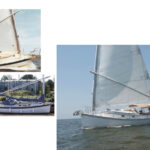
The history of Sabre Yachts is inextricably entwined with the life of Roger Hewson. Almost no one connected with the 33-year-old company based in Casco, Maine, contends it is possible to understand one without the other. And although the company founder no longer participates in the day-to-day operations of one of the few production-boatbuilding success stories left in New England, his ideas, opinions, and standards are as alive and well today as when he first conceived the company back in the 1960s.
“I have always enjoyed sailing and the creativity involved in designing boats,” Roger says, musing on his burning desire to get into the boatbuilding world some 40 years ago. That desire kept cropping up and intensifying in the late 1950s and early 1960s when he ran a very successful construction company in Montreal, Quebec. With contracts to build huge manufacturing, warehousing, and office buildings, as well as some of the exhibit buildings at the 1968 Montreal Expo, Roger used his engineering degree from McGill University in Montreal to ride the construction boom that was then sweeping Canada and the United States.
To most outside observers there seemed no reason for a successful businessman to leave a steady, ongoing concern in his native Canada to begin building sailboats in the United States. But Roger knew otherwise.
“I think it was in my blood, probably from an early age,” the 70-year-old retired executive says today. But it was more than that because Roger is not a man of mere whimsy, dreaming up impossible nautically related tasks just for the sake of personal challenge. Indeed, he is nothing if not a dedicated researcher, planner, calculator, and seriously self-disciplined designer and executor of personal philosophies and ideas — all of which have found their way into a long line of well-built, well-designed, and still highly prized sailboats, a line that now includes powerboats as well.
Quality construction
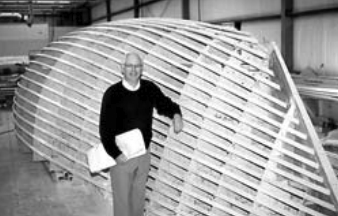
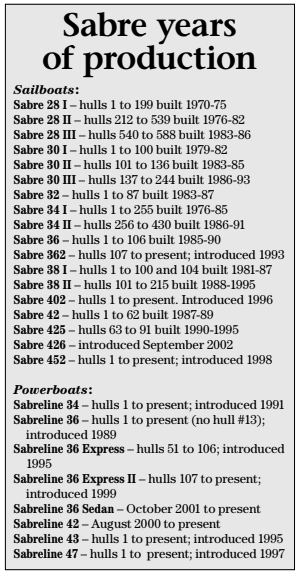
Indeed, the legacy of Sabre Yachts was built upon Roger’s early dedication to quality construction. That commitment is present in the 14 sailboat designs Sabre has produced, plus the three powerboat designs he drew in his final years at the company. Altogether, the company has turned out nearly 2,200 yachts, some 1,700 of which were built while Roger was at the helm of the company.
So where did his design genius and commitment to quality construction begin? Evidently, much of it began at age eight when Roger helped his father build a boat. A Canadian building contractor himself, Roger’s father decided in 1941 that the family needed a small motorboat for use at a resort lake an hour or so north of Montreal. Trouble was, with World War II raging boatbuilding materials and labor were in short supply. So his father decided to build the boat himself with young Roger as his assistant. “I remember fetching screws and tools for my father while he put things together,” Roger says of the project. “It was all very orderly. I think that appealed to me.”
It wasn’t until after the war ended and boatbuilding materials became more readily available that Roger got his first real taste of designing and building boats. Zippy little hydroplanes were very popular at the time, and Roger thought he could put together a particularly fast one. “I don’t really know what made me think I could do it,” he recalls. “I guess it just never occurred to me that I couldn’t.” A slightly faded black-and-white photograph shows Roger’s first hydroplane gliding through still waters. A very serious lad of 14 has his hand firmly on the tiller of the 5-hp Johnson outboard, making what looks to be good progress across the flat waters of a lake. He appears to be a lad who clearly knows where he is going.
Remained dedicated
Once bitten by the boatbuilding bug, Roger remained dedicated. He turned away from powerboats and took up sailboats with a vengeance. He raced 14-foot International Dinghies, noting what makes a boat go fast. He also raced Dragons, Lightnings, Flying Dutchmen, and Snipes. Much of this racing was done while Roger built up Hewson Construction Ltd., of Montreal. By all accounts, he was a man of boundless energy. “He was always doing something,” says his wife Charlotte, who met him in college in the early 1950s. “He loved to learn and was always energetic about it. He could easily do two or three things at once.” So it was natural enough that Roger turned his yen for building things and for sailing fast to his first notable racing sailboat, the Sabre Scow.
“It was really a very good boat in its class,” Roger recalls. It was also the first design in which he put his self-taught naval architecture skills to the test. In addition to an eye for good lines in a boat, Roger drew heavily on the knowledge packed into Elements of Yacht Design, a book by Norman L. Skene, first published in 1927. “I owe a lot to that book,” Roger says.
Dagger-like bilge boards
In the 1960s he developed the fiberglass 26-foot Sabre Scow. It featured very flat lines, almost like a surfboard, along with deep, stabilizing, dagger- like bilge boards. The name “sabre” was applied to it because of its ability to cut quickly through the water like a saber sword. The “scow” description was appended because of its flatness. Popular among racers, 13 Sabre Scows were produced between 1965 and 1967. This model was chosen as the one-design class for Montreal’s 1967 Men’s North American Sailing Championship regatta for the Mallory Cup.
But even with the relative success of his racing boat, Roger’s passion was probably misdirected. “I realized rather soon that you can’t make a living producing racing sailboats,” he recalls, noting the limited appeal that larger racing sailboats had at the time. “It was fun but not very profitable.” Still, Roger was hooked on boatbuilding. “The enjoyment of building the series of Sabre Scows was the driving force in my decision to sell the construction business and go into boat-building full time,” he says. Thus, in 1968 Roger began developing his idea for a fast, but also roomy, production cruising sailboat.
In the late 1960s, the world situation was conspiring to push Roger into the sailboat business in the United States. The tumultuous 1960s unleashed a worldwide movement for minority rights in multi-ethnic countries. Led by the civil rights movement in the United States, cultural minorities around the globe rose up to demand a bigger voice. French-speaking Canadians were among the minorities demanding, new privileges and considerations. Roger saw this as potentially divisive to the nation as a whole and a serious drag on business in particular. “It seemed the right time to re-establish a business elsewhere … away from the trouble,” he says.
The Sabre 28
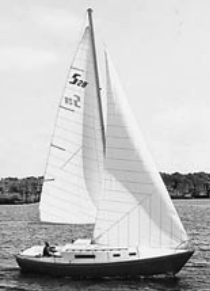
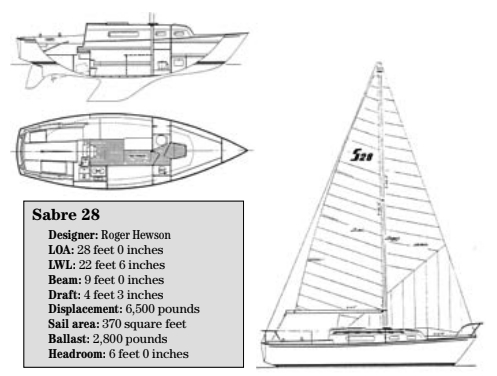
Roger had by the late 1960s already developed the lines for the Sabre 28, which his thorough research showed was the ideal size for a cruising boat at the time. The generation that fought World War II was coming into its prime earning years. A 28-foot fiberglass sailboat could be big enough and affordable for a buyer with a modest income and the leisure time to spend more than an occasional weekend aboard. But Roger was not alone in this analysis.
Indeed, he entered a fairly crowded field. By his own reckoning, there were no fewer than eight established boatbuilders producing hulls that would compete with the Sabre 28. To be successful, Roger knew he had to take steps to set himself apart from the crowd. One of those steps led to Maine.
“I was considering three locations, actually,” Roger says of his search for a place in which to build. Maine won out.
“The long nautical tradition here and the pride in workmanship were among the factors that finally settled me on being in Maine,” he says in the office at his home, located only a few miles from the Sabre production plant. The land on which the first plant was built was near property that had been in his wife’s family for generations.
Detailed plans
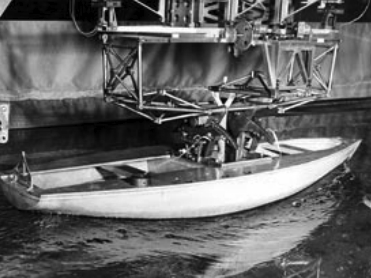
Roger left nothing to chance. He developed spreadsheets and unbelievably detailed business plans to back up his theory about the Sabre 28. One by one, he also developed comparative analyses of all of his potential competitors, considering such arcane but nonetheless important numerical variables as sales-to-inventory, sales-per-employee, sales-per-square-foot of production space, net profit as a percent of total corporate worth, and the like. And finally, as recommended by his favorite yacht design book, Skene’s, he built a scale model of the Sabre 28 and took it to the Stevens Institute of Technology in Hoboken, New Jersey. There, the model was tank tested for two days, running through all sorts of controlled sea and wind conditions in the institute’s famous water tank. “You can see how well it performed,” Roger says today, brandishing the aging graph on which each of the dozens of runs through the tank were pinpointed and quantified. Roger Hewson is nothing if not thorough.
Thus prepared in 1970, Roger and his wife, Charlotte (better known as Charlie), moved with their three children to what was then considered the backwoods of Maine. He personally participated in the construction of the 4,000-square-foot production plant, doing everything from helping to pour the concrete to swinging a hammer whenever it was needed.
At age 37, he says, he was having “a wonderful time,” often putting in 14-hour days to get the first Sabre 28 finished for the coming boat shows and to a small network of dealers on the East Coast.
Commitment to excellence
“We wanted to stand out with our commitment to excellent workmanship and materials,” Roger recalls, noting that teak toerails, solid teak joinery belowdecks, and hand-laid fiberglass hull construction were just some of the extra efforts that early buyers appreciated. Quietly, Roger boasted of building his boats by specifically not hiring experienced boatbuilders. “I wanted to train our workers in how to build boats the Sabre way,” he was fond of saying. “A boatbuilder will tell you how to build a boat his way. That can be pretty counterproductive.”
The Sabre 28 was well received in 1971. Starting with just six employees that year, Roger’s work force was up to 75 in just six years, producing nearly 100 boats annually. More importantly, though, Roger started right from the beginning creating a “Sabre culture” that continues to be an entirely self-sufficient and self-sustaining marriage of the producers, the product, and the end users.
His approach was deceptively simple: manufacture just about everything in-house, mainly to keep a firm grip on quality control but also to give the workers a sense of pride in their product. Indeed, Sabre workers built not only boats but also the various expansions of the production facility. Foremen and even supervisors had to have hands-on knowledge of the boats they were building. Nearly everyone, including Roger, got his hands dirty, brushed sawdust from his clothes, and knew intimately the smell of post-cured resin.
Roger was also a big believer in advertising of all kinds. In addition to display advertisements in national sailing magazines, he created a newsletter, encouraged owners’ associations, gave awards to owners and dealers, encouraged racing, and constantly schmoozed at boat shows and other media-related events. But his promotions of the Sabre line weren’t empty hype and huckster patter.
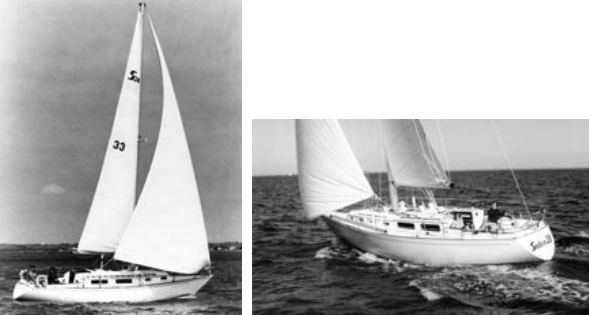
“He really believed in his boats,” one long-time Sabre owner says. “If you bought one and then met him at a boat show, he really wanted to hear about what you liked, what needed improvement, all that. He’d stand there and talk to you as long as you wanted. It was amazing.” Thus it’s no surprise that the Sabre 28 went through two revisions during its 15-year production run. There are Mark I, Mark II, and the Mark III versions, all incorporating new ideas that Roger felt would improve the boat.
Jack of all trades
No aspect of the creation of the Sabre culture was left to chance or to someone else’s interpretation. Roger himself did nearly all of the photography, layout, and graphic design of advertisements, newsletters, and company brochures for the 28 and subsequent Sabre sailboats. He even wrote the owners’ manuals for each of the Sabres created during his stewardship of the company. “I love the challenge of learning something new, something like photography,” he says.
By the mid-1970s, it became clear Sabre would need more than just the traditional-looking 28 to appeal to an increasing market for sailboats. Arab oil boycotts were rocking the American economy, sometimes doubling and tripling the cost of gasoline in a matter of months. The boating public responded with a renewed interest in sailing, eschewing gas-guzzling power-boats for cheaper-to-operate wind-driven vessels. That inspired Roger to design the Sabre 34, which is perhaps as renowned as the 28 but with some entirely different approaches to its design. The use of the reverse transom, common today but a bit unusual for its time, is a case in point.
Roger explains: “The driving force behind the designs of all Sabres, after the Sabre Scow experience, was determining market preferences regarding each detail in our design of the next Sabre model. Traditional transoms were the popular and accepted style in the 28-foot range, but we determined that reverse transoms were the popular choice in the 34-foot range.” His non-stop interaction with customers, dealers, and the boating public was Roger’s design guide.
Updated designs
“Also,” he continues, “we had decided on a contemporary overall design concept that could be gradually updated each year to the latest market preferences, rather than a more traditional design concept that would by necessity be locked into classic design features. It was really a business and marketing decision rather than a choice of which (type of transom) was right.”
Some manufacturers did get locked into a specific, unalterable “look.” Cape Dory Yachts of East Taunton, Massachusetts, is a case in point. Each Cape Dory design looked much like a larger version of an earlier one. Fans of the Cape Dory look were adamant that the company not change that look, making it tough to appeal to a broader market. “Possibly our attention to the marketing need for constant change is why Sabre is thriving today, and Cape Dory is no longer in production,” Roger speculates.
The Sabre 34 was introduced in 1976 and was another smash hit. The 28 had a solid glass hull, but the 34’s was cored with balsa, as all Sabres since then have been. Over the next 15 years, more than 400 were produced in Mark I and Mark II versions. Roger eventually included two options for the interior layout. There was the classic layout with a V-berth forward, head to port and hanging locker to starboard just aft of the forward berths, then port and starboard berths amidships, with a convertible settee, followed by a galley portside near the companionway, with a quarterberth opposite.
The other version had an aft-cabin arrangement, a common plan among many cruising and charter boats these days but fairly innovative for its time, at least in a boat of only 34 feet. That arrangement placed the head aft and the galley closer to amidships, with private cabins aft and forward. Thus, two couples could cruise in relative privacy. It was hugely popular.
Advertising paid off
When the 34 was introduced, Roger’s relentless advertising also paid dividends. Most national sailing magazines began taking the little company in Maine seriously and liked what they saw. “The 34-footer strikes a balance between tradition and innovation, between the ‘tried and true’ and the ‘oh wow,’ ” wrote Sail magazine. “Like her forerunner, she has the go-anywhere quality born of common-sense design and painstaking construction.”
Other boat reviews struck a similar note. Sailing World magazine named the latest Sabre 34 model Boat of the Year in 1987. Praise like that may account for why the Sabre 34 eventually became the longest-running hull design in Sabre history. It also accounts for Sabre Yachts moving quickly into boatbuilding overdrive.
The Sabre 34 was followed by the introduction of the Sabre 30 in 1979. Even devotees of the 28 were asking for a little more room in a pocket cruiser, and Roger wanted to be sure they got it. Besides, it was becoming clear the market for the 28 would eventually run out, which it finally did in 1986. Roger wanted to be sure he had a boat to take its place, particularly for the part of the Sabre culture that couldn’t afford a Sabre 34 but still wanted to be part of what was rapidly becoming a well-known and well-liked brand of boats. The Sabre 30 lasted until 1993 in three versions. In all, 244 hulls were produced.
By 1980, Sabre Yachts was in full stride. Although the nation as a whole was in an economic mess, with high inflation rates (10 percent), high interest rates (15 percent), and high unemployment (more than 6 percent), Sabre Yachts was expanding. Having expanded the production facility in the mid-1970s to 30,000 square feet, Roger undertook another huge expansion to accommodate his latest and biggest design, the Sabre 38. The design sported the reverse transom that was becoming a hallmark of Sabre sailboat hulls. Three versions of the Sabre 38 were built between 1981 and 1995, with more than 200 hulls completed.
First powerboat
By the late 1980s it was clear that a growing number of boat buyers were bypassing sailboats altogether. With gasoline prices stabilized for nearly a decade, the demand for powerboats was up, and Roger was ready with his first commercially produced powerboat. That 14-year-old in the hydroplane was getting his dream-come-true job. In 1989, the Sabreline 36, a fast trawler-like hull, was introduced. It was popular and well received by the boating press. But rough financial seas were ahead.
The Sabreline 36, along with all Sabre Yachts, was not immune to the double whammy that the federal government and world events soon slapped on the boating industry. Starting in early 1990, lawmakers in Washington passed a 10 percent luxury tax on American-made boats. In August of 1990, Iraq invaded Kuwait, prompting skyrocketing oil prices and leading to an American economy that remained badly stalled until well after the Persian Gulf War was won in early 1991. The economy faltered, and the entire American boatbuilding industry contracted radically with many companies simply going out of business.
Sabre Yachts also came close to losing the fight with the financial Grim Reaper. With boats piling up in inventory and much of the American banking system on shaky footing, a major lender suddenly got nervous and called for full payment of a big Sabre loan. “We wouldn’t have had to close our doors if they had stuck with us,” says Nancy Basselet, who was then and still is the company’s chief financial officer.
In early 1992, with the loss of the bank support, the plant was temporarily shut down. However, several venture capital groups immediately came forward to see if they could help the company, including Sabre boatowner Ed Miller who heard of the company’s plight. Ed was so taken with his Sabre sailboats over the years that he stepped up and in less than three weeks found funding to get the company rolling again. “It really was a tribute to the company and our customers that he came forward,” Nancy says.
Still produced
Several weeks later the plant was back in full production, and the design for a new Sabre 362 was developed jointly by Roger and renowned yacht designer Jim Taylor. This new model was chosen as a Boat of the Year by Sailing World in 1993. Roger was clearly at the top of his game. Despite this and his many other successes however, he was forced to relinquish full ownership of the company and became a shareholder with the new investor group.
In 1993, amid tears and good wishes, Roger retired, leaving Sabre Yachts to a team of 150 employees, many of whom he had personally selected and hired during the previous 23 years. “He left us in wonderful shape,” says Nancy Basselet. Roger had hired her as a secretary, but saw too much potential in her to leave her to answering phones and the like. Her story is one of many company legends repeated at Sabre.
Since Roger’s departure, the company has been led largely by president and CEO Daniel Zilkha, whose management style is different from Roger’s. With a background in running a half-dozen different types of businesses, Daniel, 60, has continued to build Sabre’s growth through acquisition and expansion while maintaining Roger’s original commitment to being “the Rolls Royce” of production yacht builders. This led to use of the patented SCRIMP method of resin infusion, which results in higher glass-to resin ratios in hull and deck laminates.
In 1996, Daniel was instrumental in converting a recently acquired boatyard in Rockland, Maine, into North End Composites, which has become a notable industrial, commercial, and architectural composites construction company.
Despite its diversified role, North End maintains an active presence in the marine mold-making and the parts production business for Sabre as well as for other boatbuilders. According to Sabre’s marketing manager, Bentley Collins, the decision was made five years ago, when North End was molding parts for the U.S. Navy’s Aegis-class destroyer program, to separate North End from Sabre. Both companies share the same shareholders, who are mostly members of the Zilkha family.
New powerboat line
In June, North End Composites announced its own line of powerboats called Back Cove Yachts. Bentley Collins says the line is targeting the 29- to 34-foot, single-engine range, while Sabrelines will continue to be bigger. The balance between sail and power, Bentley says, has helped the company endure the vagaries of the economy.
In 2001, Daniel oversaw yet another expansion of Sabre’s facility in South Casco, adding some 18,500 square feet of manufacturing plant for various new non-Hewson designs that are currently in production.
And this year, Jim Taylor, who has designed all Sabre sailboats since Roger’s departure, was commissioned to design a new mid-size boat, the 386.
Today, Roger is engrossed in another consuming project, writing down what he has learned about managing companies and inspiring people. The book, to be published later this year, also will describe how a man who is the ultimate do-it-yourselfer and self-starter remains energized.
“I’m having a wonderful time doing this,” Roger says enthusiastically as he walks among tables piled high with reference books he has bookmarked, annotated, and underlined within an inch of their lives. “This is a wonderful challenge.”
Thank you to Sailrite Enterprises, Inc., for providing free access to back issues of Good Old Boat through intellectual property rights. Sailrite.com