A spacious cruiser with modest sailing performance
Issue 55 : Jul/Aug 2007
Allmand Boats of Hialeah, Florida, introduced its first model around 1965. At that time, the company’s product line consisted entirely of powerboats. While it did manufacture small, outboard-powered open and cuddy cabin boats, most of its models were 28 to 34 feet and fitted with inboard engines.
It wasn’t until the OPEC oil embargo and associated energy crunch of the 1970s that Allmand, along with a handful of other powerboat builders (Rinker, Bayliner, and Reinell to name a few), began dabbling in sailboats. Eventually, Allmand discontinued production of its powerboat line, concentrating entirely on sailboats during the last few years of its existence.
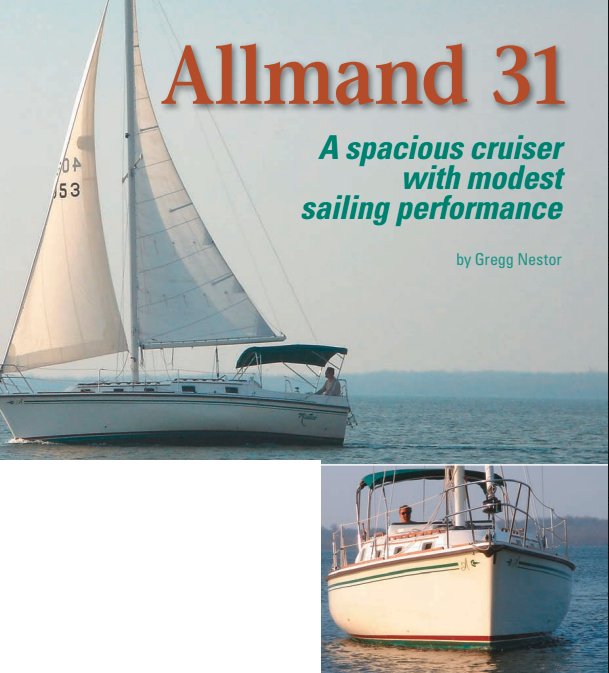
While Allmand’s powerboat line once was quite extensive, its sailboat offerings numbered only three: the Allmand 23, Allmand 31, and Allmand 35. Introduced in 1979 and manufactured until 1985, the Allmand 31 was, and continues to be, the most popular of these models.
The industry-wide recession of the 1980s hastened the demise of many small sailboat builders, including Allmand Boats. Though the company closed its doors in 1985, the family began building powerboats again in 1993.
Design
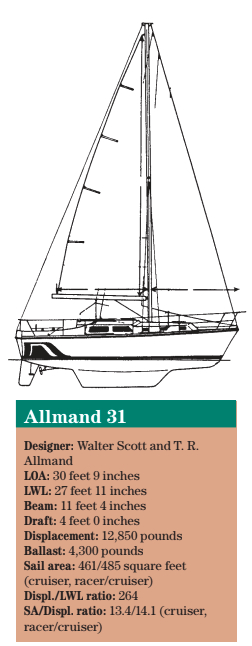
Walter Scott and T. R. Allmand are credited with the design of the Allmand 31. Coming from a powerboat manufacturer, the overall design was quite conservative, yet still contemporary. The sheer is flat, the bow is slightly raked with a hint of being con- cave, and the stern is nearly vertical. The cabin trunk is long and low, except for a slight doghouse or small half step up over the main cabin. Underwater there’s a shoal-draft cruising keel and a rudder mounted on a partial skeg. According to company literature, the keel and rudder were shaped to NASA (National Aeronautics and Space Administration) airfoil number 84A010, in an effort to produce the least possible drag with the proper lift to compensate for the sideways sail force.
The boat’s displacement is 12,850 pounds, giving it a displacement/length ratio of 264. Its generous beam of 11 feet 4 inches and waterline of 27 feet 11 inches result in a spacious interior. This feature alone accounted for most of the boat’s popularity, especially with liveaboards. The Allmand 31’s wide beam also accounts for its significant form stability.
Construction
Construction of the Allmand 31 is straightforward and fairly typical of the era. The hull is a solid hand-laid fiberglass laminate with an integral keel cavity into which the internal ballast is lowered and secured. Cast iron ballast was used for the cruising version, while a racer/cruiser model was fitted with lead. Lead is preferable to cast iron because of its corrosion resistance as well as its higher specific gravity. Once in place, the internal ballast was fiberglassed over, resulting in a double-bottom effect. To help carry the concentration of stresses, the hull’s laminate is extra thick at the keel sump and at the centerline. Also reinforcing this area are several transverse beams located just above the keel.
Like many boats, the Allmand 31 incorporates a fiberglass pan that defines the major features of the interior. Prior to the hull being removed from the mold, this full-length pan was lowered in place and tabbed to the hull with strips of fiberglass wetted out with resin. This adds additional structural integrity and insures that there is no distortion of the hull once it’s extracted from the mold. Plus, it won’t rot if subjected to bilge water. The downsides, compared to a wooden interior, are less thermal and acoustic insulation, greater difficulty making modifications, and more condensation on surfaces.
The deck of the Allmand 31 is cored with balsa. This construction technique reduces weight while increasing stiffness. The color of the deck’s molded-in non-skid can range from light blue to white or beige. An older boat can usually be recognized by the large stylized letter A located aft on the hull. This graphic was later discontinued.
The hull-to-deck joint is an outward-facing flange. This configuration is more prone to damage from a collision or hard docking than an inward- facing flange, but a one-piece hull with an inward-facing flange cannot be extracted from a mold. The popularity of the outward-facing flange can be explained by the fact that it avoids the two-piece mold. In the case of the Allmand 31, a three-step joining process makes for both a strong and leak-proof hull-to-deck joint. During the process of mating the deck flange with the corresponding hull flange, resin is applied between the two, chemically bonding them. Self-tapping stainless-steel screws (nuts and bolts are considered better) are then drilled into the flange. Once the joint has been chemically and mechanically fastened, the entire length is fiberglassed over from the inside. A vinyl rubrail, snapped over the joint, cosmetically finishes off the joint.
All of the boat’s through-hulls are fitted with bronze seacocks. These are part of the boat’s electrical grounding system and are bonded with the rudder post and drive shaft.
Deck features
The Allmand 31 has a wide and long coachroof. While this enhances the interior accommodations, on deck it results in narrow, 13-inch-wide sidedecks and a small foredeck. Fortunately, the chainplates are mounted inboard and the foredeck’s hardware (single cleat, pair of chocks, chain pipe, and single anchor roller) are clustered together and situated well forward. Though a little tight, there still is sufficient room to maneuver about on deck.
There are three hatches on the cabintop: one over the forward cabin, a second over the saloon, and a slightly smaller one serving the aft cabin. Other features include a molded-in sea hood, a vent over the galley, and four sections of teak handrail. The standard portlight configuration consists of seven opening ports (three per side and one facing the cockpit) and four large fixed portlights. As an option, all 11 could be opening. Even without this option, the standard package provides very good light and ventilation.
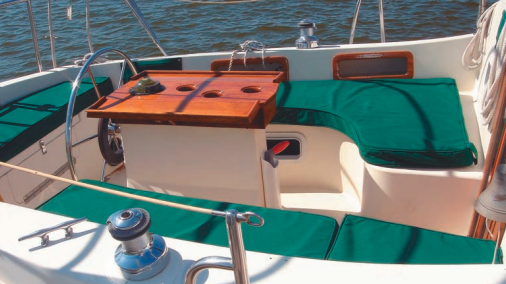
The cockpit is T-shaped and measures 94 inches long — plenty of room for a crew of six or maybe even seven. The companionway is offset to starboard and therefore allows the port cockpit seat to be L-shaped, with the short leg along the bulkhead. The starboard seat is straight and has a deep locker underneath. There also is a locker beneath the helmsman’s seat. The cockpit coamings average 7 inches high, are slightly sloped and wide on top, and house four cubbies. Wheel steering is standard, as is the teak cockpit table with compass. There are three scuppers to drain water from the cockpit: two aft and one forward. There is no bridge deck.
Stainless-steel bow and stern pulpits, dual lifelines with a pair of gates, and a centerline, transom-mounted swim ladder complete the deck features.
General arrangement
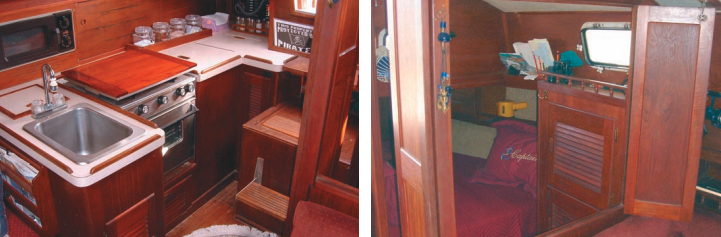
Most of the Allmand 31s were built with what is called the tri-cabin layout. This arrangement consists of a forward cabin with a 6-foot 4-inch V-berth, followed aft by a head compartment to port and a pair of hanging lockers to starboard. Situated beneath the V-berth are a 50-gallon potable water tank and several bureau drawers. The forward hatch and a pair of opening portlights provide the stateroom with light and air circulation.
The head amenities include pressurized water, a vanity, marine head with a 25-gallon holding tank, and two cabinets.
The saloon consists of a U-shaped dinette to port and a straight settee/berth amidships to starboard. The 6-foot dinette comfortably seats four adults. Seating for three more adults can be gained by extending the overleaf of the pedestal table. Lowering the table converts the dinette into a double berth. There’s stowage behind and underneath both of the saloon’s settee/berths. An overhead hatch, a pair of opening portlights, and a large fixed portlight illuminate and ventilate the saloon.
The boat’s U-shaped galley is aft of the starboard single settee/berth. It’s a bit on the small side, yet quite functional. There’s a large stainless-steel sink with pressurized water; a gimbaled stove; an 8-cubic-foot, top-loading icebox; and several stowage compartments for dinnerware and provisions. There’s also a small hanging locker for foul weather gear adjacent to the companionway.
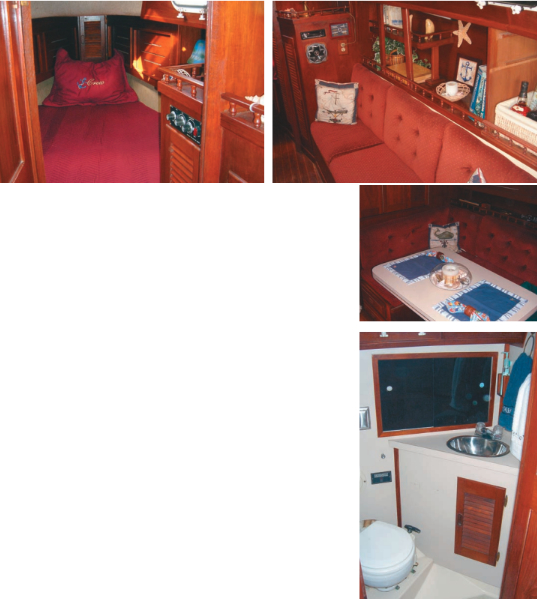
To port is the aft cabin, which features a double berth measuring 54 by 78 inches, a hanging locker, and a fold-down chart table. For light and air there are an overhead hatch, a large fixed portlight, and a smaller portlight in the aft bulkhead that opens to the cockpit. In the tri-cabin version, this area is made “private” by means of a door and a forward bulkhead, with a fold-away upper portion. A limited number of Allmand 31 Mark IIs were produced without this aft cabin enclosure. This opened things up and enhanced the boat’s already spacious interior by eliminating a door and a couple of bulkheads. Most boats, however, are of the tri-cabin arrangement.
Almost all traces of the boat’s fiberglass construction are well hidden behind teak-veneer plywood and a vinyl headliner. A few early models were touted as being “low maintenance” because they sported wood-grained laminate and a painted overhead. Head- room is a generous 6 feet 5 inches.
The rig
The Allmand 31 is a masthead sloop, whose aluminum spar is stepped on deck with a stainless-steel compression post beneath that sits directly on the boat’s ballast. The cruising model’s mast height is 44 feet 6 inches, while the racer/cruiser version is 2 feet taller. This equates to a sail area of 461 square feet for the cruiser and 485 for the racer/cruiser (although some reported figures vary). The sail area/displacement ratios for the two are 13.4 and 14.1, respectively. These are quite low (a coastal cruiser typically would have a number between 16 and 17). There are a single forestay, a pair of cap shrouds, fore and aft lowers, and a single backstay. While the shrouds are attached to inboard chainplates, headsail sheeting is to the toerail. Some boats produced later have inboard T-tracks to allow for closer trimming of headsails. A pair of primary winches is mounted on the cockpit coamings. Sheeting for the mainsail is mid-boom and is attached to a traveler and led to a winch mounted on the cabintop. Halyard winches are located on the mast. Jiffy reefing is standard.
The most common auxiliary is the 16-hp M20 Universal diesel. The 21-hp M25 Universal diesel was available as an option. Both engines are fresh-water-cooled and both are served by a 40-gallon fuel tank. Access to the engine is average to below average.
Underway
In a breeze, the Allmand 31 accelerates quickly and carries through the slowest tack. The boat will tack through about 90 degrees without a significant reduction in speed. It is an extraordinarily stiff boat; it balances quite well and exhibits only a small amount of weather helm. For the most part, the Allmand 31 sails almost level. Its best points of sail are off the wind. Its upwind performance is hampered by the combination of its wide beam and shoal draft. The boat also tends to make noticeable leeway.
The small sail area means mediocre light-air performance. Not many Allmand 31s are raced, so PHRF numbers are few. Boats with the standard rig rate between 174 and a whopping 240, while boats with the tall rig average 184. A 1980s-era Cal 31 comes in at 168, and a full-keel Cape Dory 31 at 198. From this perspective, the Allmand doesn’t seem like such a dog after all. The standard auxiliary is adequate to maneuver the boat in most conditions. As is the case with many sailboats, maneuvering in reverse takes a bit of practice.
Things to check out
As you would with any boat that employs balsa as a deck-coring material, sound out the Allmand 31’s deck and cockpit sole carefully to determine if any water has made its way in and caused delamination. Although small areas can usually be easily fixed, walk away from extensive and expensive delamination.
Examine the keel cavity for signs of a hard grounding, especially those boats that are fitted with cast-iron ballast. A break in the outer skin can allow water in, causing significant and costly corrosion of the cast iron.
Check out the engine and its installation. While most boats were fitted with Universal diesels, there have been some reports of Ducati and Renault engines. Availability of parts for either of these two exotic power-plants will be an issue.
Spend some time looking over the interior. While normal wear and tear can be expected, abuse and neglect is another story . . . so is inexpert customization!
Conclusion
Many Allmand 31s have been bought by liveaboard cruisers since the strongest feature of the Allmand 31 is its generous interior. Its shoal draft is great for gunkholing, its moderate rig is easily managed, and its hull form makes for level sailing. Neither version is a racer; however, the taller rig and increased sail area of the racer/cruiser model improve the boat’s light-air performance. The boat’s construction is solid and its looks are pretty good. Having the stigma of being built by a powerboat manufacturer probably accounts for its depressed price on the used-boat market. Expect to pay around $16,000 to $30,000 for this very roomy 31-footer.
Thank you to Sailrite Enterprises, Inc., for providing free access to back issues of Good Old Boat through intellectual property rights. Sailrite.com