In a sailors’ paradise, why do engines rule?
Issue 85 : Jul/Aug 2012
Soon after slipping our mooring at The Baths, Virgin Gorda, with our shoddy outboard pushing just enough to weave our way out of the charter-boat minefield that surrounds this stunning spit of rock and sand, we raise our jib and sit back for a nice downwind sail to Tortola.
The wind has been coming strong out of the east all week. My girlfriend, Rachel, and I sailed here eastward and upwind from St. Croix on our Cal 27. Now we’re at the east-ernmost point of the BVI., it’s calming to know everywhere we plan to go is some variant of west — no more fights through The Narrows or up the Sir Francis Drake Channel with the wind hard on our nose. So we sit back, silence the motor’s gurgling, and settle in for a cozy sail.
But I’m soon shocked to see sailboats overtaking us. In theory, that’s not odd. In a Cal 27, you accept that larger boats overtake you on occasion. No, what’s odd is that none of them are sailing. All are under motor.
I can’t for the life of me come to terms with what I’m seeing here in this sailing Mecca. Conditions could not be better — everyone is headed downwind, most of the boats require little more than unfurling the jib, and yet they’re motoring to their next destination.
I begin lecturing Rachel on the sacrilege taking place on these holy waters. She nods absently to appease me without looking up from her book, uninterested in what other people are doing.
As I rant, I think of all the conveniences these boats have — motorized winches, roller furlers, inboards, depth sounders, motor-powered dinghies — and I think of our boat: everything is manual, from the anchor to the sails to the rowing dinghy. Our 15-horsepower outboard (the size of the motors on most dinghies) can barely hold us steady heading into even moderate winds . . . on top of sounding like a lawnmower being repeatedly drowned.
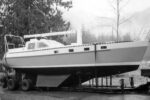
Our ragtag group of four bought Cruzan Time in September 2010 and have been fixing her up with spare change, focusing first on the necessities like a new jib, a dinghy, and GPS. But our thoughts wandered to bigger and better devices to make things easier. Something in the human condition seems to yearn for things to be easy, so we constantly upgrade.
That, I fear, has the tendency to cheapen the experience. I feel something on heading to the bow to connect the jib halyard as we dip in and out of large swells, upon reefing the main in a heavy squall, or simply hoisting the sails on a calm day, just as I feel something when picking up a mooring under sail. It gives me a little more than quiet satisfaction and maybe a sore back. It’s something that can’t be gotten easily. And it shouldn’t be.
It’s why people sail, or do anything they don’t really have to. I’m not saying roller furling or formidable engines are indulgences. If we were living aboard or had extra money, we would have them working in our favor too. But, sometimes, having a big cushion behind you means you fall back on it when you don’t need to.
Seeing these boats pass by under motor just speaks to that — to some intangible laziness. It’s like putting an insulated escalator up a small, snow-covered hill with hot-chocolate kiosks along the way, just to accommodate anyone with even the slightest inclination to see the view.
You can marvel at human ingenuity, but those who take that escalator, or choose to motor when they could sail, take for granted not only the engineering feats that made their easy ride possible, but also the experience and the final destination. Getting to the top, once admirable and challenging, is no longer any kind of feat at all. Instead, it’s barely mentionable — a side note tucked into a digital photo album.
Not everyone will agree with me. Some would prefer the escalator and many obviously prefer the motor. But I think the world rewards those who toil. They are better tried and tested, prepared for the unexpected shift in the wind, ready to face up to adversity.
So, after venting my disapproval, I sit back and shut up, to Rachel’s relief. With the rough wooden tiller in my hand, I adjust our course slightly north to follow in the wake of a 60-foot catamaran operating like a ferry. I sheet in the jib and, as the wind blows hard on our stern, foolhardily try to catch up.
Daniel Shea lives on St. Croix. Originally from Cincinnati, he didn’t start sailing until he moved to the island and bought Cruzan Time, a Cal 27, along with his girlfriend, Rachel, and two friends, who (thankfully) knew what they were doing and were able to teach him the craft.
Thank you to Sailrite Enterprises, Inc., for providing free access to back issues of Good Old Boat through intellectual property rights. Sailrite.com