Rubber roofing out of a can does the trick
Issue 90: May/June 2013
Over the years I have tried several methods to create a watertight mast boot. As a temporary fix, I once used duct tape. It was inexpensive and actually lasted about 10 months before it started to leak. I tried using a couple of rolls of mast-boot tape, a wide self-bonding tape. It was quite a bit more expensive and lasted only a year and a half before it started leaking. I also tried Spartite, a two-part liquid that forms both a mast wedge and mast boot. It worked well, but is expensive and, if not applied properly, can permanently bond the mast to the boat.
While we were in New Zealand last year, we pulled the mast for a refit. When we re-stepped the mast, we could not reuse the Spartite boot and I began looking for another solution. At the suggestion of a local rigger, I decided to try a one-part waterproofing compound that’s marketed for roof and gutter repairs. This is a thick rubbery substance about the consistency of honey that can be applied with a brush. It will adhere to metal and painted surfaces and, once it dries, it remains flexible and is UV-resistant. It seemed ideal for my application.
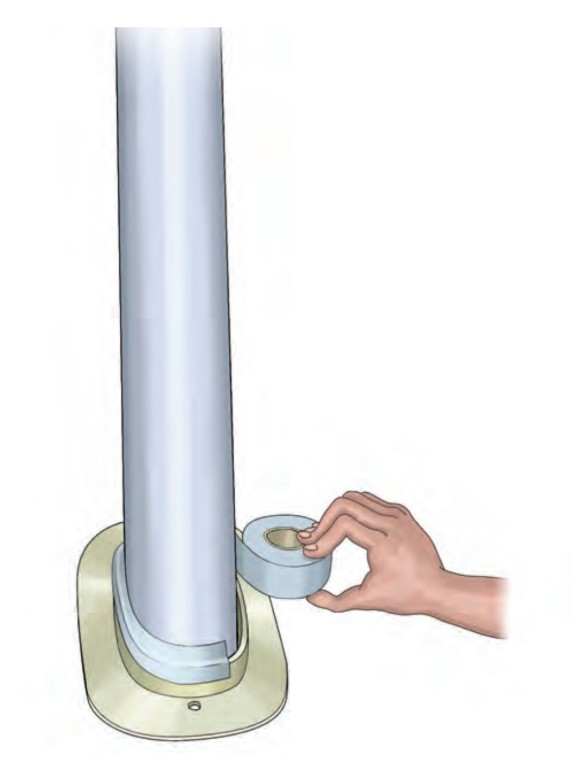
A quick-and-easy mold
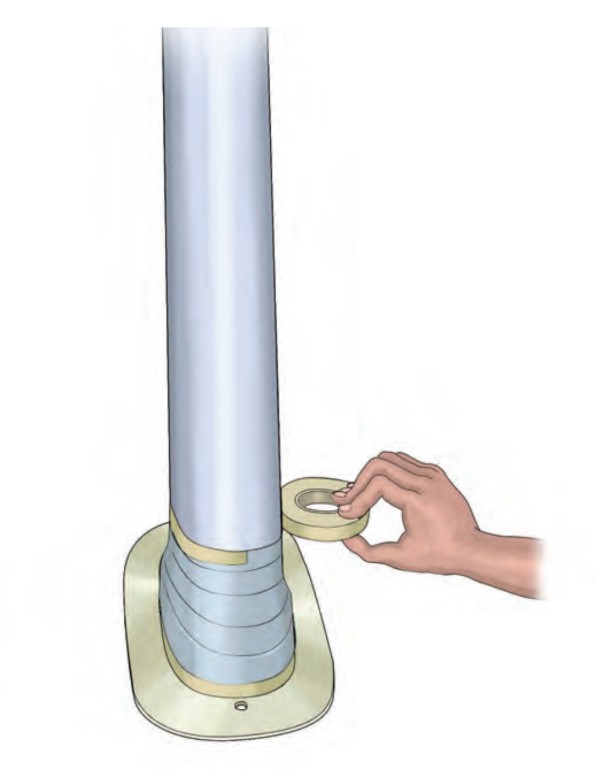
My first step in making the mast boot was to create a form, or male mold, to support the waterproofing compound until it could set. I used my ever-present duct tape to make the mold, but any wide adhesive-
backed tape would work. I started by making a wrap around the deck collar and continued to make wraps upward until I had a cone-shaped form reaching from the deck collar to the mast. Next, I put a wrap of masking tape around the mast 1 to 2 inches above the top of the mold and applied masking tape to the deck below the mast collar.
I found the waterproofing compound at a local building-supply store. The product itself is not hard to find (and several brands will do the job), but it is difficult to find in a small quantity. For Nine of Cups, our 45-foot cutter, I needed less than a quart, and the products were usually available only in 1- and 5-gallon containers. See the Resources box (facing page) for sources I’ve located that will sell and ship the waterproofing compound in 1-gallon or smaller quantities if you cannot find it locally.
Laying down rubber
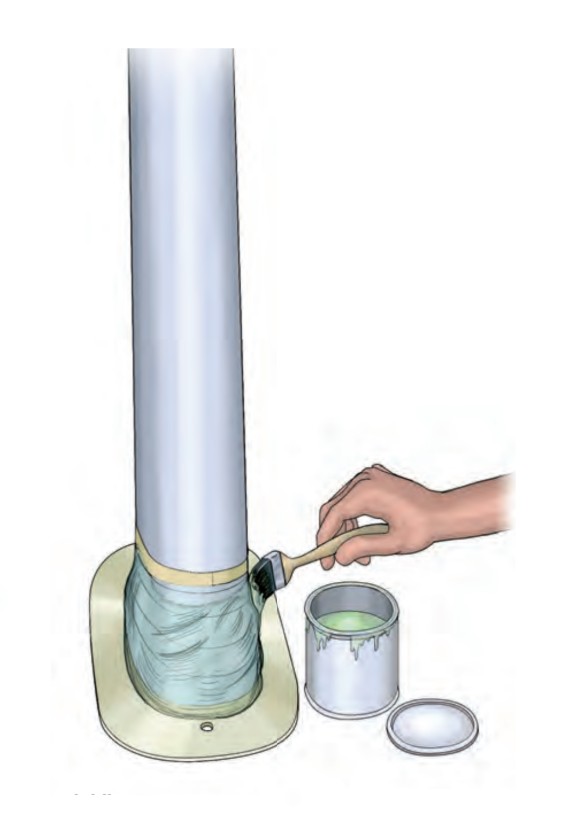
Using disposable chip brushes, I applied three thick coats following the manufacturer’s re-coat schedule. For the product I used, I was able to apply a new coat after eight hours of drying time, so I applied two coats the first day and the last coat on the second day. After it dried beyond the tacky stage, I carefully removed the masking tape, using a razor blade as necessary. I then let the waterproofing compound cure for a couple of days.
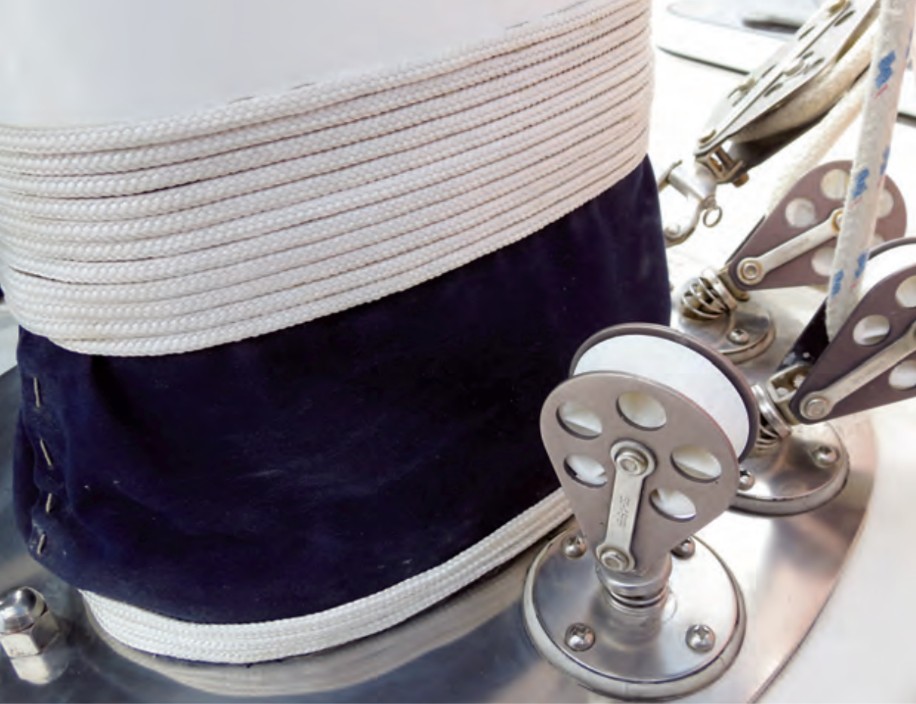
Since the waterproofing is UV-resistant, the mast boot was now functionally complete, but it didn’t look finished. I decided to make a cover from Sunbrella, using a small piece left over from our Bimini project.
The cover-up
The shape of the cover is a bit odd — it’s the base of a cone. After a bit of trial and error, I came up with a simple formula that can be used to make the pattern.
First, I measured the circumference of the mast, C1, and the circumference of the mast collar, C2. I estimated how high on the mast I wanted the cover to reach and put a pencil mark on the mast at that point. Then I measured the distance from the base of the mast collar to the pencil mark on the mast, which is Ht in the formula. You can calculate the two radii, R1 and R2, using the formulas below.
R1 = (C1 x Ht) ÷ (C2-C1)
R2 = R1 + Ht
For example, on Cups the mast has a circumference of 26 inches and the mast collar has a circum-
ference of 31 inches. The distance from the bottom of the mast collar to the top of the cover is 7 inches. Plugging these values into the formulas:
R1 = (26 x 7) ÷ (31-26) = 182 ÷ 5 = 36.4 inches
R2 = 36.4 + 7 = 43.4 inches
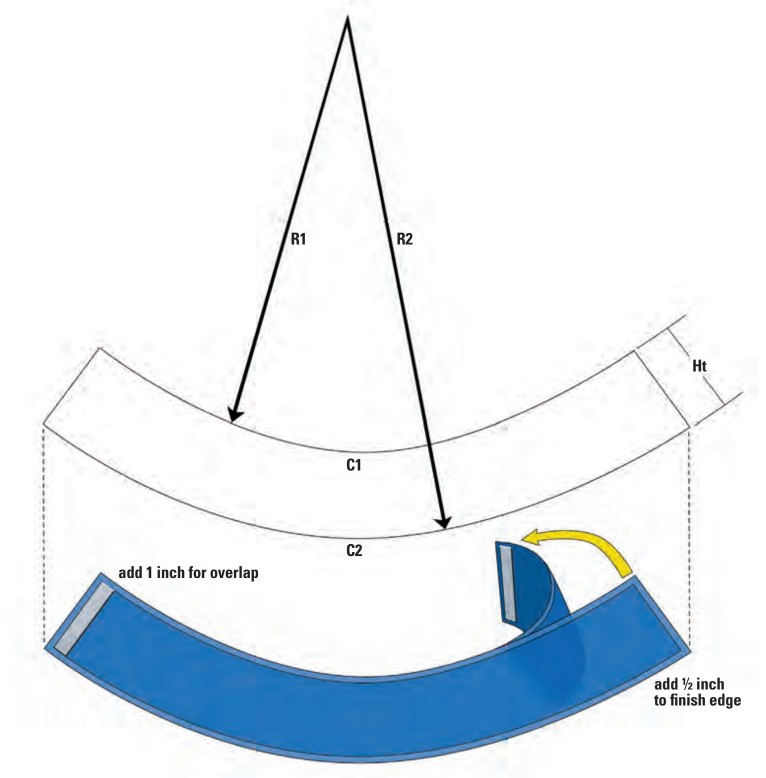
Before marking and cutting the fabric, I made a paper template to check my calculations. Once I was convinced the template was accurate, I used it to draw the pattern onto the fabric. I added an extra inch to one end of the pattern to allow for an overlap, then added 1/2 inch to the entire outline to allow for hemming the edges. Next I folded the 1/2-inch of material along the outline and hand-stitched it. Marcie keeps a roll of basting tape on hand. It’s narrow double-sided adhesive tape and works well to hold the material in place while stitching it. The last step in the fabrication process was to hand-stitch mating pieces of Velcro onto the ends of the fabric where it overlaps.
I installed the cover by wrapping it tightly around the mast and collar and pressing the Velcro strips together. I wanted to add a whipping with 1⁄8-inch white nylon line to the top and bottom to give it a finished look. In previous versions, I used a French spiral hitch and once I even finished it with a Turk’s head. It was a lot of work and I don’t think anyone but me ever noticed. This time I used an easier method. I used a hot-melt glue gun to attach one end of the small line to the cover about 1/2 inch from the top, then made 12 wraps of line tightly and neatly around the mast working upward. I put a small dab of glue on each revolution and secured the end to the mast and the wrap just below it with another dab of glue. Using the same process, I also added a whipping at the bottom around the mast collar. The end result looks nice and I can remove it quite easily when necessary.
This mast boot has been in place for more than two years. It has been exposed to heavy seas and cold temperatures in the waters of southern New Zealand and Tasmania as well as the more tropical tempera-
tures of Vanuatu and Fiji. So far it has shown no sign of leaking. I did find that the whipping at the bottom of the cover had a tendency to trap water between the cover and the mast boot, leading to a bit of mold growth. I have since removed the lower whipping. I also found that the Velcro began to lose its grip after a couple of years and, using a curved needle, I have now hand-stitched the Sunbrella in place.
I have also learned that the manufacturers of some of these products do not recommend its use on stain-
less steel because it will not adhere well. This should not be a problem in this application. If the mast collar is stainless steel, the membrane will form a tight flexible boot over it, shedding water downward.
David Lynn is Good Old Boat’s newest contributing editor. He and his wife, Marcie, have lived aboard Nine of Cups, their 1986 Liberty 458 cutter, since purchasing her in Kemah, Texas, in 2000 and have sailed more than 70,000 nautical miles in their ever-so-slow world circumnavigation. They recently explored Tasmania and are planning to cruise west along the south coast of Australia. Visit their website at www.nineofcups.com or their blog www.justalittlefurther.com.
Thank you to Sailrite Enterprises, Inc., for providing free access to back issues of Good Old Boat through intellectual property rights. Sailrite.com