Clean cuts in fiberglass cloth
Issue 68 : Sept/Oct 2009
Working with fiberglass cloth presents a number of challenges. One of them is making a straight cut across the width of the material. To draw a line with a felt-tip marker and a straightedge, you need a large flat surface on which to lay out the cloth for marking and cutting, something that’s often difficult to find at home, never mind aboard the boat. Even with a well-drawn line, your cut may waver across the strands, resulting in a raveled edge. However, a simple technique ensures you can always cut a perfectly straight line, even if the cloth is not lying flat.
Fiberglass cloth is woven. Warp fibers run the length of the material and weft fibers run back and forth across it. At the edges of the cloth, where the weft fibers double back, they form a series of loops.
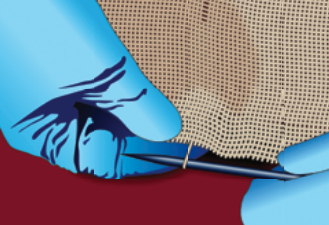
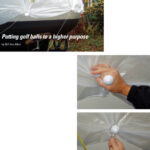
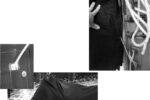
To cut square across the cloth, first measure your desired length along one edge and mark the loop in the weft at that point. You now need to snag this loop, which you can do by poking through it with a sharp pointed object such as a nail, a marlinspike, or an awl. Be careful to snag only the loop.
Pull on the loop. This will cause the cloth to bunch up along these threads. While keeping tension on the loop, milk the bunching fabric along until you reach the other side of the cloth. Pinch the edge of the cloth at the bunching, and snip off just the corner of the fold to cut the weft threads where they return across the cloth.
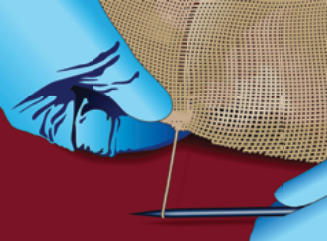
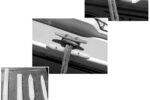
Pull on the loop, milking the cloth off the threads until the loop is free of the cloth. You will see a distinct line where you removed the threads. This is your cutting guide. It’s perpendicular to the woven edge, easy to see and to follow. When you cut along it, you will get your straight cut.
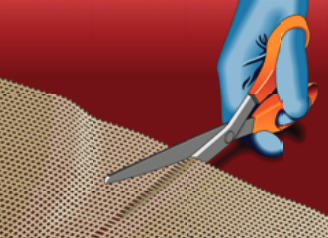
If you need to cut along the length of the cloth, or whenever there is no edge loop to snag, just grab two or three of the lengthwise threads and pull on them, milking the threads out of the cloth in the same fashion. Cut along the gap you created by removing these threads.
Stan Freihofer retired recently after 32 years with U.S. Agriculture Quarantine Inspection, which later became part of the Department of Homeland Security. These days, he’s restoring a 1981 Cape Dory 25 that unfortunately spent most of her life out of the water. His restoration story is at http://www.reefroof.com.
Thank you to Sailrite Enterprises, Inc., for providing free access to back issues of Good Old Boat through intellectual property rights. Sailrite.com