It satisfies an aesthetic need
Issue 102 : May/Jun 2015
Gerry Douglas, Catalina Yachts’ designer and vice president, says that a person’s tastes in boats are established at around the age of 14 by the yacht designs popular at the time. My outline of what a yacht should look like, though, came at a much later age, not by what was fashionable in construction at that time, but rather by what I discovered in books. One such example was Joshua Slocum’s, Sailing Alone Around the World. (Note: This classic was produced by Good Old Boat as our first audiobook and is available at AudioSeaStories.com. –Eds.) Images of his vessel, Spray, with her clipper bow and extensive bowsprit, were rooted in my memory. As I got older, sheerlines and bow and stern shapes became for me the characteristic hallmarks of a handsome yacht.
Until I read Rob Mazza’s article, “The Once and Future Boat Bow,” in the March 2014 issue of Good Old Boat, it never occurred to me how much racing had to do with bow design and function. I have little interest in racing . . . so perhaps my brain has no business going there. While the bowsprit pole is still a prevalent tool in competitive modern yachts, the clipper bow has today all but vanished from recreational boatbuilding.
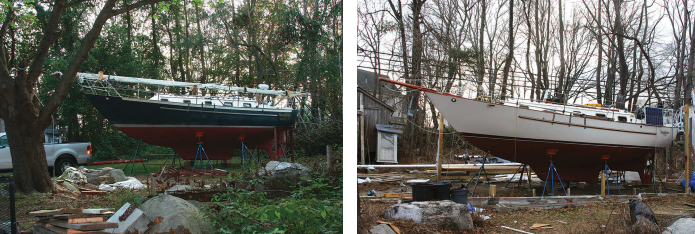
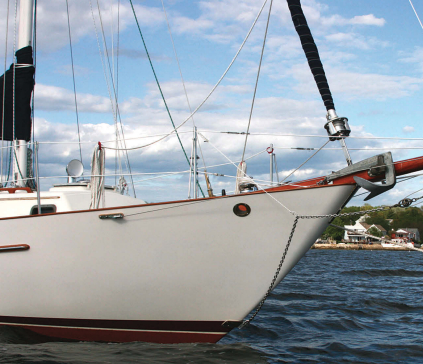
Being an Alberg and Crealock man, I’ve owned my share of Cape Dorys and Crealocks. My present vessel is a Pacific Seacraft 34 I call Saudades. Though gentleman Bill Crealock’s designs did not have a genuine clipper nose, the traditional bow certainly shines through on many of his small ship designs. Each time I rowed my dinghy away from Saudades after a long day of sailing, I could not help but admire the Crealock sheer and the gentle way the boat sat in the water. Circling my vessel in the dink, I envisioned her with a long bowsprit. One day, as I rowed around the mooring ball, the elegant bow looked back at me in anguish, with chips, scratches, and dings where the anchor had damaged the hull on its many trips up to the bow roller. It called for a solution.
A bowsprit is conceived
Two summers ago, I had the hull of Saudades painted and decided it was a good time to fit a small bowsprit, similar to the one on my old Caliber or the ones on Island Packets. The reason for a bowsprit was twofold: to keep the anchor away from the bow and to create a suitable place to attach a drifter or spinnaker. At least that was what I kept telling myself.
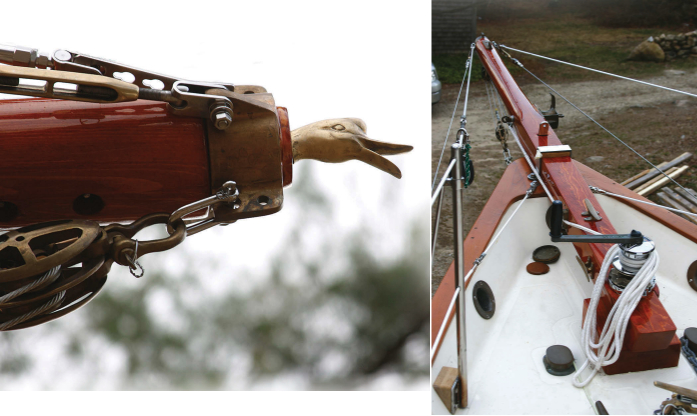
If I am to be totally honest, the real reason for adding a stick to the bow had more to do with aesthetics than function. Proof was in the design. Each time I sketched the layout, the bowsprit got longer and narrower. In the end it went from being a foot-long extended platform to taking on the shape of a protracted stout broomstick. Influenced by Slocum’s Spray and old British fishing smacks and using Lin and Larry Pardey’s Taleisin as a model, I decided to go long and round.
To do so, and do it right, would mean making many other changes, such as adding a bobstay, eliminating the stainless-steel bow pulpit, and running the lifelines to the tip of the bowsprit. In short order, an $800 project grew to $4,200.
My concern was that, when the enterprise was finished, it should look like the boat was originally built and equipped with a bowsprit. I certainly did not want it to look like an add-on or like one of those 1970s Volkswagen bugs with an aftermarket Rolls-Royce forward trunk lid.
Appropriate materials
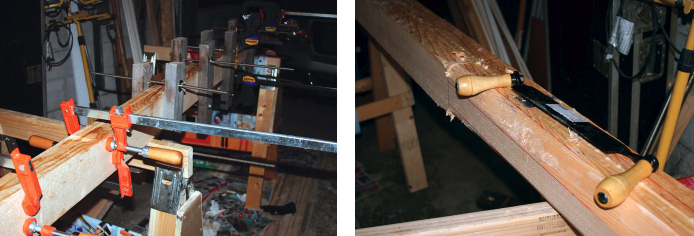
I started my bowsprit venture by researching the correct lumber to use. Ultimately, the choice was Sitka spruce — old growth spruce — three boards each 10 feet long, 5 inches wide, and 2 inches thick purchased from M.L. Condon Lumber in White Plains, New York. The final bowsprit would measure 5 x 5 inches in cross section. Sitka spruce is not cheap, but teak would have been three times more expensive. I priced a solid 6- x 4-inch beam of teak, 12 feet long. It was $1,200. The old-growth spruce was half that and, if it were fir, would be half what I paid for the spruce.
Sitka spruce has been used in shipbuilding for hundreds of years and was a mainstay for the construction of timber spars due to its light weight-to-strength ratio. But weight was not a factor in building the bowsprit. If I were to do it again, I would probably use the cheaper fir. Shaping the sprit and making it perfectly round took some work. Without going into details, all I can say is I am grateful for the invention of the electric planer, in my case a small 6.5-amp Makita. I first tried using a drawknife without much success. Here a quality (expensive) tool is critical but I took the cheap eBay road and the knife soon lost its edge. On top of that, I didn’t want to take the time to learn the knack of using the tool or make an error by removing too much wood. The Makita worked wonderfully.
As the project unfolded, I encountered countless unforeseen hurdles. Most were my fault for not exercising better forethought and planning and for taking on the idea before drawing up plans on paper. The mistake, as always, was misguided enthusiasm in my rush to get it done and savor the results as soon as possible — the “I must have the boat ready for the spring launch” philosophy.
Completing the package
Some of the changes I had to make to the boat included fabricating a new forward chainplate to incorporate the bowsprit, extending the lifelines, adding new forward stanchions, and designing and installing a suitable bobstay chainplate and whisker stays. I acquired much of the hardware, including the bronze anchor bow roller, from Port Townsend Foundry in Washington state. They specialize in fittings for old gaffers and sailing vessels. I purchased the cranse iron and Herreshoff bronze blocks from Bristol Bronze.
I am very happy with the outcome and can’t wait to confuse other Pacific Seacraft owners when they try to sort out what vessel they’re looking at. The final outcome was a perfect marriage between Crealock’s bow design and an old-world fishing smack sprit.
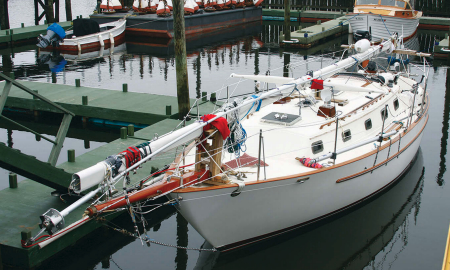
As Rob Mazza mentions in his article, “It’s well understood that beauty is in the eye of the beholder and tastes change on a generational basis based on the types of boats people grew up with.” Very true, Rob. But in my case, having not grown up around boats, I had my own visualization of what a boat bow should look like. My ideas were conceived primarily through books and movies and had more to do with grace than function.
I love my bowsprit. A modern Beneteau or Hanse bow leaves me cold. Something is missing. I must admit that without divergent tastes the world would be a dull place indeed.
The same is true of a Jackson Pollock or a Matisse. Give me a Monet, a Renoir, or a Cheoy Lee Clipper.
Michael Brimbau, a Verizon retiree, is an author, poet, and co-founder of The Literary Hatchet magazine. He is the author of Lizzie Borden, The Girl with the Pansy Pin and a book of poetry, The Sadness I Take to Sea and Other Poems. When not writing, he sails New England’s South Coast and works on Saudades and Chinstrap (a Cape Dory 22 he has bonded with and cannot let go).
Thank you to Sailrite Enterprises, Inc., for providing free access to back issues of Good Old Boat through intellectual property rights. Sailrite.com