Issue 3 : Nov/Dec 1998
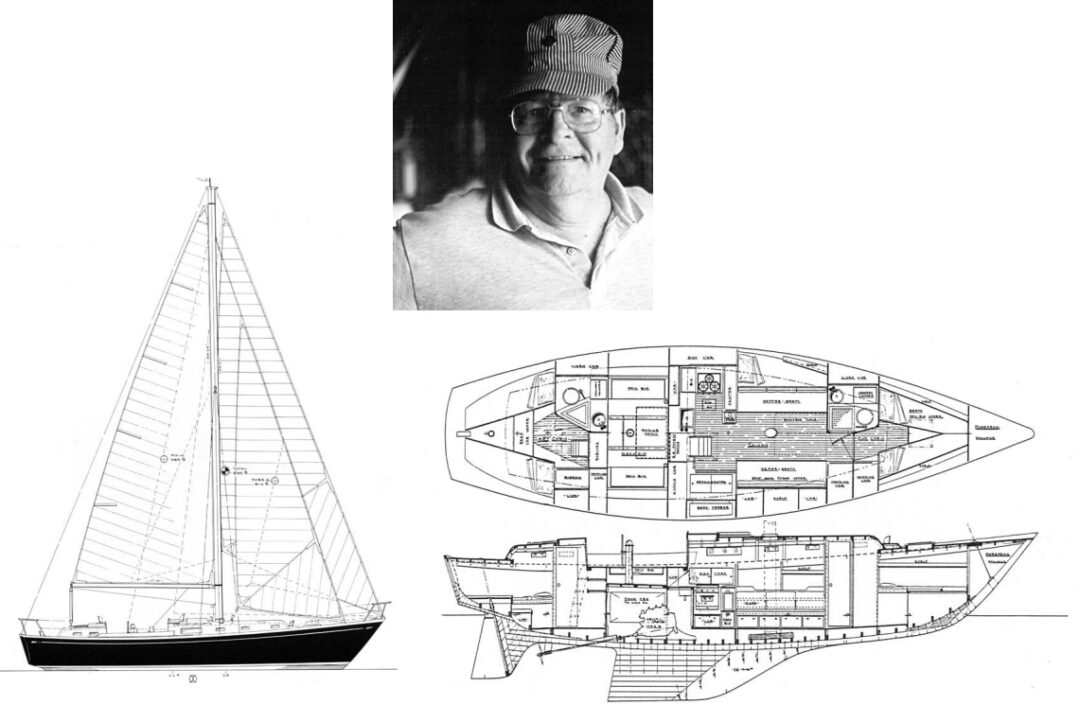
In his home office in the foothills of the Cascade Mountains, Edward (“Ted”) Brewer mops his brow and shoves back his stool. He is tall and solid. His hair is dark and his sense of humor keen. “It’s too hot to work today,” he says. “The ink’s running.”
Ted, one of the country’s best-known yacht designers, still draws the old-fashioned way with ink and splines. There are blueprints and papers scattered all over his wide desk, and at one edge there is a row of “ducks” — those traditional lead weights that hold the splines in place while you draw a fair curve.
The walls are knobby with half-models of some of his boats. Pictures of others are framed alongside copies of his impressive professional credentials. And everywhere there is the paraphernalia of the one-person business: the fax, the phone, the file boxes, the letters waiting to be answered. But all that is for another time.
“Let’s go into the house,” he suggests. “It’s cooler.” In the few short steps between the office and his house we run into a blast of dry August heat that feels like the Sahara at these high latitudes. It’s 85 degrees Fahrenheit and rising in the valley of the mighty Skagit River, 75 miles north of Seattle. The Skagit, the second biggest river after the Columbia on the west coast of the continental 48, is only 150 yards away, but the cool water it draws from melting snows in the rugged Cascades looming high overhead is doing little today to temper the heat.
The office and the house are remote, situated on a dead-end road off rural State Route 20 in northern Washington, miles away from the nearest city and surrounded by farming land given over to fields of nose-high corn scorching at the edges for want of rain.
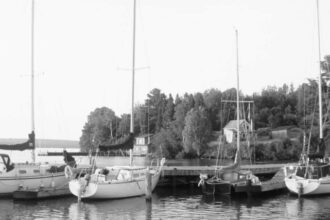
For a man so well known and respected in the yachting world, Ted lives a quiet life. His home is comfortable but modest. The boat he keeps at La Conner, the nearest saltwater marina, is a 24-foot power cruiser.
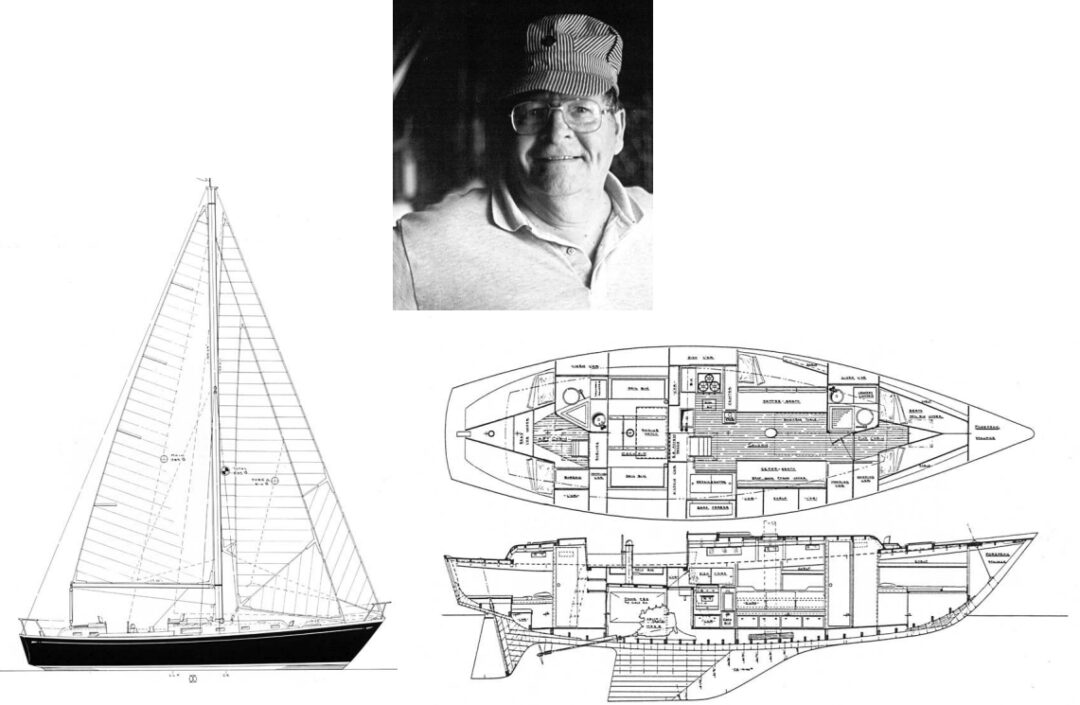
This is the man who worked on the America’s Cup boats American Eagle and Weatherly, boats that won the Olympics, the Gold Cup, and dozens of celebrated ocean races. He’s also the man who designed scores of the good old boats still cruising out there.
He likes the peace and quiet now. At age 65, with more than 260 yacht designs under his belt, he feels he’s earned a rest. He still keeps designing, though. He can’t get totally stopped. He has just finished the lines of a 35-foot keel/centerboard cutter in double-chine aluminum for a California owner, but he’s disinclined to take on any work involving a design of more than 50 feet.
He laughs wryly. “I designed a 100-foot yacht once. Never again. The amount of work is incredible. You have to hire experts to help you. It has all the components of a full-size ship.”
The magic of designing, he says, the magic that keeps drawing him back, lies in the lines and the accommodation. But there’s no magic in designing the shaft bearings, the ballast, and the chain plates. That’s just number-crunching and drudgery.
Now he’s working on the plans of a 29-foot powerboat for home builders to construct from plywood or aluminum. It will cruise at 15 to 18 knots with a single diesel or twin outboards. “That kind of plan is always in demand,” he notes.
Ted started his working life in the Royal Canadian Army Service Corps, but was advised by a friend to get out as soon as he could because there was little chance of promotion in such a small army. He made it to lieutenant, however, before joining C&C Yachts (then the Canadian Northern Company) as a yacht broker.
While he was in the army, he had studied yacht design by correspondence from the Westlawn School. His big break came when he heard that Bill Luders Jr., a respected designer from Long Island Sound, needed an assistant designer.
His first job for Luders was to design the plumbing for a ferry. “I hardly knew where to start,” he confesses. “But I learned quickly. In fact, I worked for Luders for seven years and learned a lot. And he made me teach myself a lot. Bill Luders was a wonderful sailor, friend, and employer.”
In the early 1970s, Ted originated the radius-bilge method of building metal yachts that made construction much easier for amateurs and professionals alike. He first applied it to the Goderich 35 design. And if you’re wondering why that name rings bells, it’s because it was a Goderich 35 that later sailed all the way around the globe without navigational instruments of any kind, not even a compass.
In 1979 he moved to Washington state, designing all kinds of boats, ranging from small dinghies to the 68-foot schooner Tree of Life, which was nominated one of the “100 Greatest Yachts in America” by Sail magazine.
But his favorite design remains one of his early ones, Black Velvet, which was custom-built with a strip-planked wooden hull in about 1970. Black Velvet was a fast boat with a fin keel and a skeg-hung rudder. “She had to be fast to windward,” Ted explains. “I designed her for Fred Chevrier to sail on Lake Champlain, and Fred said it was important that she beat well because ‘No matter where we go, it’s always to windward.’ ”
The design was such a success it was later produced in GRP and became the Cape North 43, which, among other achievements, won the closely contested Swiftsure Race. But the design didn’t end there. Black Velvet lives on in the highly regarded Whitby 42 cruiser, which is basically the same boat with a full-length keel instead of the fin-and-skeg underbody.
Ted has always known how to make boats sail fast and go to windward well, even cruising boats. From the beginning he favored the fin-keel design, and even when people asked him for cruising boats he’d do his best to persuade them to accept a fin-and-skeg underbody.
In the early days, most people ordering cruising-boat plans wanted full-length keels, and Ted would try to talk them out of it. He would negotiate until he got permission to take at least a little “bite” out of the after end of the keel where it would do most to help maneuverability and cut down on wetted surface drag.
How did he decide on the size of the bite? “I always took the biggest bite I could get away with,” he admits. That trademark “Brewer bite” was a compromise that suited the coastal cruisers/club racers very well. It gave them improved windward ability and much better maneuverability in the close quarters of the marinas that were starting to spring up everywhere.
The first of the fiberglass production boats produced in the 1960s and early 1970s were not influenced by the later International Offshore Rule for racers, which favored shallow, beamy boats. But in the late ’70s and the ’80s, the builders of production family cruisers also demanded more beam because it added greatly to the space down below.
“The French also carried the beam way aft so they could get double staterooms into 30-footers,” Ted says.
Are the owners of older boats, those built before the influence of the IOR became so pervasive, at any kind of disadvantage?
“Not at all. They have less beam, and therefore less accommodation. That’s all,” he says. “Moderate beam, in fact, makes a boat more seaworthy because it is less likely to capsize; and if it is hurled upside down by a large breaking wave, it is likely to recover more quickly than a boat with excessive beam.”
If you have a really good old boat, Ted has a word of advice:
“Hang on to it. Maintain it as best you can, and look at it as money in the bank — it’s an investment that will pay off in the end. Maintain it like new, and you’ll never be sorry.
“The Whitby 42 cost $42,000 to $45,000 in 1972. The last Brewer 42 (basically the same boat) built in Florida in 1990 cost $260,000. You work it out. And here’s another example: The Luders 33 was $13,500 brand new. Now used ones sell for $40,000.”
He considers the price of new sailboats to be “outrageous.” That’s mainly because comparatively few new production boats are being built. And the reason is that the good old boats built in the early days of fiberglass seem to be lasting forever.
One of the few problems with older boats, according to Ted, lies with the extensive use of balsa-cored decks to minimize weight and lower the center of gravity. Unless you’re very careful, water seeps into the balsa when the deck gets damaged or you drill holes for new fittings. Edge-grain balsa is good at containing the area of dampness, but after a while extensive delamination of the wood and fiberglass can begin from a small patch. (See Bill Sandifer’s article on Page 38.) But if you take care of your balsa coring and maintain your old cruiser in first-class condition, you’ll have a boat that’s as good as new.
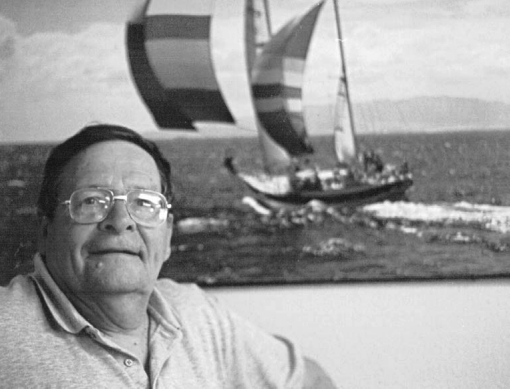
Ted’s own boat, an unconventional 24-foot Nimble Nomad, is one of a series of power and sailing flat-bottomed centerboarders he designed for Nimble Boats in Florida. None of them has any balsa cores. The decks are solid, composed of skins of fiberglass separated by a core of resin mixed with filler. “It can’t rot, and you don’t need to worry about compressing it when you tighten up on a fastener for a through-deck fitting. It’s there forever.”
Circumstances dictated Ted’s choice of boat. “In the best cruising season, the summer and fall, there’s very little wind on Puget Sound. And when there is wind, it seems to curve around every island and come straight at you, so I prefer to sit in the comfort of a cabin and go to windward at 7 knots to get places,” says the man who has competed under sail all over the world and taken part in three Trans-Pac races.
One year he and his wife, Betty, cruised north to Sucia Island in the San Juan group in a Nimble 30 yawl, which has become a cult boat. During their cruise they came across a very ugly houseboat. A woman aboard the houseboat took one look at the Nimble and exclaimed: “What a pretty boat!”
Ted was skeptical. “I figured, heck don’t get too excited. Anyone going around on a houseboat as ugly as that can’t possibly be a judge of beauty.”
But then the woman revealed that the houseboat was on charter. “We have a Concordia back East,” she added. Ted was greatly mollified. “That suddenly made me very happy, because anyone who owns a Concordia surely knows a pretty boat when she sees one.”
When Ted looks back over a lifetime of work and 260 designs, does he spot anything he wishes he’d changed? Would an inch here, an inch there, have made any difference?
“Not to the underwater hull, not to the performance. But to the stuff above the waterline, yes — to the looks of the boat. I think it happens to every designer. You see a boat or look at a design years later and you say: ‘God! Why didn’t I give her an inch more spring in the sheerline?’ Or ‘Why didn’t I pull that counter out another couple of inches?’ It can make a big difference to the looks of the boat.”
When he’s not at his drafting table, Ted is either writing books and articles or pursuing his hobbies. He has written three books — Understanding Yacht Design, now in its fourth edition; Cruising Yacht Design; and Ted Brewer Explains Sailboat Design. His passion for sharing the secrets of boat design also reveals itself in the many articles he writes for the yachting press here and abroad.
He is justifiably proud of his G-gauge radio-controlled model railroad setup, in which he has invested “thousands — far too much,” and his collection of World War I books, which now numbers about 300 volumes.
But he doesn’t get to indulge in his hobbies as much as he’d like because the lure of the drawing board is always there. And you just never know when another miracle like Black Velvet might happen.
Thank you to Sailrite Enterprises, Inc., for providing free access to back issues of Good Old Boat through intellectual property rights. Sailrite.com