Issue 3 : Nov/Dec 1998
Gently used, previously owned … call good old boats what you will. When we’re in the market to buy one of these used gems, there are a couple of hurdles to jump simply because they are old boats. In this collection of articles on the financial side of old boat ownership, Art Saluk talks about the process of buying an older boat including survey, sea trial, and haulout; Jim Plummer reviews the realities of financing an older vessel; Geoff Parkins discusses issues involved when insuring your good old boat; and Jerry Powlas reminds readers that upgrades should be tailored to the boat’s use. On a high note, Bob Wood discusses tax deductions that apply equally to any boat whether a good old one or a new one at five times the price. All of the shortcomings are surmountable and the advantages worthwhile. Read on …
Before you buy …
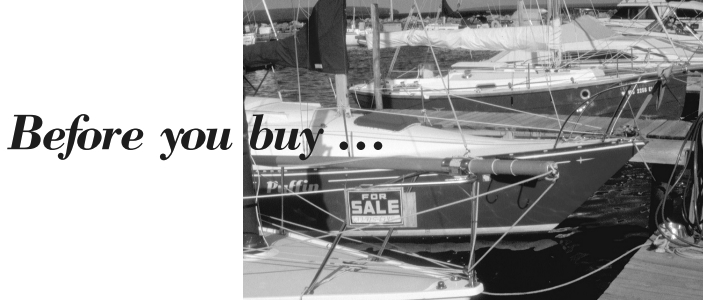
You drive by her each morning and evening, and your heart starts to flutter. Her graceful lines and the shimmering water make the world beautiful. As she bobs on her mooring, all seems perfect in the universe. One day you drive by and notice the FOR SALE sign hanging on the lifelines and you know you must own this boat.
Before you rush out with your checkbook in hand to buy your dreamboat, there are several things you must know: how to assess the condition of the boat, how to value the boat, how to prepare an offer, and how to enact the transaction. Each of these steps contains potential pitfalls that can be quite costly if not properly addressed. Obvious as it may seem, it’s easy to forget that time invested properly in your purchase can save you thousands of dollars down the road. A boatless sailor with a pocketful of cash, and a graceful yacht in need of a new owner, are the ingredients for a poor decision.
There have been many articles written on how to assess the condition of an older boat. (See Bill Sandifer’s article on Page 38 in the September issue of Good Old Boat.) These articles focus on how to look inside lockers, under cushions, behind the stove, behind drawers, and in every nook and cranny where you can fit a flashlight for signs that the boat has been well maintained all along and not just cleaned up for sale. Determining for yourself that the boat appears to be in good condition prior to making any offers, hiring a surveyor, and paying for a haulout can save you hundreds of dollars.
Several sources can help you determine a fair price for your future boat. The primary sources of data used by many lending institutions and brokers are the BUC Used Boat Price Guide and NADA’s Used Boat Prices. These books offer a good guideline as to the value of a particular model of boat. The Internet, classified sections in sailing magazines, and brokers’ ads will also give you an indication of the range in asking prices. Combining data from these sources will give you a sense of the market value.
Most likely you will notice a difference between the published values and the advertised asking prices. Many factors contribute to this difference. An owner’s overestimation of his boat’s value and a built-in “negotiation factor” are the two largest factors. A high asking price may be justified due to recent upgrades such as new sails, a new paint job, a new engine, or an exceptionally well-maintained boat. Once you have determined a fair and realistic value of your prospective purchase, the time has arrived to make an offer and arrange for a survey and sea trial.
All offers should be made subject to a survey and a sea trial. This is the time for your surveyor to determine the condition of all aspects of the boat and associated equipment. The sea trial not only gives the surveyor an opportunity to inspect the boat while under way, it gives you the opportunity to find out whether you feel comfortable with the way the boat performs and to decide if it meets your expectations.
The sea trial will also give you an opportunity to see how the owner handles the boat while under way and at the docks. This will give you a little insight into how the owner has treated your prospective new purchase. Before the survey and sea trial take place, however, the seller will want a deposit.
At this point you should put all of the details of your offer in writing. Your offer should include the following:
- Amount of the offer.
- Amount of the deposit.
- Terms of the offer (how long is the offer good for, list of equipment that is included, etc.).
- Conditions of offer (survey, sea trial).
- Dates for each event to take place (acceptance of offer, sea trial, closing, etc.).
- Responsibilities (who is responsible for costs of survey, sea trial, etc.).
While this may seem to be a lot of trouble, it will make clear all of the implied conditions of your contract and prevent difficulties and misunderstandings if there are unexpected problems on the sea trial or afterward. Remember that you are involved in a transaction that involves thousands of dollars.
Typically a 10 percent deposit will be required to accompany the offer. Be certain that the seller has agreed to let an escrow agent hold the deposit for you. If you give it directly to the seller, and the boat is subsequently not purchased (say the sea trial performance was disappointing), there is always the possibility of the seller’s not being as cooperative as he was when accepting the deposit.
There is only one remaining thing to do prior to laying out hundreds of dollars for the survey, sea trial, and haulout: find out if there are any liens on the boat. The responsibility for the lien will go with the boat and her new owners. There are unfortunate sailors out there who have bought their boats twice. If the boat is documented, write the U.S. Coast Guard Documentation Center and ask for a title abstract. It will cost you $25, and they will fax you the abstract within a couple of days. You only need to provide them with the official number and name of the boat. Many smaller older boats have not been documented but instead are state registered. If this is the case, you should have a copy of the title with no liens recorded.
Now you are ready to hire a surveyor. Make certain that you hire a reputable surveyor who is a member of a recognized association such as NAMS or SAMS. The survey should include going up the mast to inspect the rig and going out on the sea trial. Be certain to ask the surveyor for several references of boats that he has recently surveyed. His report is the last thing standing between you and ownership of your new boat.
The surveyor’s report will certainly contain dozens of recommendations. Be certain to review them carefully so you understand the magnitude of each and how they may affect the seaworthiness of the vessel. You should view most of them as a project list for the boat. If there is a major problem, however, now is the time to review it with the seller.
Make a fair estimate of the costs to make the proper repairs, and ask the seller to reduce the agreed-upon price by that amount. You are better off taking a monetary settlement and then making the repairs yourself than having the seller do the repairs for you. The older boat will have many small things that need tending to, and it is my belief that the survey should not be used as a document to “nickel and dime” the seller into a lower price.
Now you are ready to buy your dream. Have the seller prepare two original bills of sale for you. You will need them later if you decide to document your boat. Have both bills of sale signed and notarized by the seller. If the boat is documented, be certain to get a copy of the original document. You will need this if you are going to re-document the vessel. If the boat is state registered, then have the original title signed over to you. I always recommend that you have proper insurance coverage take effect the day you take possession of the boat.
Be absolutely certain the beautiful boat that has caused your heart to flutter will not later cause it to ache. Take the time to have a proper survey and establish ownership with clear title. The devil always seems to lie in the details. Working with a yacht broker will free you from tending to these details. The broker will be able to establish market values, obtain a title abstract, coordinate the survey, and prepare the paperwork. The critical issue is not whether or not you work directly with the seller or with a broker, but that you ensure you have performed all the tasks to protect your new purchase.
Thank you to Sailrite Enterprises, Inc., for providing free access to back issues of Good Old Boat through intellectual property rights. Sailrite.com