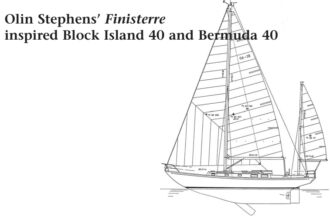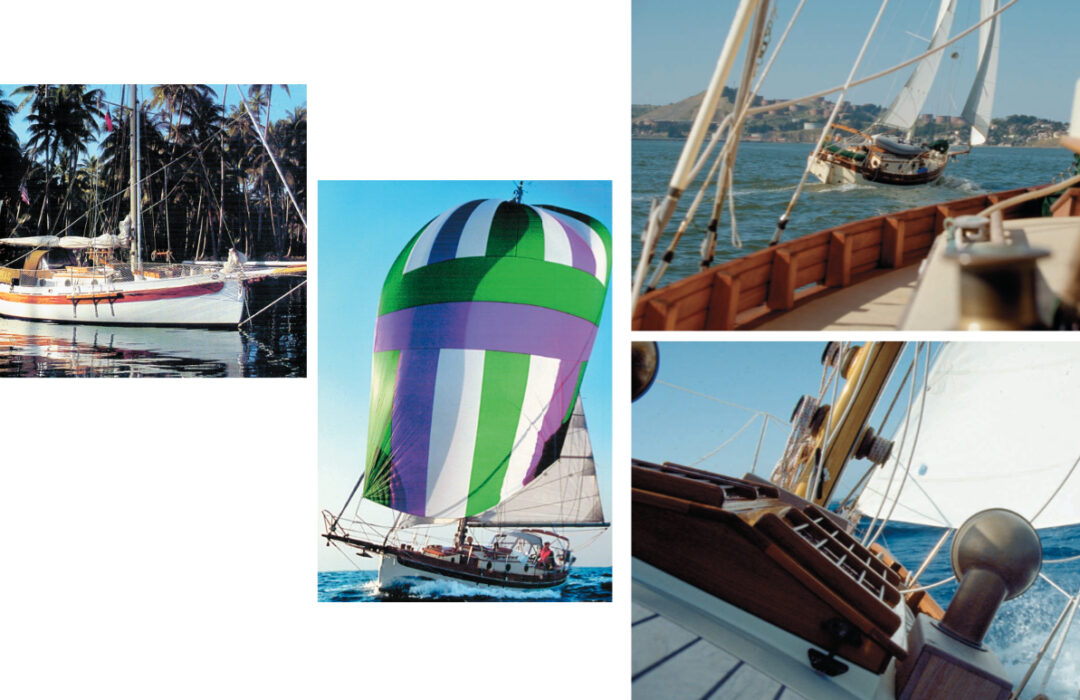
Inspired by Seraffyn’s design, Bristol Channel Cutters create adventures and legends of their own
Issue 6 : May/Jun 1999
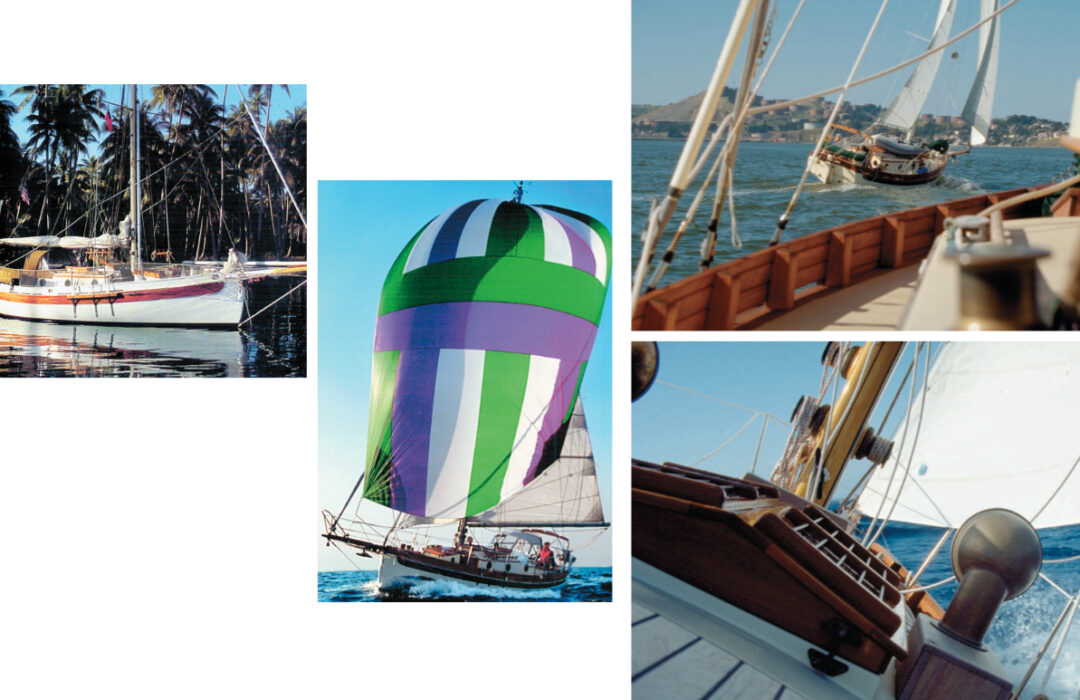
The Bristol Channel Cutter (BCC) is a boat of superlatives. For many dedicated long-distance cruisers, she is, for her size, simply the best of the everything: the most comfortable, the most seaworthy, the most traditional, and (naturally) the most expensive. There are some who call the BCC the Rolls Royce of yachts, but they’ve got it the wrong way around. The Rolls Royce is actually the BCC of automobiles.
What is intriguing about this boat, and the cult that has sprung up around her, is that her design is that of an old-fashioned British working boat. A century ago, scores of long-keeled cutters like her were hanging around the western approaches to the English Channel and the Irish Sea, waiting to transfer pilots to inward-bound sailing ships. These pilot cutters needed several characteristics to survive. They had to be utterly seaworthy because they stayed out in all weather. Gales were just an ordinary part of their working lives. They had to heave to well, because they spent much of their time waiting in one spot. But they also needed a fair turn of speed and weatherliness when a ship seeking a pilot appeared on the horizon, because it often happened that the first pilot cutter on the scene got the piloting job. And the pilots naturally favored the faster cutters.
So the design of the pilot cutters evolved as they competed to make a living at sea, being shaped by the unforgiving forces of nature and the unremitting demands of free commerce. Not that you’d equate today’s BCC with the rough-hewn finish of the working boats. The BCC, as designed by the legendary Lyle Hess and built today by the meticulous Sam L. Morse company, is as cultured a piece of sailing machinery as you’re likely to find anywhere. In fact, you wouldn’t be far wrong if you said that Chippendale and Hepplewhite were the BCCs of fine furniture.
Basic design
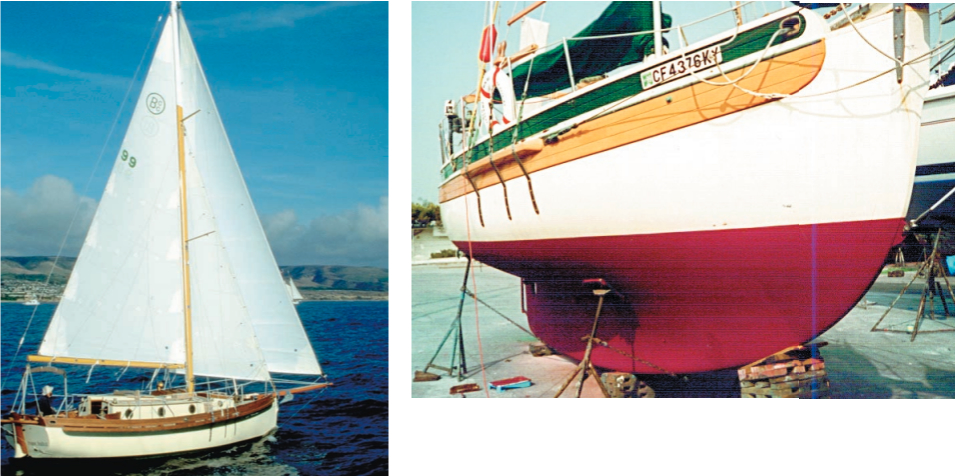
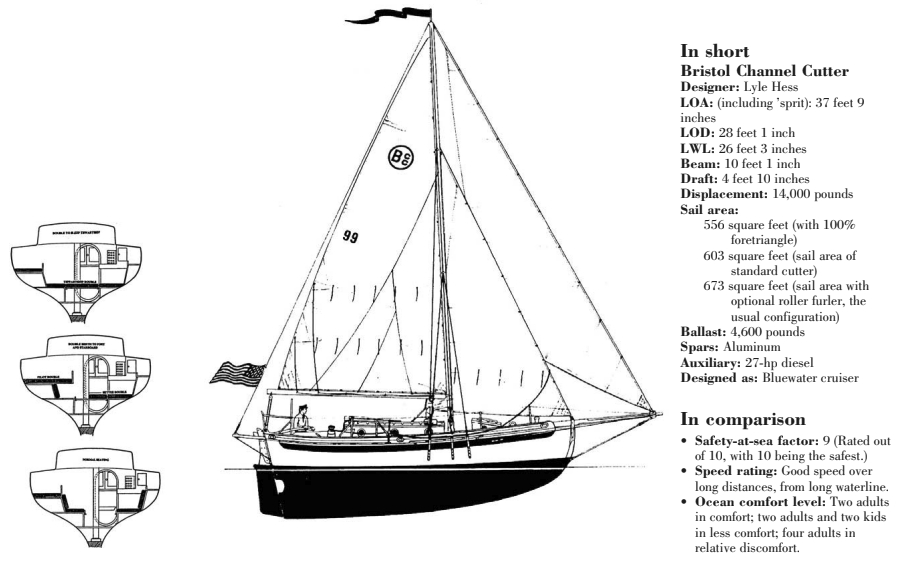
Leaving the superlatives behind for a moment, what we have here is a very heavy displacement hull with moderate sail area, an outboard rudder, a long, fairly shallow keel, and a 6-foot bowsprit that certainly won’t be everybody’s cup of tea. It’s not a recipe for daysailing or fast around-the-buoys racing.
BCC owners, who seem to have all the answers ready, will tell you a bowsprit adds sail area that spreads fore and aft, rather than upward. Thus, because it lacks the leverage of a tall skinny rig, a jib set from a ’sprit provides thrust without making the boat heel. Not everybody buys that argument, suspecting that a large low sail probably creates exactly the same heeling moment as a small high sail; and suspecting, further, that a bowsprit was the only way you could add sail area in the days of gaff rigs, when masts had to be short because of problems with staying them. With modern materials, we can now stay tall masts quite adequately, and we can provide boats with all the sail area they need, a lot of it up high to catch more wind in light air. We can also balance a boat very nicely without the help of a bowsprit, which means we don’t have to make those daring trips to the end of the ’sprit to free the roller furler when the line jams.
Nevertheless, the BCC is a very safe boat to sail, even for a singlehander. You can run into a large balk of waterlogged timber on a dark night and not have to worry about bashing in a fin keel or ripping off a skeg and rudder. The BCC will ride up and over it. In shallow waters, she won’t get crab-pot lines jammed in her propeller or rudder, either.
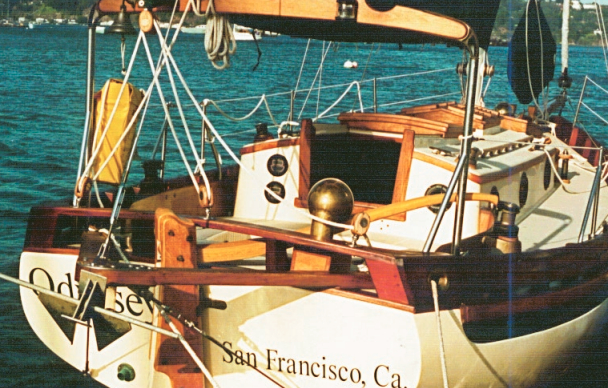
Her fairly shallow draft of 4 feet 10 inches allows her to explore the wonderful cruising grounds of the Bahamas and many other areas that can be tricky for those with 6-foot keels. She is so solidly built and so well designed for her purpose that no modifications are needed to improve her seaworthiness or her fitness for ocean voyaging. There is plenty you can do to personalize her, of course — in fact, if you buy a new one, starting at about $150,000, you can custom-order many modifications — but basically she’ll be ready for sea work from the very start.
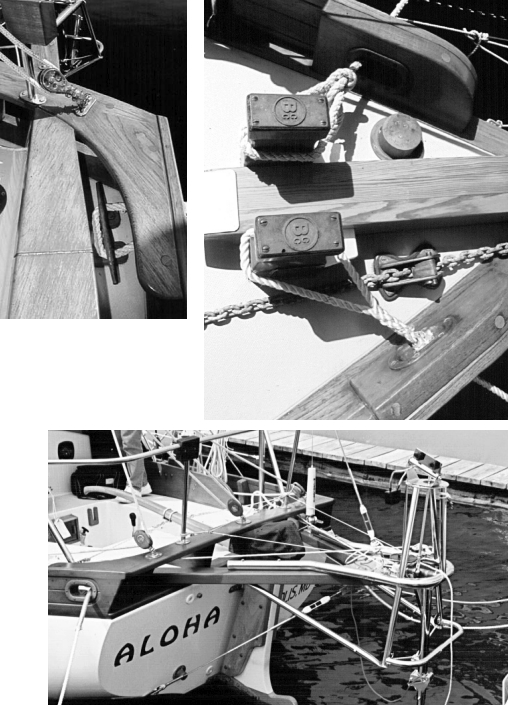
The hull is solid fiberglass, and the deck is fiberglass with a core of marine plywood. The lead keel, accounting for about 32 percent of the boat’s total displacement, is encapsulated in the hull, and the double-spreader aluminum mast is stepped directly onto it. The BCC’s wide sidedecks are bounded by 8-inch-high teak bulwarks that provide good footing in bad weather and stop a lot of gear from disappearing over the side. Her rudder is attached to the end of the keel and to the flat transom — a strong and very sensible arrangement — and is controlled by a tiller.
Accommodations
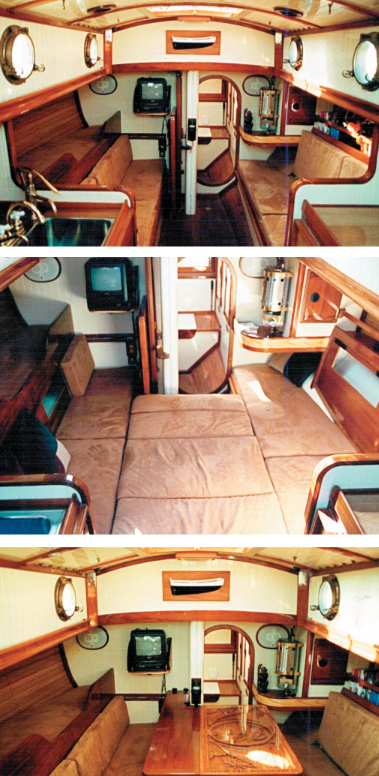
The Sam L. Morse company builds the BCC with three basic interior layouts, and new owners are offered many options without extra charge. You can have a workbench up forward, for example, instead of a single berth. There’s also the option of a pilot berth that converts into a double, and a quarterberth on the starboard side. But it’s the well-planned galley that excites most comment from visitors, particularly the large amount of counter space. There probably isn’t another 28-footer with a galley so pleasant to work in.
There’s plenty of headroom in the main cabin — up to 6 feet 6 inches if you need it — and the cabin is unlined. That means you can get to important stuff such as plumbing and wiring — or a hole in the hull — when you need to. The raised scuttle hatch up forward provides headroom in the toilet compartment. The standard auxiliary is a 27-hp diesel, which fits into the BCC’s engine hole with a comforting amount of room to spare.
In general, the interior of the BCC exudes the same air of elegance and workmanship as a 1920s Pullman car, with bronze ports, a teak skylight, and lots of shippy brass.
The rig
A gaff rig would make a lot of sense on this boat, particularly when she’s sailing off the wind, which would be most of the time on an ocean cruise, presumably. It’s a sturdy, well-stayed, powerful rig, one that’s much more likely than a Bermuda rig to remain standing after a roll-over.
No doubt you could arrange with the Sam L. Morse company to take delivery of a new one with a gaff rig, but the standard boat comes with a tall rig, a long bowsprit, a long boom, and a short boomkin to support the backstay clear of the mainsail leech.
The mast rises 41 feet 6 inches above water level to support the 556 square feet of canvas this heavy displacement hull requires. The cutter rig is not quite as efficient to windward as a sloop rig would be — two small headsails rarely produce the same horsepower as one big one — but it certainly makes life easier for small crews. The jib flown from the end of the bowsprit can be on a roller furler, which means it can be put to sleep as the wind pipes up, leaving a nice snug forestaysail set inboard, where it’s safer to work.
With jiffy reefing on the mainsail, and a nice flat, stable platform at the foot of the mast to stand on, reducing sail in a blow should be easy. If you opt not to have a roller furling jib, you can fly an enormous genoa, Yankee, or nylon drifter from the bowsprit end, as the Pardeys do aboard Taleisin, a near twin of the BCC.
You might not expect old-fashioned boats like this one to sail to windward particularly well, but sometimes they can surprise you. In the first place, their sheer mass and seakindly motion keep them moving through choppy seas that knock lighter, more lively boats backward. And in the second place, that projecting bowsprit makes it possible to trim the jib to a narrow sheeting angle and still have the sheet run outside the shrouds. So there are times when boats of this type will point surprisingly high and go surprisingly fast, which is a very handy attribute when you’re faced with a two-week windward slog against the trades. But then, as we saw earlier, perhaps it’s not so surprising, considering that in the last century their livelihood depended on their being able to get a pilot to windward quicker than their rivals could.
There’s not much more to be said about the rig, except that it is massively solid and more than fit for the job, just like practically everything else on the boat.
Performance
The BCC does not have a kittenish performance around the buoys, but if you point her nose across an ocean you’ll soon discover that she’s no slouch.
“The boat can easily make 150 miles a day in the trades with the working sails only,” says one owner, quoted in the advertising literature the builder puts out. “I have made many 170-mile days, and some slightly higher.” You have to accept this with due allowance for unbridled enthusiasm, of course. In theory, a boat with a waterline of 26 feet 3 inches, could do no more than 165 miles a day, at a constant speed of just over 6.8 knots. In practice, it is possible to exceed that speed in short spurts when running down the face of a wave. But even so, 165 miles in a day is very good going indeed for a non-planing boat of this size.
But perhaps the rules of physics do not apply to the BCC. Here’s part of a letter to the builder from the owner of a BCC called Puffin: “Just a note to tell you Puffin has finally outdone herself with a 187-mile day on the way to New Zealand from Tongatapu. A good deal of near-gale-force winds and a pinch of current has pushed us 579 sea miles in four days. It looks like 1,036 sea miles in seven days, light to light.”
Puffin would have had to average more than 7.7 knots to cover 187 miles in 24 hours. One suspects that she had more than a pinch of help from the current. The other times and distances indicate a speed of just over 6 knots, which is more reasonable. But all quibbling aside, Lyle Hess’s sturdy little cutter is obviously capable of reaching her maximum speed fairly easily — and that, in the end, is the design magic that makes a boat a swift passagemaker.
Known weaknesses
The BCC’s weaknesses are either non-existent or well hidden. One certainly never hears owners complaining about them. As befits a loyal clan of cultists, they are remarkably tight-lipped about her flaws — if, indeed, she has any. Those of us made sufficiently skeptical by practical experience will conclude that she does have flaws, but that they are remarkably minor.
There is that bowsprit, though. It’s not a weakness as such, but it an be a nuisance, especially when you’re docking, or playing with the jib at the splashy end of it. There’s nothing you can do about it. You just have to learn to love it.
Owner’s opinions
Chris Edwards, who raced yachts to their limit for much of his sailing career, eventually graduated to a BCC. After competing in two Whitbread Round-the-World races, three Admiral’s Cup races, two World One-Ton Cup championships, and so forth, Edwards found himself racing his Bristol Channel Cutter, Xiphias, in the inaugural series of races known as the Phuket-Port Blair Andaman Cup Regatta.
There were five races. The first was 450 miles across the Andaman Sea, from Phuket, Thailand to Port Blair, in India’s Andaman Islands. Then there were four races of about 35 miles each among the islands. Xiphias won the long-distance race easily on handicap — but she also beat three yachts of 34 feet, 36 feet, and 38 feet over the line. She then went on to win three of the four inshore races. All very well, you say, but this was Chris Edwards. He could have sailed anything and won. Maybe. But Edwards himself says there was very little in the way of tactics involved in the ocean race.
“It was a close reach on one tack for most of the race to Port Blair. It was Xiphias’ powerful sail plan and her constant, seakindly motion in the rough seas that won the day.”
He has grounded her “a couple of times,” and had to contend with “some fearful tropical storms.” He also says he’s had to sail her hard to windward to clear a shoal or lee shore. He says in a letter to the Sam L. Morse company: “Her strength, her perfect balance and seakindliness, and her ability to make headway under a variety of sail settings, has convinced me that not only is she the perfect cruising design, but also a trustworthy friend.”
These, of course, are obviously the sentiments of a man smitten with his BCC, and you should make due allowance for it. But Chris Edwards is not alone. The files of the Sam L. Morse company are bulging with similar letters from exuberant owners, praising the ability of their BCCs to weather storms and look after their crews in atrocious conditions.
For a common old working boat, the BCC has come a mighty long way.
Conclusion
It’s tempting to note that if you have to ask the price of a Bristol Channel Cutter, you probably can’t afford one. Let’s just say that while they cost as much as many a small house on a modest plot of land, they’ll give you a lot more in the way of adventure and excitement, if that’s what you’re looking for.
Thank you to Sailrite Enterprises, Inc., for providing free access to back issues of Good Old Boat through intellectual property rights. Sailrite.com