Issue 6 : May/Jun 1999
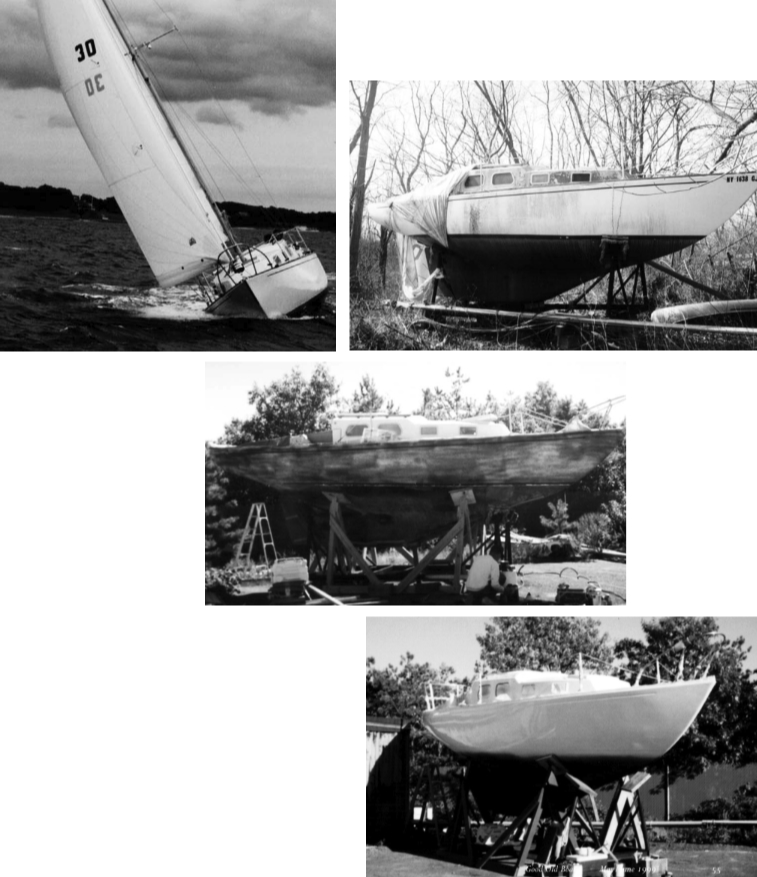
Every day I would see her twice as I drove past to and from work. I could not tell if she was a boat or a derelict. This continued for seven years. She never moved, was never even touched. One winter we had a lot of snow, and she resembled an igloo! Finally, the house in whose yard she was dying sprouted a FOR SALE sign. Still the time was not right. Eventually the FOR SALE sign said SOLD, and I called the real estate agency.
“Excuse me, I am calling about that house in Eastport,” I said. “It’s sold,” said she. “But I am interested in the boat in the yard.” I could almost hear her eyes widen in surprise. I left her my name and number. Soon the telephone rang, and the boatowner was on the other end. “May I go on board and check her out?” I asked. “Yes,” said the owner, “but beware of the bees, wasps, and other stinging things that have taken up residence.”
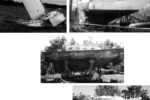
Scott Walter, my friend and eventual partner, joined me to check over the hulk. The keel had been damaged slightly from being introduced to sandbars. Vines were growing up her sides, entwined in the cradle. Moss was a half-inch thick on her north side. Something had made a perfectly round nest in the head. The dirt and leaves had gotten everywhere during the 10 years she had sat in the back yard. An old mainsail had been used as a cover, but was now ripped and blown off. Scott was as skeptical as I was excited. I finally had found a boat I could afford! Several telephone calls to the owner resulted in a price of $2,500, and we were able to buy a Bristol 27, hull #30, with a steel cradle, two ladders, five sails, a 9.9-hp Evinrude, and a project of immense proportions.
We moved her the day the buyers of the house were moving into their new home. They were thrilled to see her go! Walter, the grizzled boat mover, walked around her, spat, and said, “I sure hope you didn’t pay much for her.” We had not. Following her down the highway, my car was showered with all the debris blowing off the boat. Scott was nice enough to let the boat live at his place of business. This meant there would be no yard bills during the restoration period.
The first thing we did was empty the entire boat. This included removing dead squirrels and mice along with the sails, anchor, lines, stove, motor, and so on. Next we attacked the moss, vines, leaves, and dirt, inside and out. This process took a month. Then I built a cradle that fit outside the original cradle. Once the new cradle was in place, we lowered the old one away from the hull. We did this for two reasons: we needed access to the bottom of the keel for repairs; and two pads from the original cradle had rotted to dust.
We next removed 200 years of bottom paint! The paint was a full 1/8-inch thick! Once the bottom was down to the original glass, we barrier-coated it and prepared for new paint. While this was going on, I removed every piece of wood from the interior and refinished them at night after work in my wood shop at home. We set the outboard in a tub of fresh water and were amazed that, after sitting for 10 years, all it needed was fresh plugs and gasoline. It started right up, and lasted the entire first season! (It died while I was sailing with my 7-year-old son, and I had to sail into the slip, but that’s another story!)
The restoration project was a true Tom Sawyer story. One close friend of ours is an “electro-magician,” and he upgraded the electrical system from one battery to two. He also helped me install the new gauges and running lights. Another good friend is a plumber, and with his help we replaced the thru-hull for the sink (because the old one was stuck open) and replumbed the fresh water system. We also installed scuppers in the rear of the cockpit. Another dear friend was a “floor guy,” and he refinished the interior floors. He also used his floor machine to sand the rudder, a task for which lesser sanding machines were useless. During the time that all of this was taking place, my dear wife (who is kind enough to indulge my quirks and fascination with old boats and cars), was cleaning, sanding, masking, and repainting the deck.
The repainting process required over 1,500 feet of tape and about one month’s supply of newspapers. The deck was two-tone colored from the factory, and we wanted to keep everything as close to the original as possible. My wife is an artist with very steady hands. At one point, she spent two days on the deck with a quarter-inch-wide brush cutting all the edges around the two-tone, and around all the deck fittings. We then sprayed the boat, and it turned out like new!
We sent the mast to the rigger, and we replaced every piece of line and inspected the stainless rigging. The rigger pronounced the mast safe and strong and shipped it back to us. We then moved to reassembling the interior. Luckily, I had had enough sense to label every piece, so the result was just a giant jigsaw puzzle with screws. We also replaced the fixed ports that had turned white with age. This was a straightforward process, because every piece was marked.
We then painted the bottom, jacked the old cradle back in place, and removed the temporary one. We moved the boat and took her to her first launch in more than a decade.
Now Scott and I have one of the nicest B-27s around, and we were even bold enough to change the name. Because of what we gave her, and what she gives back in return, we have named her Second Wind. She lives up to her name every time we sail her!
Thank you to Sailrite Enterprises, Inc., for providing free access to back issues of Good Old Boat through intellectual property rights. Sailrite.com