The simplicity of good old boats meant there was little to go wrong… the price was right, too …
Issue 6 : May/Jun 1999
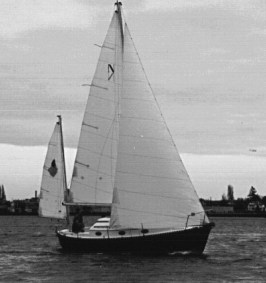
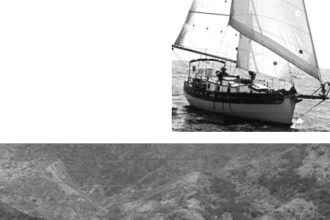
I am often asked how to reduce the cost of buying a new boat. Like other costs, boat prices have risen much faster in the last 20 years than the average person’s income. Today a new Nimble 30 yawl costs more than $85,000. I bought one in 1986 for less than $40,000. Likewise, in 1964, a spanking new Luders 33 cost $15,000.
If we compare today’s boat prices to those of years past, it is easy to see that a large chunk of the price increase is due to inflation. In the 1960s, boatyard rates were $10 to $12 per hour; today a boatbuilder charges four times that rate. This holds true for sailmakers, riggers, mechanics, painters, and all the other craftsmen involved in building a good sailboat. The people who make boat hardware also earn more, but they also pay more for the bronze, stainless steel, and aluminum that go into their products.
Raw material prices have skyrocketed as well. The price of resin for fiberglass boats took a huge jump during the 1970s oil crisis and never returned to its pre-crisis level. The price of teak has quintupled, and other materials have risen similarly It is no wonder that new boats cost so much.
Still, in my opinion, a major factor in the increased cost of a new boat has come with improved technology: we demand more in our modern boats in the way of comfort, convenience, performance, and amenities.
A similar trend exists with our automobiles. In 1964 1 bought a four-wheel drive International Scout for $2,250; 30 years later I priced a fully outfitted Ford Explorer at $25,000. That is a 1,100-percent price increase! But the newer machine had a four-speed automatic transmission, AM/FM cassette radio, air conditioning, electric window defogger, power disk brakes, power steering, reclining seats, intermittent wipers, and more gauges than a Boeing 747. It also got 40 percent better fuel economy, cruised comfortably at speeds the old Scout could only achieve if you drove it off a cliff, and was running like new at 75,000 miles. The Scout was a rusted skeleton when the odometer hit that mileage figure.
A moderate-sized sailboat today has many items of gear aboard that simply were not considered 35 years ago. Indeed, much of what we consider essential today had not been invented back then, and much of what had been invented was for larger, more luxurious boats. In 1960 the typical 25- to 35- footer had no pressure-water system, hot-water heater, shower, or marine head with holding tank and pumpout access. Nor did it have lifelines; pulpits; self-tailing winches; roller bow chocks or travelers; masthead, nav, and strobe lights; roller furling jibs and mainsail; wheel steering; or folding or feathering prop. There was no diesel engine, generator set, dual-battery system, shore-power hookup, electric refrigeration, or propane stove with oven. And no electronic luxuries such as depthsounder, log, knotmeter, VHF, SSB, wind speed/direction indicator, autopilot, GPS, Loran, SatNav, radar, or weatherfax. Air conditioning, water makers, bow thrusters, power windlasses, and the onboard computer did not exist.
In the late ’50s and ’60s, the typical 30-foot cruiser was powered with an outboard or, at best, a small gasoline auxiliary — the 30-hp Universal Atomic 4 or 12-hp Bluejacket Twin being the most popular. The electrical system consisted of one 6-volt battery. There was no battery charger. The battery was taken home if it needed charging. There also was no shorepower system. There was little point in having a shorepower plug in any case because there were few marinas, and the few that did exist rarely provided power outlets at the slips. Most boats hung on a mooring, and the owner rowed out with his dinghy loaded with duffel and stores when he was going off for a cruise.
The stove was a one- or two-burner pressurized alcohol unit that flared up regularly, or a Sterno gizmo that took a half hour to boil water. There was no hot-water heater, and you pumped the fresh water up from the tank by hand. There was an icebox, of course, either built-in or portable. The icebox wasn’t electric because the 6-volt battery would have collapsed instantly under the load. Quite a few boats had sinks, but many other small cruisers had only a basin that you emptied through the companionway hatch. Woe to the cook who emptied it to windward!
The boats had either a bucket or a marine head, but no holding tank, Y-valve, or pumpout access. The Environmental Protection Agency (EPA) was still a dream in ecologists’ minds. Showers were definitely limited to large “yachts,” so on longer cruises sailors took sponge baths or saltwater showers on deck.
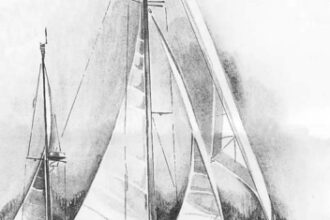
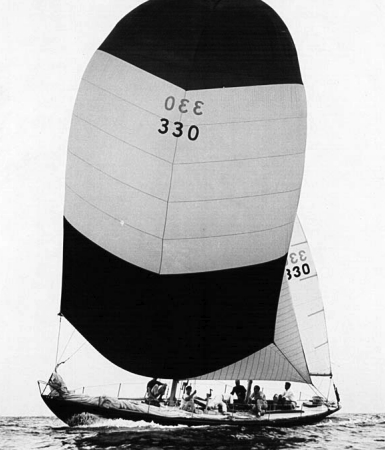
Winches often were not geared, and selftailers were non-existent. Getting in the #1 genoa on a big boat was an exercise in agility and muscle. Storm, the Luders 40-footer that I raced on for years, didn’t even have a spinnaker halyard winch. That led to some exciting moments when the sail filled before we got it all the way up, but we always succeeded. Although other 40-footers sported them, Storm had no spinnaker pole track either; a couple of padeyes on the mast did the job, and I can’t say that we ever missed the finer adjustment of a track. It is not that we weren’t keen competitors — Storm was one of the top boats in her class on Long Island Sound and, with her designer/builder Bill Luders as skipper, won more than her share of both distance and day races — rather, Bill believed in simplicity. In truth things rarely went wrong on Storm because there was little that could go wrong.
Navigational equipment consisted of a compass; wind direction was determined by tying a short length of nylon stocking to the shrouds. Somehow we dithered our way through fog without benefit of radar, and we always managed to find the turning mark even at night without benefit of Loran. We seemed to know the direction of the wind well enough to stay ahead of the competition, too. And although we had no windspeed indicator, we always managed to shorten sail about the time that the lee rail went under. When green water rolled onto the deck, we figured out, without the aid of a computer, that we were carrying too much canvas.
The compass light was the only electric light aboard; kerosene was used for running lights, so we rarely had problems running short of battery power, and because the diesel started with a hand crank, it didn’t matter too much if the battery did go flat. Storm’s galley consisted of a one-burner gimbaled Sterno stove and a plastic basin we emptied overboard, yet our crew of six hearties never went hungry, and we never had a plugged sink drain.
When it came to safety equipment, Storm had no radio, depthsounder (well, we did have a lead line), safety harnesses, life raft, or EPIRB; no jacklines, man-overboard pole, strobes, or high-capacity electric bilge pump. In one respect she was better off than the eight-meter sloop Vision that I first started racing seriously aboard in 1957. Storm, at least, had a bow pulpit and life rails! On Vision it was definitely one hand for yourself and one for the ship. Granted, at night in a stiff breeze, “the one hand for the ship” was often a death grip.
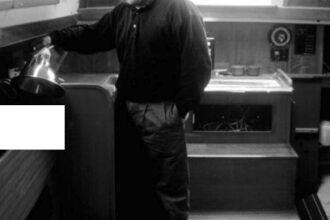
I’m not proposing that we give up safety gear or modern conveniences, but judicious selection can save substantial money. On my last boat, the hot and cold pressure-water system with shower cost $1,000. Because I sail and anchor out whenever I can, I rarely had hot water in the tank. And because I would rather pay 50 cents for a shower in a marina than wipe up the head after the shower has soaked everything, the shower was still virginal when I sold the boat. I could have saved $1,000 and never missed it. The oven on the alcohol stove was a $750 extra and that probably represented about $150 for each time I used it in the five years I owned the boat. I also could have easily lived without shorepower, which set me back another $400. I only used it during the winter to keep a couple of lights burning to dry the boat a bit. A $10 extension cord would have served just as well.
Switching to a 2-cylinder diesel instead of the standard 1-cylinder unit cost another $1,500. Then there were the other extras: custom upholstery, varnished interior, special Formica, and a $700 diesel cabin heater. In short, for me there was almost a 25 percent increase in the base cost simply for “I can’t live without it” doodads that really added little to the pleasure of sailing or cruising. As on Storm, I managed without rollerfurling gear, Loran, SatNav, radar, and wind speed/direction indicator.
I am not suggesting that you put on a hair shirt and live like a hermit, but if the budget for that next boat is tight, analyze your needs. Then put your money into the essentials like hull, rig, and sails, and learn to live without some of the little luxuries. Any money you save can be set aside to help pay for that long cruise, and you will be the better for it. If you do have a few shekels left over, the best extra you can buy for the boat and yourself is a copy of L. Francis Herreshoff’s The Compleat Cruiser. That famous little book is still the Bible for “keeping it simple” and getting the best out of cruising.
First published in Cruising World, October 1995.
Thank you to Sailrite Enterprises, Inc., for providing free access to back issues of Good Old Boat through intellectual property rights. Sailrite.com