Issue 6 : May/Jun 1999
John Smith may be a metallurgist by trade, but he’s perfectly at home drilling holes into fiberglass to add railings and lifelines and wiring new electronic toys for his Pearson Commander, Pocahontas.
And he’s had to be. His 1965 Commander rolled off the assembly line just 6 years after Carl Alberg collaborated with the Pearson cousins to create the first fiberglass boat big enough for recreational cruising. A lot of improvements have been made in fiberglass boats since then, and John has worked hard to keep Pocahontas up-to-date.
“I sort of followed along from the earliest days of simple sailing up until now, when you have everything aboard the boat,” John says.
In 1970, when John purchased his used Commander, the recreational boating boom had not yet hit, and builders were not adding small details, such as depth sounders or even sternrails to keep the captain aboard.
“We had no sternrail on the Commander. The lifelines came down and fastened to a deck plate. When you were in the back there, it was fairly easy to pop off the stern. I used to fall off once a year,” John quips. “I even walked off the end of a pier once. Pat and I were walking hand-in-hand, staring at the sunset. Then I took one step too many.”
But before he added the luxury of a stern rail, John concentrated on adding gear that improved navigation and sailing ability. One of his first alterations in 1970 was the installation of a sheet winch for the giant 170-percent genoa.
“I had a working jib that was too small most of the time, and I had a gigantic genoa. It came way back behind the winches, and we couldn’t see out. It swept along the deck. When we came about, it hung up. In racing it was OK because there was somebody on deck to carry it around. But when cruising? You might as well motor,” he concludes.
While John and Pat did their share of racing with the Lake Erie Yacht Club, they also liked to cruise. The winch allowed them to handle the big sail by themselves.
“The other thing I put on (within the first two seasons) was a radio direction finder (RDF), which came with a weather channel,” says John. “The RDF was useful on the Great Lakes because there were lighthouses (with RDF) every 40-50 miles along the shore. You could reach across the lake, get three beacons, and locate your position in the center of that triangle. It was also useful when you got close to a port. You could home in on the beacon.”
In the early days, he points out, “I didn’t have a VHF radio. It took a lot of power and was very large and very expensive, about $400 in 1970. I never bothered with any kind of radio until long after I moved to the Chesapeake in 1974.”
The Commander was originally sold with the option of an inboard Atomic 4 engine or an outboard. Pocahontas had the outboard, a little 6-hp Mercury, which sat in a well in the lazarette and had a pull start. Despite its tiny size, it had plenty of spunk to push the 26-foot Commander, even in bad seas, John says. Without an electric starter and no modern-day radio communications, the boat’s electrical needs were few. A single battery powered a couple of cabin lights and the RDF.
But before their 1972 trip through Canada and the Great Lakes, John added a second battery and a battery charger, which allowed them to run cabin lights for three days without recharging. In the early ’70s, “no outboard had an alternator, so you could not charge from an outboard motor. When I was at a dock, I had a portable car battery charger I plugged in.”
John decided to change the location of his compass after they took a cruise out of sight of land, then made land too soon. “We reached land several hours sooner than we should have, from what I was reading on the compass. After that, I didn’t trust the compass” he says.
It was a wise decision. He soon found out that “the compass always pointed toward the beer,” he says, laughing. “I had a metal ice chest a few feet from the compass. I thought the compass was pointing toward that ice chest. But the beverage cans were made of steel, and it pointed toward them.”
After he realized the ice chest and cans interfered with the magnetic field of the compass, “I mounted a compass in the floor of the cockpit. It’s an unusual thing, but it works very, very well. I had it mounted just below the companionway in the cockpit.” This is one of his most useful adaptations, because he can read the compass without leaving the tiller.
When they moved to the Chesapeake, John began adding electronic items, as they became available and reliable, and other equipment, now considered basic on sailboats, such as the stern rail and ladder.
Fortunately, there are companies that have made it easy for boaters to add these features to their good old boats by designing easy-to-install kits for most older model boats. In the ’80s, John purchased a stern kit for the Commander from Tops-In-Quality, a Michigan-based company, selling stanchions, bow pulpits, and other stainless steel products for boats built in the ’60s, ’70s, and ’80s. The addition required him to replace the boat’s lifelines, since the original lines were not long enough to reach the railing.
The installation required him to drill a few holes in the fiberglass deck so he could bolt the new stanchions in place. The company includes directions that make the installations relatively easy. He later bought and installed the Top-In-Quality ladder kit, too. Before, they used a simple removable ladder that hung off the side when in use, and was stowed in the lazarette when not in use.
Over the years, John noticed that Pocahontas no longer had the luster of youth. Her hull was dull, despite his constant waxing, her chrome was chipping, and her non-skid deck had worn thin. By 1988 this do-it-yourselfer realized it was time to turn to a professional for help if he was to keep his little cruiser up to snuff.
Before investing in a major overhaul, however, he had the boat surveyed to determine how much deterioration she had suffered over more than 20 years of service. “I was concerned with whether it was worth restoring . . . if the hull and deck were strong,” John says. Fortunately, the surveyor found no major problems. John is adamant that boat owners should survey their boats before deciding to have an expensive overhaul. “You absolutely have to have a survey. Your boat may not be worth restoring. The critical factor is the deck. The decks are all balsa cored. The inner layer of fiberglass is 1/8-inch thick, then you have one inch of balsa wood,” which is topped with the fiberglass deck.
“It’s light and stiff,” he continues, “However whenever you put fittings through the deck, if you don’t keep them sealed, water seeps in and rots that wood. In restoring these boats, the real critical thing is the condition of the deck. It’s a devil of a job to do yourself. (See Bill Sandifer’s article on this project in the November ’98 issue.) In the worse case, they have to cut the outer fiberglass deck off, cut the wood out, and replace the wood, then put the original fiberglass back on. If you have to have major deck repair, it costs more than the value of the boat.”
The balsa core rots, John says, when “you drill holes, but don’t do it right, or you don’t use epoxy to fill the hole.” He evidently did his drilling correctly, because Pocahontas had only a few small areas of rot even though he admits he was unaware of the potential problem caused by drilling holes in the deck until later in his cruising life. “Every season you drill more holes in the boat. That was a springtime ritual. I never heard about re-caulking or re-bedding probably until I had had the boat for 20 years.
John chose Hartge’s Boatyard in Galesville, Md., for the overhaul because of its reputation for fine work. Workers fixed the balsa rot problem by drilling holes through the fiberglass and injecting epoxy.
John also learned it’s important to re-bed deck fittings approximately every eight years. “The bedding compound gets old and brittle.” Then gaps can form between the deck and the compound, and water can get in these gaps. “I had everything re-bedded.”
A modern way of installing new fittings through these older, balsa-cored decks, he points out, is to “drill a hole bigger than you need, fill it with epoxy, let it dry, then drill another hole for the fitting. Then it’ll never see water,” he concludes.
While Pocahontas did not suffer from major deck rot, the balsa core had created a problem around the mast. “The mast is stepped on deck. It has a compression post to support it. Between the post and the mast, the deck is cored with balsa wood. Over time, that wood starts to compress. Water gets in. We had the whole area cut out and remade, a six-inch diameter plug of fiberglass from the metal pole to support the mast step.” John cautions other boaters who have a similar rig to check for deck rot under the mast.
Another deck problem is crazing, those hairline stress cracks that run in many directions. “Crazing is basically cosmetic, but you have to watch the cracks. Most crazing is just in the gelcoat. If the cracks get deep, they can get into the fiberglass. Crazing is fairly easy to fix with epoxy fill. My boat had very little crazing, just a little around the rudder post.”
Boatyard workers sanded and repainted the non-skid portions of the deck, which had worn off over the years. “Tread Master is one approach; it’s a glue-on product,” John says, but he prefers the paint-on method. “When you paint the non-skid (a polyurethane), you mix in sand or grit or plastic beads with the paint. It’s not so nice on bare feet, but it works very well and it looks good,” he says.
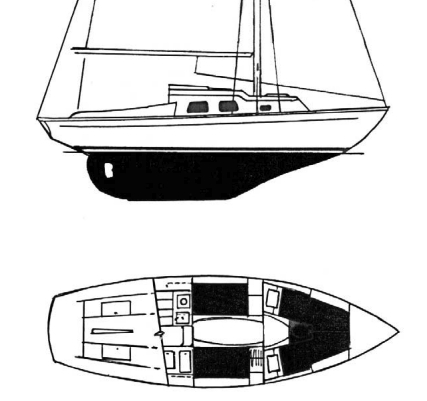
John had the workers paint the smooth portions of the fiberglass deck white and the non-skid mats in light blue so it’s easy to recognize a non-skid surface. The yard also restored the hull. While John didn’t have to worry about blistering, a scourge of fiberglass boats built in the ’70s and ’80s, he was concerned about pinholes in the gelcoat. “I used to use rubbing compound, which gets rid of the oxidized gelcoat. After you’ve done that for 20 years, you’ll find a lot of little pinholes because you’ve worked through the gelcoat,” John says. “At some point, you can’t bring up a new gloss with the rubbing compound. You have to eventually go to painting the hull.”
Pocahontas had the traditional mahogany cockpit seats. They were beautiful, but John had taken them down to bare wood three times and knew how much trouble they were to keep up. “The only time it’s decent weather to varnish,” he notes, “is when it’s the perfect time to go sailing.” So, he had Hartges replace them with teak, a much more durable wood in wet weather conditions. The yard also re-chromed all the metal on his boat, including the winches, stanchions, and deck fittings, and they added a traveler, for fine-tuning the sail shape. Commanders never had travelers.
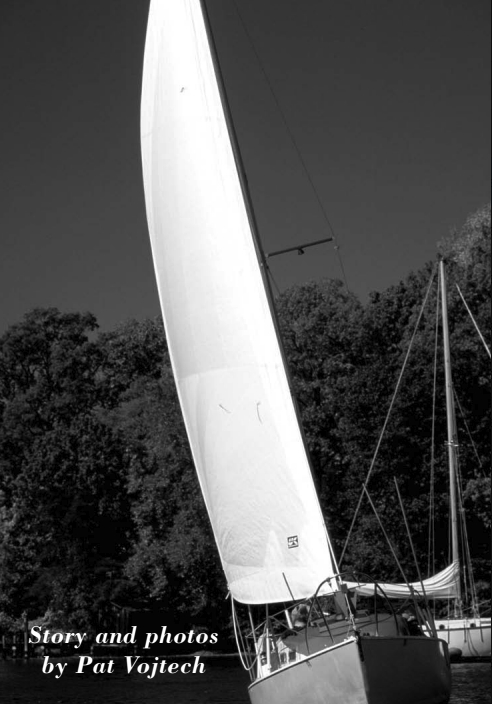
About 10 years ago, John added roller furling and purchased a new, smaller 135-percent genoa to replace the giant sail that often dragged off the deck into the water when they heeled. The new genoa has a padded luff to help it keep its shape as it is rolled up. “As we get older, we get lazier,” John quips about the addition of roller furling. But the truth is he had purposely avoided buying early versions of roller furling. “The first roller furling caused the front along the luff of the sail to sag, so if you had roller furling, you automatically had bad sail shape,” John says. Today’s genoas with padded luffs have helped resolve that problem, he believes.
In the early ’90s, John added a full-battened main with lazyjacks, and changed the reefing system on his rig. “The full-batten main gives you very, very good shape, and it’s very efficient; it keeps the sail from flogging, which makes the sail last a great deal longer. The lazyjacks make the sail very easy to handle.” The mainsail simply falls down inside the lazyjack lines when he releases the main halyard. It’s a quick and easy system that often saves sailors from wrestling with the sail when bad weather moves in quickly.
The main reason John installed the lazyjacks was because they keep their boat in a very busy creek. Back Creek in Annapolis is one of the busiest creeks on the Chesapeake Bay. “We take down the main when we come into the creek,” he says. “When you’re trying to see, steer, and tie up the sail at the same time, it’s difficult. It’s very nice to have it contained. You just let the halyard go, and it’s down,” he says.
“We think the lazyjacks paid for themselves on the first day out because we got in 50-knot winds. We were going across the Bay to Oxford from Annapolis. When the wind hit, we let go of the halyard, and it all came down. Once it’s down in the lazyjacks, you just use the Velcro straps to wrap it up. It’s not in the cockpit in your lap.”
While battens have been known to catch up in the lazyjacks, John says, “I haven’t found that to be a problem.” The original reefing system on Pocahontas only lasted a few years. The boom had a spring-loaded gooseneck fitting. “You took the boom and pulled it out about an inch, and you rolled the sail around the boom,” John explains. “As you reefed, the back end of the boom got lower and lower. By the time you took much of a reef, the boom was practically in your lap. It was a real mess,” particularly, he points out, when they were reefed and sailing downwind. “The boom dragged in the water.” He feared the boat might broach and lose the mast, so he replaced the reefing system with a jiffy reef.
By 1990, it was time to address the growing electrical needs of Pocahontas. John had already added shorepower, so they could have 110-volt power and a regulated battery charger and run appliances at the dock. That, combined with the VHF radio, depth sounder, masthead light, cabin lights, and loran had created a wiring nightmare. John was worried about the fuse panel on Pocahontas. “I had two or three things coming off of one fuse. I thought it was getting to be a fire hazard.”
He contracted with Ocean Navigators in Annapolis to do the work. “I had the electric panel remade, half for AC control, half for DC control, just as in more modern boats. I had them put in circuit breakers instead of fuses. The old fuses were inadequate and corroded. Six fuses were plenty in those days. Now you need about 20. I also hooked up the electric-start outboard.” Today, all the wiring is relatively new from the engine and batteries to the panel board. He did not have Ocean Navigators replace wires running through the hull.
At the same time, John realized it was time to upgrade his engine. “I finally decided I needed an engine with an alternator on it, because I had added so much stuff.” He purchased an Evinrude 9.9-hp engine and put in a built-in battery charger that charges two batteries off the motor or shorepower.
Thanks to the new panel board and engine, John and Pat can operate loran, a depth sounder, an electric fan, and an engine fan, while listening to favorite music on stereo without worrying about fire hazards or running out of power.
The couple’s most recent indulgence was in self-tailing winches. “They’re absolutely magnificent,” says Pat, who has tailed a few sheets in rough weather.
John believes a fiberglass boat needs major attention every 10 to 12 years. “That’s the limit before it starts to look shabby,” he says. So in 1998, he decided it was time to restore Pocahontas again. This time he chose J. Gordon & Co. located at the mouth of Back Creek in Annapolis, his homeport.
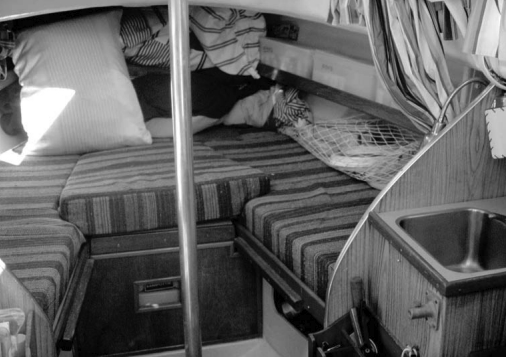
The yard sanded, primed, and painted the hull and replaced the non-skid surfaces on the deck. Meanwhile, Pat contributed to the restoration of Pocahontas by sewing new cushions for the boat and curtains for the cabin.
The renovation cost about $8,000 — more than the $6,000 John originally paid for the boat, but approximately the value of a Commander in similar condition on today’s market, John says. Ultimately cost is not the issue for John and Pat. They love the classic, rounded style of the boats built in the ’60s and ’70s.
John compares the restoration of Pocahontas to the restoration of an old house or an antique car. “It’s a question of whether you want to preserve what’s old,” he explains.
Thank you to Sailrite Enterprises, Inc., for providing free access to back issues of Good Old Boat through intellectual property rights. Sailrite.com