Issue 7 : Jul/Aug 1999
Cruising, as the saying goes, is sailing from A to B, so you can fix what breaks along the way. Unfortunately, things that break include people as well as boats. This article will help you fix some common injuries that occur offshore and better prepare for medical sea emergencies.
Before we plunge ahead, a few things need to be said about expectations. Don’t expect to be a doctor. Don’t expect perfect results. Don’t expect to know everything, and don’t expect to be fearless. On the other hand, do expect to treat effectively the majority of all cruising injuries. You’ll learn from experience that attitude greatly affects the outcome of your treatment. By developing a captain’s foresight toward cruising medicine, you can safely voyage anywhere in the world.
What is the foresight and attitude you need to be successful in dealing with traumatic on-board injuries? Tristan Jones said, “Always put the vessel first, and she will care for you.” It is likewise with high-seas medicine. Approach treating an injury with the mindset of another ship’s system needing repair. When a crewmember is hurt, an integral element of the vessel’s operating system is down. Safety is at stake for the injured mate, as well as for the entire crew. Consequently, approach the injury as other ship’s problem to be solved. I don’t intend to sound cold-hearted about the poor soul sprawled on deck, but I do intend to draw upon your skills as a sailor. You already know more than you think. You already have a mindset for solving at-sea emergencies. Cruising medicine, therefore, is simply adding new data to the mental program you currently use.
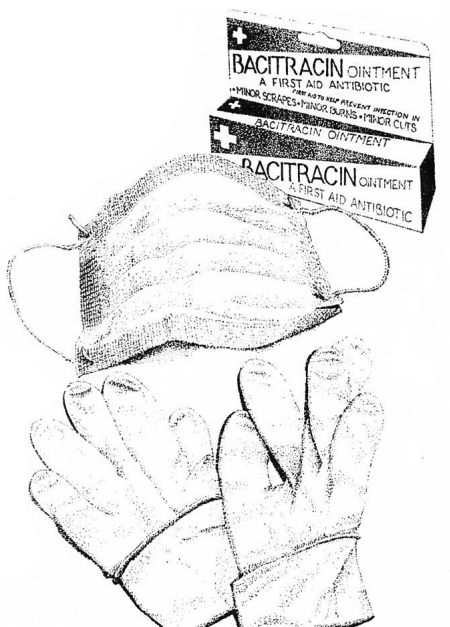
Most injuries at sea result from crew versus boat. The boat always wins in these encounters, so it might as well be accepted from the start that the vessel gets priority. “One hand for the boat, the other hand for yourself” especially applies to moving about the boat in rough seas. The most common injuries I treat arise from direct trauma involving head and extremity mishaps. Needless to say, the best treatment is prevention. Always, when topside, keep your center of gravity low and your stance wide — in other words, crouch down. This not only stabilizes your body, it also decreases the potential force of a traumatizing event. Oftentimes, the difference between a sprain and a broken bone is the distance of a fall. That’s why small children (close to the ground) rarely break anything until they fall from a tree. In short, stay close to the deck.
Moreover, use a natural physiologic phenomenon called propioception‚ to avoid injury. Propioception lets us know where our bodies are in space and time. Occurring in the cerebellum of the brain, messages travel between brain and extremities, allowing the body to know if our position, posture, and co-ordination are correct. By watching the horizon while moving about and grasping handholds, we maximize our brain’s ability to anticipate trouble. Small gyrations sensed by our body, plus visual clues of deck vis-à-vis horizon, give us early warnings of impending disaster. Therefore, tune-in to propioception by focusing on the task at hand. As they say in Kung Fu, “Be one with your movements, grasshopper.” No daydreaming on deck allowed.
Suppose, however, that despite our best Zen intentions, we collide with the boat. What should you know about treating trauma? First, let’s begin by approaching accidents in a systematic fashion. When someone gets hurt, start by asking, “How serious is it?” If conditions allow, keep the patient still while you assess the damage. Start by asking the victim, “What hurts?” After 24 years in the ER, I’ve learned that the patient usually knows what hurts. Then do a quick assessment of the rest of the victim’s body. Touch the patient from head to toe. Look for blood, deformities, and skin color changes. Listen for verbal clues that you’ve touched something painful under his foulies.
Be especially attentive to the neck. Feel along the back of the neck for any tenderness. If you elicit a moan, stabilize the neck with anything that will keep it from bending or moving. If you have a cervical collar, use it. But anything will work that provides support. For example, a pillow folded around the neck and taped together or the panels of a life preserver taped parallel to the neck would work well. Leave the neck immobile until the pain is completely gone or a doctor clears the neck.
Next, examine the area of pain. My anatomy professor told me that God gave us two limbs so we could compare them when one got hurt. Look and compare the extremity that is injured to the normal one. If they look different, there is either a bone broken or severe swelling. Check the deformed appendage for blood flow by feeling the temperature of the skin.
If it looks white and feels cold, the blood flow is compromised. In essence, the kink in the blood vessel must be straightened out, or the limb will be damaged. While it may sound scary, you must reduce the deformity until the appendage looks and feels normal. Medicate the patient with whatever you have on board for pain control. Then, by trial and error, manipulate the extremity until good color, temperature, and alignment are obtained. Immobilize the appendage, elevate, and re-check color and temperature every four hours. When you arrive shoreside, have a professional check out your work.
In the event an extremity is deformed but shows no sign of restricted blood flow, it’s perfectly acceptable to splint the injury as it lies. As long as the limb is getting blood downstream, a day or so of malalignment won’t damage anything. In the interim, make sure the limb is supported and splinted, so no further deformity is created. Then, re-check for color and temperature every four hours. When you’re shoreside again, have a doctor see the victim.
Dislocations are another cause of limb deformities. Shoulder and finger dislocations account for the majority of joint traumas. Consider the case of the grinder, who, in his exuberance to win, slips off the winch handle and dislocates his shoulder. It is immediately apparent the shoulder is out of socket. It hangs uselessly at his side, and any movement produces exquisite pain. If you gently press on the shoulder joint, you will feel a soft indentation when compared with the opposite shoulder. Medicate the patient with pain pills until he is completely relaxed. Then, place him belly down on the galley table or another high platform with his injured arm hanging over the edge. Let the arm dangle and attach a 5- to 10- pound weight to the affected wrist. You can use a fire extinguisher, fishing weight, or something similar to tape to his hand or wrist. The principle is the same: the weight will eventually fatigue the shoulder muscles enough to relax them, thereby allowing the humerus bone to slip back into the joint. If you try to force the shoulder back when the patient is tense, I guarantee failure. A patient in pain is incredibly strong. It’s best to let the pain medications take effect, then let the weight do the job. When the shoulder pops back in, the patient will immediately feel relief. He can move the arm and will tell you the shoulder is back in place. Nevertheless, place his arm in a sling for several days while the tendons heal.
While broken bones appear more dramatic, I see more sprains and strains than anything else. With these soft-tissue injuries, pain and immobility can be as great as a fractured limb. Usually a patient knows whether or not a bone is fractured. Sprains, on the other hand, involve ligaments and tendons but still interfere with the normal function of the limb. The object of treatment, therefore, in the case of a sprain, is to support the ligament. In the case of a sprained ankle, use whatever lateral support material you have on board. For example, extra sail battens can be cut to size and placed on each side of the ankle. Wrap strips of a torn T-shirt around the splint, then wrap the whole thing with duct tape. Be sure to leave the toes exposed in order to check for blood flow. If the foot is getting cold or pale, loosen the tape. This makeshift splint will allow the patient to move about when necessity calls. But remember this rule: for every hour the patient is on his feet, an hour of elevation is needed to reduce the swelling. In addition, use pain as a monitor. If it hurts to do it, don’t do it. Try it a different way. Be creative and use your head before your limbs.
Speaking of heads, they always seem to get in the way of the boom. I’ve lost count of the number of sailors wearing my needlework. Usually a cut on the scalp results from boom-bang, and life at sea goes on. However, I want to give you my doomsday speech so you’ll remember some danger signals. There is a one-in-a-million scenario to watch for whenever head injury occurs. Anything that causes the head to shake around can break a blood vessel inside the brain. If that vessel bleeds, there’s nowhere for the blood to go because the brain sits in a box — the skull. Pressure inside the skull will gradually build until enough force is present to affect the breathing center. Now, way before the patient stops breathing, signs of increasing pressure can be noticed. These are the symptoms to watch for:
- One pupil larger than the other
- Projectile vomiting
- Severe headache
- Blurred vision
- Acting incoherent
- Fever
- Problems with walking, talking, and grasping
- Fluid coming from the nose, ears, or eyes
Should the victim demonstrate these signs, the pressure on the brain must be relieved. Your job is to recognize the importance of getting the patient to a hospital. In the meantime, elevate the head 30 degrees and keep the person quiet. Give Tylenol for pain but not aspirin or ibuprofen. These medications will cause more bleeding.
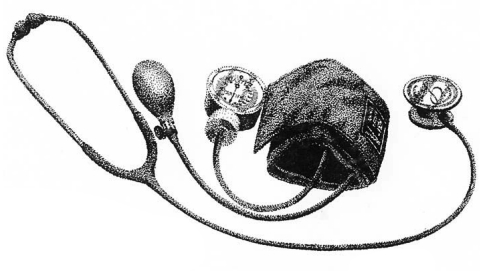
Quite simply, concussion is swelling of the brain. Whenever your body gets hit, the area of trauma swells. In the case of a leg, it’s no big deal. But if the brain expands, the pressure is trapped in the skull. Rarely is this swelling life-threatening. But without a CT scan to tell us about the presence or absence of blood versus swelling, there’s no way to tell for sure. Just keep watching for the signs.
This unlucky sailor has probably also sustained a laceration to the scalp. Bleeding can be dramatic because the scalp is richly supplied with blood vessels. This bleeding is different from internal hemorrhaging because we can do something about it. First, take a towel or cloth and press it firmly on the location of the bleeding. After a while, the bleeding will stop. Not only does this arrest the hemorrhage, but it gives you and the patient time to settle down. Few things look as frightening as blood all over the deck or running down a sailor’s face when you’re far out at sea. Studies show that we all overestimate blood loss at the scene of a trauma. Compound blood mixed with water on deck, and it may appear that Jaws has struck. Don’t panic. Take a deep breath, lift up the towel and guesstimate the length of the cut.
Several options are available for closing the wound. Option one is to do nothing. The blood will clot, and in a few days the wound will seal. Option two is to sew the cut closed. If you have an offshore medical kit, use the staples as directed. Incidentally, there is a nifty new product on the market, which is a medical “super-glue.” Its called Dermabond, and I use it in the ER to close practically all lacerations. You simply hold the wound together and glue it closed. Couldn’t be simpler. Or grab your canvas kit, soak the thread in rubbing alcohol, and use your canvas-repair skills. There’s nothing magical about closing a wound. Option three is to isolate strands of hair on the opposing edges of the cut and tie the strands together. I used this technique a lot when I trained people in wilderness medicine. Having only a knife and the clothes on their backs, these wilderness students made do with things at hand — or head, in this case. The key is to improvise and keep calm.
Emergency medicine at sea is but one more skill required of the bluewater cruiser. Part of the lure of the sea is self-reliance and creativity. Marine medicine, in many respects, represents the ultimate trust in yourself. You’ve already demonstrated the confidence to face nature on her terms by being at sea. The human body is just another expression of nature at work; therefore, approach injuries at sea in the same manner you would when caught in a gale.
Prepare yourself and the crew before the event occurs, keep a level head, attend to what’s in front of you, and know when to ask for assistance. The human body has a remarkable ability to repair itself and will see you through the worst of traumatic storms. When you successfully treat your first high-seas medical emergency, the sense of fulfillment will approach the experience of landfall after a long voyage. Building your captain’s attitude and attending to your vessel’s safety will enhance your voyage upon the seven seas and throughout life.
Thank you to Sailrite Enterprises, Inc., for providing free access to back issues of Good Old Boat through intellectual property rights. Sailrite.com