Call him apostle or zealot, Roger Winiarski believes in bronze
Issue 12 : May/Jun 2000
If he’s not a “bronze god,” Roger Winiarski at least ranks as an angel to anyone looking for hardware for a boat of classic design. I met Roger after almost giving up on finding a bronze gooseneck that would fit the mast I was building for my 1968 fiberglass catboat. I wanted bronze because it suited the classic style of the boat and because all the galvanized goosenecks I had seen were just plain ugly. Of course, the stainless ones were all fabricated for aluminum masts. It seemed hopeless. In fact, early in my search, I had asked at a local boating superstore about goosenecks for a sailboat, and the teenager behind the counter brought out a spinnaker pole fitting. I knew immediately that I was in trouble and assumed I would have to make a pattern for my own use and have it custom cast.
Luckily, I found Roger before I’d even finished rounding the spar. When I called to ask about a gooseneck, he not only knew what one was, he had a selection of them in different styles and sizes. I immediately made plans to visit Roger’s company, Bristol Bronze, and have a look. When I got there, I was impressed.
I’ve never been one to get emotional over hardware, but the selection of classic marine castings was truly impressive. In this day of stamped-out stainless-steel and aluminum fittings produced for high-volume builders of nondescript plastic “yachts,” the graceful and functional hardware that Bristol Bronze produces is almost impossible to find. Almost. Roger has dedicated his company to the art and science of bronze yacht fittings and his dedication has paid off. If Nat Herreshoff were to rise from the dead to order some turnbuckles, he would come to Roger.
Since its inception in 1990, Bristol Bronze has been turning out high-quality bronze hardware cast to patterns of classic design from Herreshoff, Lawley, Merriman, Crosby, and others. Roger’s philosophy is simple. He believes the hardware designed prior to World War II had much going for it that today’s hardware is lacking. This lack is evidenced not only in the design, but also in the manufacture of today’s marine fittings. Roger is on a mission to change that and he began his mission, not surprisingly, with his own boat.
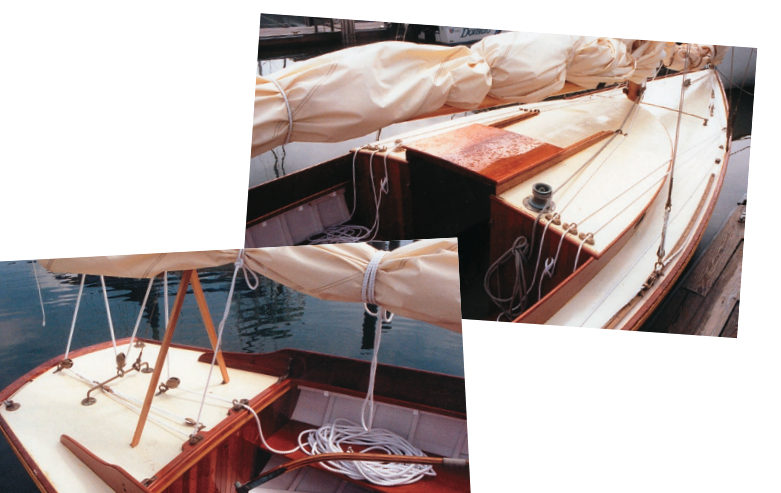
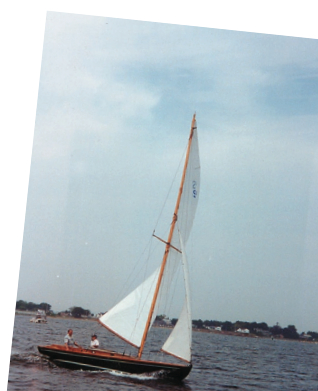
Roger’s boat is a Herreshoff S-class sloop, designed in 1919 by Captain Nat himself. The class is still actively raced, and the hardware on the boats is, in some cases, 80 years old or more. It is not unusual, therefore, for a block or chainplate to fail after so many decades of hard use. In most cases, the owners were obliged to fit stainless-steel replacements that in no way matched the style of the boats. This would not do for Roger, and when one of his fittings finally failed, he set about finding a replacement, cast in bronze, that was in the style of the original.
Nothing worthy
What he found was a dreadful assortment of generic stainless-steel hardware meant for the modern boat market. There were no companies offering fittings worthy of his boat’s heritage, so he decided to make his own. Having spent 30 years in the industrial metals field, Roger knew which alloys of bronze he wanted to use in each application, and he had patterns made of his boat’s hardware. The resulting castings were exact duplicates of his originals, made of virgin bronze and ready for another 70 years or more.
When the other S-boat skippers saw the new hardware, they began asking Roger to fabricate a cleat here and a pintle there, until he had the patterns for every piece of original hardware on the S-class boat. At this point, he thought to himself, “Well, if I need this stuff, and all my friends need this stuff, there are probably lots of people who need this stuff.” Thus, Bristol Bronze was born.
In the beginning, the market for his products was scattered. The problem was not that boat-owners preferred stainless fittings. It was simply that they were unaware of the outstanding characteristics of real bronze. It is this lack of metallurgical knowledge, which any good shipwright of 80 years ago had down pat, that Roger hopes to remedy. If Roger has his way, real bronze will regain its rightful place as the marine metal of choice.
I use the term real bronze because much of the stuff that passes for bronze at your local boat supermarket is technically brass. That’s right, brass. The stuff we were all told would evaporate in a marine environment gets sold by the ton as pad eyes, cleats, and chocks every year. And every year it disappoints the unfortunate skippers who bought it. Most of the metal from which these parts are fabricated is melted down from scrap. This would be fine if a close watch were kept on what kind of scrap was being used but, sadly, this is not the case.
In many instances, these fittings are made in China or Taiwan. Many of the foundries of the Far East are small, and many buy their raw materials on the cheap. This almost invariably means that they use scrap. The end product, whether it’s a cleat or an ashtray, is a mishmosh of several cuprous alloys, including huge amounts of brass.
The shoddy practice of passing this brass off as bronze has given the real thing a bit of a beating. The cheap stuff polishes up nicely, but it won’t take much abuse because of its high zinc content. In fact, that’s the only difference between brass and bronze: technically, brass has about 10 to 30 percent zinc in its makeup, and bronze incorporates tin in place of the zinc. The rest is simply copper, plus any other metals (silicon, aluminum, phosphorous or sometimes, as in the case of gunmetal, even a little zinc — go figure!) that are required for a certain characteristic, such as strength or corrosion resistance. Incidentally, the bronze from which Roger casts his hardware is virgin bronze, purchased in pig form from a smelter.
Stainless steel rusts
So, if the bronze hardware in the store is questionable, why not go with stainless? It gets along with aluminum much better than bronze, and it’s stronger than bronze. The answer is twofold. First, the metal known as stainless steel is really and truly steel. This means that it contains iron. Iron will oxidize and form rust. It is unavoidable. The iron content may be low, but it’s there. Stainless shackles and blocks will leave rust stains on your sails, decks, and so on. It used to be that stainless fittings were dipped in a bath of heated nitric acid to eat away the surface molecules of the iron and leave a corrosion-free veneer of nickel and chrome that could be polished to a high gloss. This process, known as passivation, was rendered prohibitively expensive for most applications by the EPA, which required extensive safety precautions and disposal protocols because of the caustic nature of the acid and related containment problems.
Passivation guaranteed a truly stainless steel — as long as the surface was not scratched. That’s why so many old stainless fittings are still looking shiny and new. But if you own an old passivated fitting and the veneer has been scratched, rust will get a foothold, unless you feel like dealing with boiling acid and the Feds!
The other disadvantage of stainless steel is that it is subject to crevice corrosion. Steel is a strong, but brittle, alloy. As it starts to work under cyclic loading, tiny spiderweb cracks appear — not overnight, but eventually. Much of this can be mitigated with good design, but good design is not so easy to come by. At any rate, these cracks allow corrosive elements such as seawater to enter the steel and concentrated rusting begins in a very small space. This is where a lot of the bleeding rust on the fittings comes from. This process goes on until the fitting eventually fails — and fails suddenly. Unlike bronze, which gives you some warning as to when it plans to give out (look for white powder or flaking of the metal), stainless usually surprises you with a bang. This is not to say that no excellent steel fittings exist; it’s just that like anything of quality, they’re not cheap.
Strong alloy
As to stainless steel’s advantages, they are many. It’s strong, readily available, and the best choice for applications that require direct attachment to aluminum. But if you own a classic boat or one with a wooden set of spars, you might want to consider the use of bronze wherever possible. It won’t stain your sails with rust, and it won’t look out of place. And as to the issue of strength, it is strong enough, in one alloy or another, for any use on a boat. In fact, Bristol Bronze has come up with a bronze that is actually stronger than stainless steel and still retains the desirable qualities of all bronzes. Roger calls it “high tensile bronze” and it is one of his proudest accomplishments.
He developed this high-tensile bronze, or HT bronze, from an alloy that a former employer had dabbled in years before. The idea behind it is that, unlike stainless steel, bronze cannot be tempered after casting by heating it up. This is true of all the bronzes except HT bronze. If you try to temper regular bronze, it just gets hot. Bronze is only as strong as its cast form. It needs to be work-hardened by machining or extruding. But HT bronze is different. It can actually be placed in an oven after the casting is made and tempered to a tensile strength greater than that of stainless steel. The problem is that to temper metal you need to go to a tempering oven, and that costs money. Consequently, HT bronze is more expensive than regular silicon or manganese bronze. The extra cost is worth it, however, if you plan to use it in a high workload application.
For example, the owner of the new schooner, America, had purchased massive stainless steel shackles for his boat when she was rigged. A year or so after launching, he noticed rust stains on her beautiful and expensive sails and teak decks. He called Roger to ask if he might be able to replace the shackles with bronze versions of equal strength. They put HT bronze shackles on her that year, and there have been no complaints. In fact, the owner ordered several additional fittings, including stanchion bases and cleats. These items work as well as the original stainless steel ones and look better than rusting fittings on this classic design. Roger can cast any of the fittings he produces in HT bronze but, for most applications, blocks and chocks for instance, it would be an expensive case of overkill.
People unaware
If all this seems a bit confusing, it’s no surprise. Roger came to this knowledge through decades of work in the metals industry. He has found that most people are unaware of the advantages bronze has over other metals and has begun giving seminars on the subject of metals in the marine environment at the Museum of Yachting in Newport, Rhode Island; at the International Yacht Restoration School, also in Newport; and at the Landing School in Kennebunkport, Maine. He hopes to clarify some of the misconceptions about all metals used in the boating industry and give his students the knowledge required to evaluate hardware thoroughly.
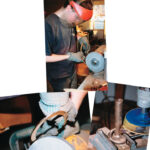
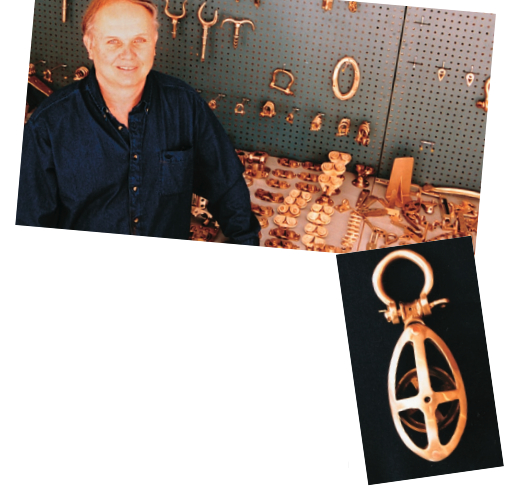
One might think that this is a lot of fuss over a little thing, but Roger is passionate when it comes to metal. When you look at his hardware, it is obvious that care went into its casting and finishing. The pieces themselves are designed by some of the greatest naval architects and builders of the last hundred years. Chocks, blocks, and anchors by Herreshoff, goosenecks by Merriman, cage blocks by Crosby and a host of other designs by past masters adorn the tables and walls of the rooms at Bristol Bronze. In addition, Roger casts complete hardware sets for the Herreshoff Fish class, the S-class, the Buzzards Bay 12 1/2 (and Joel White’s beautiful Haven class), the Biscayne Bay 14 and, most recently, the Comet. The Alberg Owners’ Association has contacted Roger about a line of hardware for the various designs of Carl Alberg, and the list continues to grow.
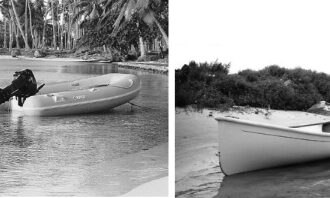
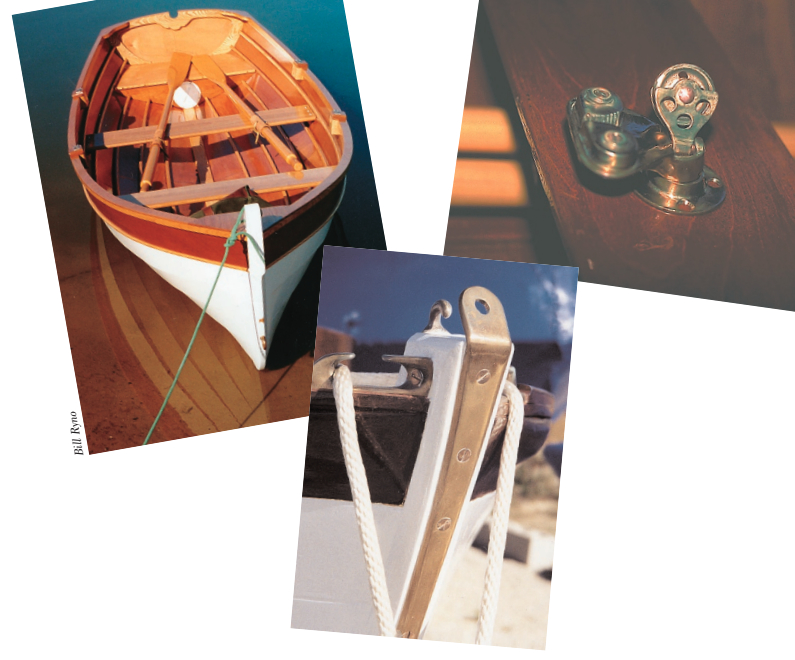
Professional builders are also turning to Bristol Bronze for the quality they see in all of Roger’s work. Tony Davis, the maker of the Arey’s Pond catboat line, offers as standard many of the fittings Bristol Bronze produces. The same is true of Bill Ryno who has developed beautiful rowing and sailing skiffs sold as Brightwood Boats (see photo on Page 41). The famous Beetle Cats of South Dartmouth, Mass., are being fitted with sail tracks from Bristol Bronze, and a growing number of custom builders are coming to Roger for the builders’ plates and fittings they need to complement their finished boats. Add to this the huge number of people who are restoring or building their boats themselves, and you get an idea of what prompted Roger to start this business in the first place.
On the lookout
But Roger is not only interested in producing standard fittings of exceptional design. He is always on the lookout for unique or unusual fittings that simply do not exist anywhere but on an abandoned wreck or a flea market table. The aforementioned cage block is one example. Another quite marvelous fitting is the stay clamp that was originally intended for hanging a riding light on the forestay. It works by the use of a lever and cam arrangement that clamps down on a stay when a load is put on the lever’s hook. It’s simple and elegant, and nobody — except Roger — makes them anymore. And plans for the future include a possible line of rust-free bronze tools that you can be sure will be fabricated from an appropriate alloy.
If all this sounds like a plug for Bristol Bronze, consider this: I checked with eight manufacturers of bronze fittings in this country and England and found only one other gooseneck I would consider buying. It was made by Davey & Co., in England. It was not the exact fitting I wanted (I wanted a sliding gooseneck on a track, and the Davey product was fixed with a half band to the mast) but it seemed well-made. The price, when I figured in the shipping costs, was higher than the gooseneck I bought at Bristol Bronze, and I will say that Bristol Bronze is not exactly cheap. However, it seemed ludicrous to buy a piece of hardware overseas when I was fortunate enough to find one much closer.
It’s a shame that so few foundries have an interest in the beautiful fittings of the past. The jobs they were designed for have not changed for hundreds of years and they seem to have reached a pinnacle of aesthetics and function that we, in the present, do not fully understand or appreciate. Perhaps companies like Bristol Bronze will help change that.
David is a coastal New England native who’s been sailing all his life. A professional guitarist by trade, he has spent the time between tours and recordings building and designing sailboats, his other passion. He lives in South Dartmouth, Mass., where he is building a boat of his own design.
Thank you to Sailrite Enterprises, Inc., for providing free access to back issues of Good Old Boat through intellectual property rights. Sailrite.com