An addict explains why trailer sailing is on the rise
Issue 15 : Nov/Dec 2000
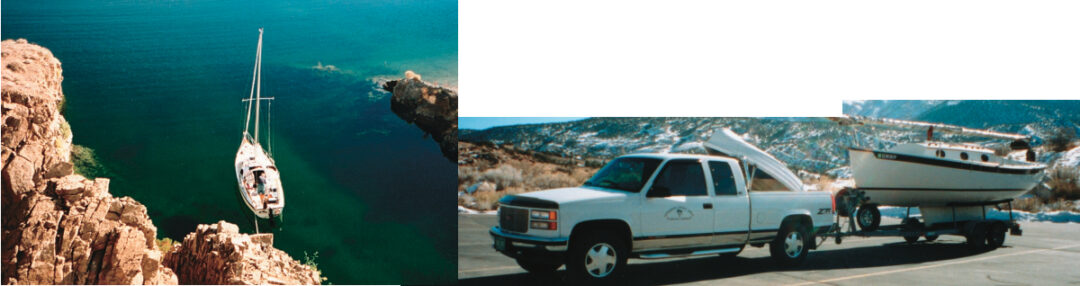
Undulating curtains of snow sweep past our window, nearly obscuring our small ship, now shrouded in tarps. Nose lifted to the wind like a hound, she tests the air for Chinooks, portents of warmer days to the south. Winter hangs long here in the high country, and cabin fever is a lurking specter, known to drive the most stable of sailors to distraction. Not to worry — only a few days left before we hook up for the warm and vibrant Sea of Cortez or perhaps the sunny shores of the Texas Gulf Coast. We are still weighing the advantages of each, and we may have to toss a coin to decide.
Ahh! the pleasures of a trailerable pocket-cruiser. I think of my friends in the Northwest whose larger boats are now socked in for the winter by icy rain and stormy seas. Or those, on the hard, in the Great Lakes country, their owners left with frozen dreams of better times. Not that I don’t covet a big ’un from time to time. I do.
The reality, however, is that our current vessel is the type best suited to our lifestyle, allowing us the Pacific Northwest in summer and a little southern exposure in winter. We hope to expand this itinerary to include visits to the Great Lakes some day or possibly even Nova Scotia, which I have always wanted to see. And, gee, it’s been a long time since we’ve had key lime pie in Key West.
Trailersailing seems to be on the rise, and with good reason. For many, slip and yard fees have become prohibitive or at the least a financial strain. The trailerboat, on the other hand, may reside at home for free, which also makes it more available for spur-of-the-moment maintenance projects or maybe just to admire and lift spirits on a bad-hair day. Not to mention the fact that pocket-cruisers require less crew and are easier to handle for us aging baby-boomers. All this, in addition to its magic-carpet portability, makes trailering a booming sailing option.
What kind of a sailboat fills the bill? Well, there are as many answers to that one as there are sailors. We, personally, like to think of ourselves as grand voyagers, on a somewhat less than grand scale — cruising and gunkholing friendly coastlines — living off the fat of the sea, if you will. We also enjoy meeting local sailors and delving into regional culture. To us, a sturdy little traditional design is the key. Proven seakeeping qualities with a built-in margin of safety in heavy weather add confidence, allowing us to leave civilization behind. That she should have a shoal draft is a given, and we prefer the certainty of a fixed keel, even though she might not point quite as well. We have found our much-modified Com-Pac 23D (featured in Good Old Boat September 2000) to be as close to ideal as we could wish, though we have looked at a number of others we liked also. High on the list might be a Seaward 23/25, Bayfield 23/25, or our former Pacific Seacraft 25 — the larger of these are pushing the envelope as viable trailersailers but are doable for the determined individual.
While we’re on the subject of size, don’t let lack of standing headroom trouble you. Its benefits are highly overrated on a small cruiser. When below, we are either sleeping, eating, or reading a book, none of which we care to do standing up. Much of the time on a small boat will be spent in the cockpit in any case. A dodger or Bimini (or both) can be added for weather protection, providing additional living space.
For serious pocket-cruising, we have found anything under 23 feet to be a bit small for a couple who plan to be a couple for any length of time. We are particularly fond of having a private forward cabin for nature’s calls . . . or just a quiet place for someone to have a good cry when things are not going well. Being captain can be an emotionally expensive business, and I have found myself bawling like a baby on several occasions. The first mate, on the other hand, seldom cries at sea, though I have often felt she might, should she be aware of the situations I have put us in.
When it comes to a motor, I beg you not to consider an outboard for other than daysailing or the occasional weekender. Not that they won’t work; many people seem to get along well with them. For my part, I liken them to being pecked to death by a duck — it may take a while, but they will eventually kill you.
For any sort of extended coastal cruising I consider an inboard diesel to be mandatory. Yanmar is my favorite, though we have used several other makes, and they were all good, reliable, engines. When properly cared for, they are nearly bullet-proof and will outlast an outboard (and all but the youngest sailors) several times over. Their ability to generate ship’s power is a real asset, and a nice little diesel tucked away, low in the bilge, makes for an inherently better-balanced small craft. An outboard, hanging off the stern, is quite the opposite — and I won’t get into the subject of gasoline volatility on a small boat, or the reliability of outboard ignition systems in a saltwater environment.
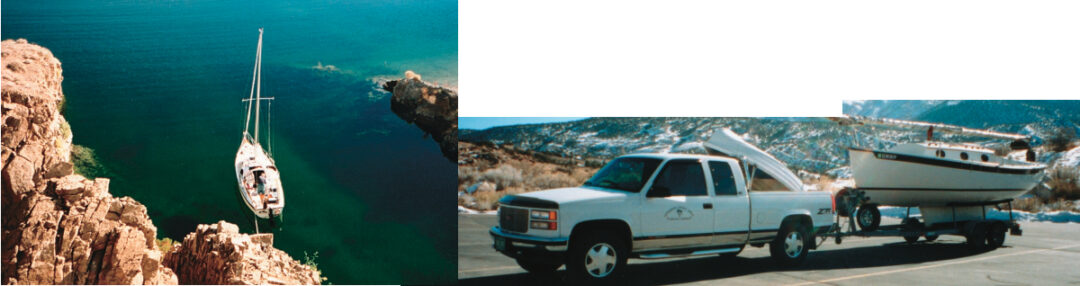
You will, of course, need a tow vehicle, and here again, there is a wide range of units to suit most any application. I prefer a pickup truck, but then I have always been a closet bubba. There are probably more trailerable boats being towed by vans and SUVs than anything else. Four-wheel drives are awfully nice to have on a slick launching ramp and will many times prevent the vehicle from becoming part of the voyage.
The kind of boat I have been talking about is probably going to weigh anywhere from 2,500 to 4,000 pounds dry. When we throw in gear and provisions and cipher in the trailer, we may be talking as much as 5,500 pounds. Anything beyond this will take some special consideration for towing and launching and may partially negate the inherent advantages of being a trailersailer. This notwithstanding, I have seen some pretty large boats being towed around the country, and theoretically some of these could be launched from a trailer (one would stress the theoretical aspect). Most of these behemoths are best left to a travel lift or crane for safety’s sake. We hauled our Pacific Seacraft 25 (nearly 7,000 pounds with gear and trailer) around the country for several years, but often felt limited as to where we could put her in, due to available launch facilities. Still, we often wish we had her back.
The trailer is such an integral part of the equation that I am constantly amazed at how little consideration it receives from some otherwise knowledgeable trailersailors. Even for a lightweight boat I prefer a dual-axle setup, with brakes on at least one axle. Controversy rages over the type of brake system to consider. The ubiquitous surge brakes on boat trailers have been around a long time. They work fine in flat country where snow and ice will not be a factor and might make the most sense when salt water is in the program. That said, I must add a few cautionary notes on surge brakes. In mountainous terrain you can go through a set of brake shoes in a hurry as they “stay set” all the way downhill in most instances — even if you are “gearing down” to brake and don’t really need them. Also, in icy or slick conditions, they can and do grab occasionally, not a good thing. The new surge “disc brakes” (now being offered on many of the late-model boat trailers) are more forgiving and can be retrofitted to early units.
I personally prefer electric brakes since we begin in the Rocky Mountains, even though corrosion can be more of a problem in salt water where we wind up. Thoroughly flushing with fresh water after each launch can hold this to a minimum (this should be done no matter what braking system is used). The advantage of the electric system is that the trailer brakes are activated proportionately as the tow vehicle’s brakes are applied. Also, the electric brakes can be “feathered” with the brake controller in the vehicle, allowing you to apply the trailer’s brakes slightly in advance of (or even independent of) the vehicle brakes, giving a more predictable control factor on slick surfaces.
Trailer bearings must be repacked on a regular basis to avoid bearing failure (brought on by the inevitable drops of water finding their way past the seals — yes, even with Bearing Buddies). This is one of the most frequent causes of breakdown for the freeway cruiser. Another common source of trouble is spring shackles and springs that become fatigued from long periods of load-bearing without appropriate blocking of the trailer frame (as during layup). Should money not be a problem, you might want to consider the new springless “torsion axles” that are nearly immune to this problem and can be retrofitted to most trailers.
An oft-forgotten cause of metal fatigue is high-speed vibration brought on by unbalanced trailer wheels. I would wager that not one in five boat trailers has ever had its wheels balanced. This simple expedient can save untold problems with trailer components and boat equipment. In this context, I would hope a spare tire and wheel are in your plans, as trailer-size tires are not always available in some locales and almost never at midnight on the lonely stretches where these mishaps tend to occur.
All this makes trailering sound fraught with danger and mechanical difficulty. It’s not. A trailer kept in good order with minimum maintenance will be trouble-free for many thousands of miles. Over the years, I have pulled sailboats from coast to coast and Alaska to Florida, with relatively few trailer-related problems. The problems I have suffered could have been prevented if I had known then what is outlined here.
Speaking of long-distance travel, we chanced upon another of the trailer-boat’s big advantages. They can become, in essence, a mini RV, able to furnish much the same amenities as the big land-yachts, if not on such a grand scale. During a recent three-week trip to the Northwest we stayed in motels only twice, and even that could have been avoided with a bit more trip planning. A little-known resource in this direction are county fairgrounds, which often maintain RV facilities for exhibitors at fair time but remain available for use by the public at other times. We had the one in Port Townsend, Wash., nearly to ourselves at peak tourist season, and were delighted with its park-like atmosphere and sparkling-clean showers — all for the grand sum of $8 per night. Local RV parks were crowded and three times the money.
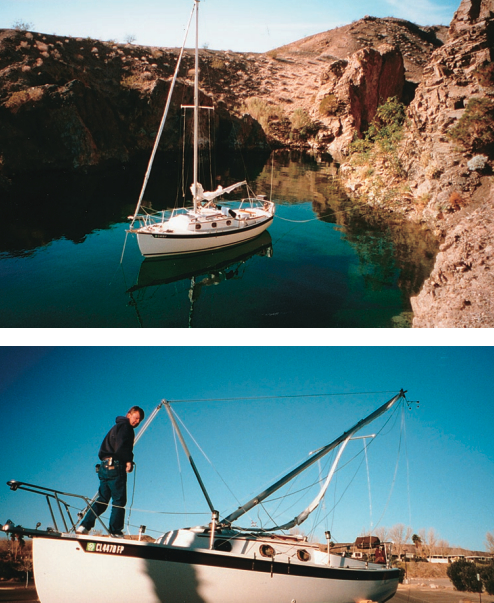
One thing that might give pause to the prospective trailer-cruiser is the daunting job of mast raising/lowering. For years, I relied on the help of sympathetic dockside loafers, whom I attracted by sending the first mate aft to lift the mast by herself. The quality of help one receives under these circumstances can be “iffy” at best, and often turns into a Three Stooges act. Upon hearing of our trouble, a good friend sent me the plans for a gin-pole system he had worked out involving port and starboard bridles to steady both the mast and gin-pole. The raising is done using the boomvang connected to a halyard. This works like magic and now the first mate, by herself, can safely have the mast up or down in a matter of minutes, even in considerable sidewinds.
In the last few years we have sail-camped our small cruisers from the Gulf of Alaska to the Gulf of Mexico, with many remote ports of call in between, an odyssey of adventure and discovery made possible only through trailersailing. Like most sailors, we dream of bluewater passages to exotic locales, and in time this, too, may come to pass. In the meantime we’ll use the interstates to help make more realistic dreams come true. If you are being held prisoner by local climatic conditions or working two jobs to support your big guy at the marina (I’m speaking here of the boat, ladies), you might want to consider trailersailing as a viable option.
Ron and Terrel are rancher/sailors landlocked in Colorado where they raise Suffolk sheep and border collies. They sail their Com-Pac 23 in the Northwest in the summer and the Sea of Cortez in winter.
Thank you to Sailrite Enterprises, Inc., for providing free access to back issues of Good Old Boat through intellectual property rights. Sailrite.com