An old Dutch design lives on because it’s just right for its home waters
Issue 14: Sept/Oct 2000
The Netherlands is often called the Venice of the North, due to the great number of canals, waterways, inland lakes, and the sea. For several centuries, the Netherlands was a maritime nation with far-flung possessions. The Dutch were proficient as naval architects, designers, and builders of merchant vessels to sail the worldwide trade area they served.
Long after that era was past, shipbuilding was still an important industry in Holland. The Dutch became adept at designing shallow-draft commercial vessels suitable for trade generated along their own local system of waterways. The basic design was also adapted for use as a pleasure vessel. Leeboards were developed to compensate for the lack of a keel or centerboard in the characteristic flat or round bottom. The wide beam and the bottom shape resulted in larger below-deck spaces than those found in conventional hull configurations. These designs often had a mast-step arrangement that allowed for easy and quick striking or stepping of the mast, without the use of a crane, in order to accommodate passage under the many low bridges. It was customary for a carved wooden figure to be mounted on the rudder head; often it was a dolphin or lion’s head.
Among Dutch yachts of various vintages and sizes, all of which have leeboards and flat or round bottoms, are types known as Schouw (scow or punt), Grundel, Schokker (fishing boat), Lemsteraak, and Ooszeetjalk (East Sea barge).
The Boeier
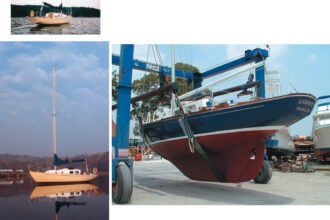
One of the most successful shallow-draft boat designs from Holland is the Boeier (pronounced Booyer). Well over 100 years ago, sailing yachts of this particular design were plying local waters. They were so well-suited to prevailing conditions that the design has survived over the years, and a modern version is still being built and sailed. A prime example of a contemporary version of this venerable design is the Boeier 630 (indicating that her length on deck is 6.30 meters). The 630 is modeled after a famous racing yacht called Sperwer (Sparrowhawk), which has a permanent home in a maritime museum in Enkhuizen, the Netherlands, in recognition of the many trophies won during her outstanding racing career. Sperwer was designed by Eeljfe Holtrop van Der Zee in 1880.
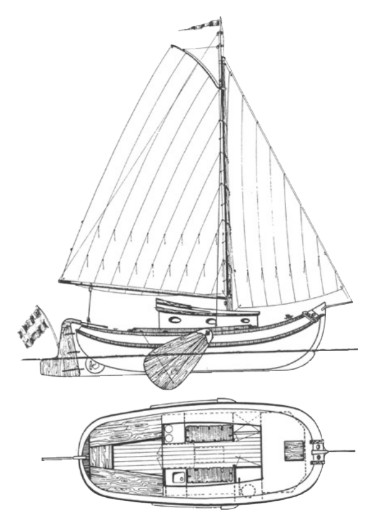
The principal dimensions of the Boeier 630 are:
LOA 25 feet 4 inches
LOD 20 feet 6 inches
Beam 8 feet 4 inches
Weight 4,409 pounds
Ballast 1,102 pounds
Mast height 30 feet 7 inches
Mast lowered 5 feet 4 inches
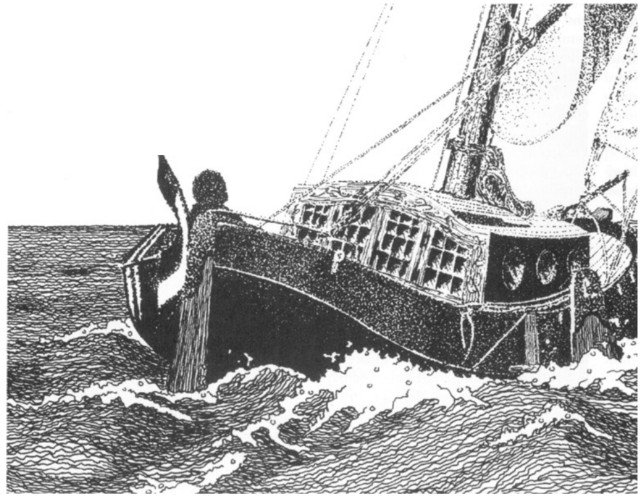
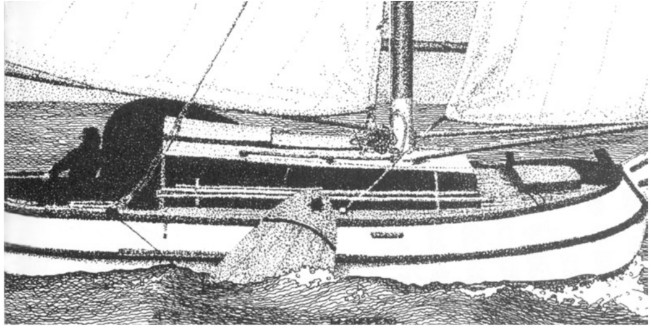
The hull can be constructed of wood, steel, or glass-reinforced plastic (GRP). If fabricated of GRP, thickness above the waterline is reported to be 5/8 inch; below the waterline it’s just over 7/8 inch, and the deck is almost 1 5/8 inches thick. Boeiers do not heel as do keel or centerboard yachts. This is in part due to the width of their beam, which also makes for the characteristically spacious area below deck. The hull design results in a cockpit that stays relatively dry in stormy weather. It is equipped with two benches that can convert into a berth. The cockpit, rudder, and leeboards are all of oak.
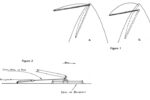
Mast tabernacle
The mast is constructed of Oregon pine and equipped with a counterweight at the base. It is mounted in a tabernacle to facilitate striking the mast without disconnecting the shrouds. The mainsail is loose-footed and attached to the mast with hoops. The sail is laced to the curved gaff. The jib and staysail are also loose-footed. The headstay is secured to the 6 foot 6 inch jib boom, as is the jib. The boom facilitates striking and raising of the mast. Sail dimensions are: mainsail, 207 square feet; jib, 88 square feet; staysail, 75 square feet.
The cabin is entered from the cockpit through double doors. Joinerwork is of wood, and there are two settees: one each to port and starboard, which can convert into berths. The head is located to starboard. The galley is situated in such a manner that the cook has standing headroom. In the forepeak is a double berth.
There is an option of inboard engines — a Mitsubishi 9 hp or an 11-hp diesel engine. The 9-hp engine may be sufficient on canals and lakes. The 11-hp engine is recommended for using the yacht in strong current rivers or at sea.
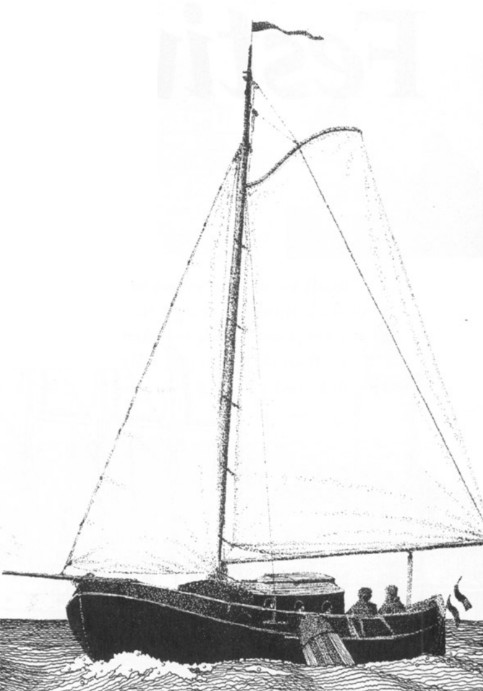
Suitability of design for intended service, sturdiness, comfort above and below deck, and stable sailing characteristics have preserved the usefulness of this venerable old type of yacht for many years.
High quality
Some time ago, I visited several yacht-building facilities in the Netherlands. The high quality of work being performed in all phases of construction was noteworthy. What really caught my eye was the expertise and careful attention to detail given to interior joinery. Beautiful custom-crafted elements of teak, mahogany, oak, and rosewood (especially favored by British customers) were being created. The workers were predominantly well beyond middle age and some were quite old. It pleased me to see these gnarled old hands still putting out the same quality of craftsmanship that had been the standard in the olden days. It was disconcerting, however, to see how few young apprentices were on hand to learn from the masters.
Although traditional methods of producing these boats have changed and will continue to change with the constant development of new technology, in my view the features that made the Boeier so successful in past years will continue to prolong her desirability and usefulness, and she will sail away into the next millennium.
As many Dutch boys do, Fred notes, he started sailing at age 12 in Holland. After arriving in the U.S. in 1938, he skippered and crewed many boats and campaigned a Flying Dutchman during the 1960s and 1970s. He retired from a career in energy and pursued a career as yacht surveyor/appraiser until he was well into his 80s. He and his twin brother just celebrated their mutual 90th birthday in Holland. Fred notes that he must have been born on the starboard tack. He arrived 10 minutes earlier than his brother.
Thank you to Sailrite Enterprises, Inc., for providing free access to back issues of Good Old Boat through intellectual property rights. Sailrite.com