Here’s how to help a good old body keep sailing
Issue 30 : May/Jun 2003
Growing old is the most unexpected thing that happens in one’s lifetime. When that three-score milestone fades into the distance behind you, sailing activities take on slightly different priorities.
I’ve been sailing for more than 68 years. My wife, Elsie, has been sailing with me for 53 years (ever since we were married). We’ve sailed in all types and sizes of craft and, if the fates allow, look forward to many more years on the water.
What are the special problems for the over-the-hill gang who want to stay on the water, but would like to take things a little easier and enjoy a little more comfort? The simplistic answer is to switch to a smaller boat or change from a sailboat to a trawler-type powerboat. For ease of handling, it would be ideal to have the smallest sailboat that meets your needs, within the boundaries of safety, comfort, and enjoyment.
But most sailors in their 60s, 70s, or 80s have long ago found the boat they love and fitted her out with all the things that make her home. Renouncing their love and embarking on a new boating relationship is not an enticing thought. The only trouble is, we’re not as able-bodied as we used to be — a hard thing to admit.
More taxing
Handling a large boat, climbing in and out of dinghies, moving about in rough weather, raising and lowering sail, or hauling in the anchor . . . these activities can become unexpectedly taxing. I enjoy singlehanding my boat, and I have my solo deckwork routine down pat. But I’ve had a couple of bad scares on deck that I haven’t mentioned to my wife. So lately I’ve been taking more time to think out my deckwork and prepare more carefully while solo-sailing. Although sailing my boat is an effort, giving up my schooner would be like asking me to reject one of our children.
Reduction in physical requirements is primary. For nearly every physically taxing job on deck, there is an easier way or a piece of equipment that can reduce the muscle-power and agility required.
For anchoring, as an example, is it possible to install a roller on the bow where a plow anchor can be stowed? If you use a fluke-type anchor, how about changing from one of the heavy galvanized-steel ones to one of the lightweight modern aluminum-alloy types? Along with a reduction in weight, you can actually increase your holding power with the aluminum anchor. The pull required to release an anchor from a sticky mud bottom is daunting for the older back. An electric or mechanical anchor winch can be a great asset and, if that winch can be operated from the cockpit, anchoring becomes even simpler.
Staying aboard
Most of us use harnesses, but we should use them more frequently as we age, especially when alone on deck. Remember that reaction times slow down some. The installation of fore-and-aft safety lines, or jacklines, is not that complicated, and the small expense involved is a good insurance policy. All you need is forged pad-eyes, through-bolted with backing plates, mounted fore and aft and connected with wire or nylon line.
When choosing jackline material, consider flat nylon webbing instead of round lines, since round ones tend to roll underfoot and could cause a fall. If these lines can be installed free of obstructions, your safety harness can be clipped on in the cockpit, and you can travel from cockpit to bow without unclipping. Some people use two lengths of tethers on their harness, the longer one allowing foredeck work.
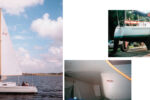
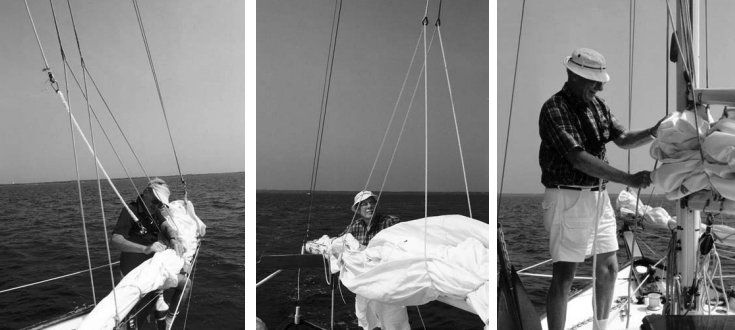
Our schooner sports a long bowsprit. Although it gives a saucy look, it presents special problems for a safety line. When doing work out on the end of the bowsprit, we clip our harness to the fisherman-staysail halyard, which goes to the top of the foremast, near the bow and is cleated off at a premarked position for this purpose. The pre-set cleated-off length of this halyard keeps it taut overhead when we’re out on the end of the bowsprit (see photo below).
If the ultimate happens and someone goes overboard, a man-overboard retrieval system should be easily available on deck. We have a Lifesling fastened to our stern boom gallows. What if you go overboard while singlehanding? A life jacket (I wear an inflatable one) and a line trailing astern are good ideas. You also have to be able to get back on deck when you’re next to the boat. We have a rope ladder with hard rungs that remains on deck, fastened to the base of one of the stanchions. A 1⁄8-inch nylon line from the bottom rung hangs over the side of the boat and can be reached from the water (see Good Old Boat, May 2002). I went into the drink once while getting into my dinghy while at anchor in a secluded cove. It worked out very nicely (and there was no one around to see my foolishness).
Daunting trip
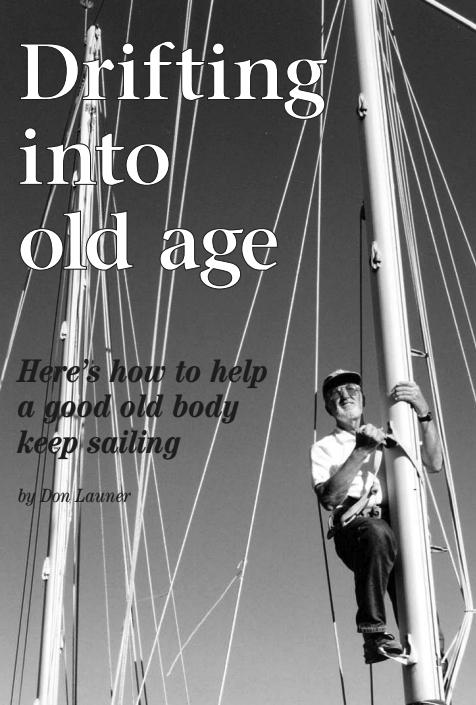
Trips to the top of the mast are not something sailors of any age look forward to, and for older sailors this can become particularly daunting. I’ve installed folding mast steps to the top of our mainmast and foremast. This lets me go up the mast at my own pace without having someone on deck to hoist me. The folding steps give a good, solid feeling of stability. I always use a nylon linesman’s belt, which keeps me safe while climbing and when aloft.
Much fatiguing and hazardous foredeck work can be reduced with a jib-furling system. Aside from its obvious advantages, it makes the foredeck a safer place when anchoring under sail, with no sailcloth or sheets to slide on or trip over. It also stores the genoa on a furler, so the sail doesn’t take up room in the cabin or sail locker.
To ease mainsail furling, lazy-jacks hold the sail close to the boom as the sail is lowered. This helps prevent the lowered sail from billowing out in the wind, getting underfoot, or else blocking visibility. Lazy-jacks are easily rigged with a minimum of hardware. Their only two drawbacks are a slight increase in windage aloft and the added care required when hoisting sail to keep the battens from going outside the lazy-jacks. Lazy-jacks also provide an emergency backup system in the event of a topping-lift failure, preventing the boom from dropping into the cockpit and doing damage to equipment or craniums.
A roller-furling system on the mainsail is another way of simplifying the furling procedure and should be considered when purchasing a new boat. For an existing boat, it will incur major refitting and expense.
Eases furling
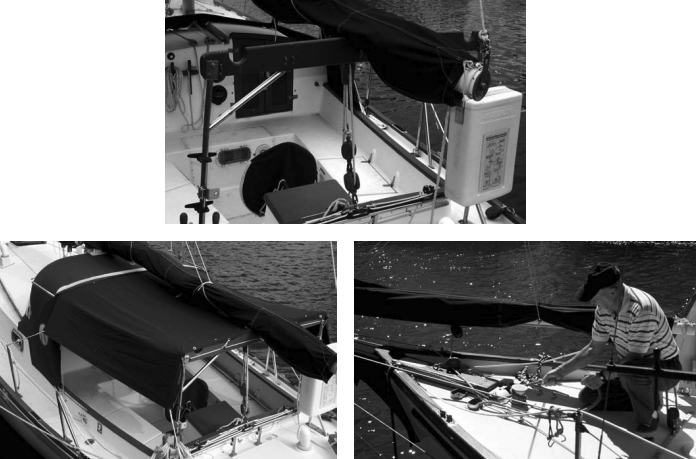
Our traditionally-rigged schooner has a boom gallows, another asset that eases sail furling. Although I never had a boat with one before, it seems ready-made for the older sailor. When furling the main in high and confused seas while standing on the cockpit seats, I now have a solid boom to hang on to, instead of one that is swinging back and forth. An ancillary advantage of the boom gallows is that it provides a stable ridgepole for a winter cover, boom tent, or cockpit awning.
And speaking of cockpit awnings, we all know that reducing our amount of time in the sun is essential. Although this advice is true for all age groups, it’s only as we get older that those sunworshiping indiscretions of our youth return to haunt us, and we are belatedly concerned. A wide-brimmed hat is a good idea, and make sure when purchasing sunglasses that they are “UV- 400 protected.” Our eyes have been subjected to a lifetime of sunlight, but it’s not too late to give them better care. In addition to the hat and sunblock, a cockpit dodger, awning, or Bimini will reduce the UV and make the cockpit more enjoyable in hot climates . . . as well as on rainy days.
We have a cockpit awning that zips onto the aft edge of our dodger and extends to our boom gallows. It has side panels that can be attached to the lifelines, keeping the rain outside of the cockpit coaming. Although the mainsail can’t be used when the awning is in place, it is wonderful while at anchor, in a marina, or while motoring on a rainy day.
Being in the cockpit during those cold, windy days in the spring or fall can be exhausting. A dodger provides protection from the cold wind and spray. And to make the trip around the dodger to the foredeck safer, we’ve installed dodger handholds (see the March 2001 issue of Good Old Boat). Weather cloths, fastened to the deck stanchions, also help to cut those chilling winds. More handholds in the cabin also are a good day’s project that will repay your efforts in the future.
If you don’t have one already, consider an autopilot. There are many good ones on the market, which, for a very small investment of electricity, will save many tedious hours at the helm. They are a delight when hoisting sail singlehanded, holding the boat into the wind perfectly and obviating those mad dashes back to the cockpit to readjust the heading. Autopilots are also welcome on long days under power when the engine is providing the necessary electricity. Leading halyards back to winches in the cockpit where you are close to your engine and rudder control also makes it easier to hoist sail when singlehanded.
The dinghy becomes unexpectedly heavier as we get older. Stern davits ease its handling. If you prefer a hard dinghy, you might want to consider a nesting dinghy that allows you to lower smaller and lighter sections over the side from the cabintop.
Are the soles of those comfortable old deck shoes becoming hard and slippery? Relegate them to shoreside activities. A few splashes of bottom paint won’t hurt them now. You don’t want to become the new candidate for the “I’ve fallen, and I can’t get up” commercial.
Comfort belowdecks
Although safety equipment and labor-saving devices on deck are important, let’s not forget belowdecks comfort. It’s a paradox that the older we get, the more we want to simplify our lives, while at the same time, the more comfort counts. In pursuit of the comfort side of the equation, an inverter that will power a small microwave, hair dryer, or electric coffee pot can make your sailing life more pleasant. In the last year or two, inverter sizes and prices have come down, and their AC output wattages and efficiencies have gone up.
As I get older, my body’s thermostat doesn’t work as well as it used to, so high heat and humidity and cold, windy days become uncomfortable. We’ve installed a small marine air conditioner (with salt water heat exchanger) beneath the settee for the hot days. A few years ago we were visiting a marina in Baltimore’s Inner Harbor in August. It was 90 degrees with 90-percent humidity. Our onboard air conditioner made a good night’s sleep possible.
The flip side of this is cabin heating for cold nights. Deciding which heating system to install is not easy. Options to evaluate are price, size, reliability, safety, ease of maintenance and installation, combustion efficiency, heat exchanger efficiency, and choice of hot water, forced air, convection, electric, propane, compressed natural gas, diesel, or kerosene. We have three kerosene lamps aboard: a trawler lamp above the cabin table and two bulkhead-mounted ones. These take the chill off a cool evening, but for really cold weather, our diesel cabin heater will bring the cabin temperature up into the 70s on the coldest of nights.
Carbon monoxide detector
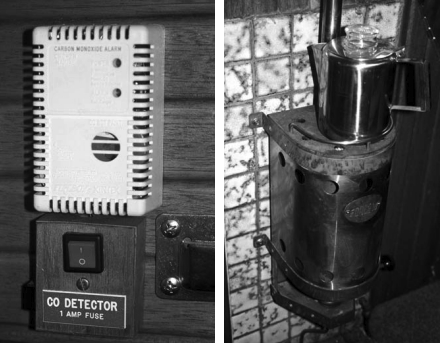
When we’re in a marina on a cold night, we have an electric heater that we use when ample shorepower is available. If you’re using any type of flame to heat the cabin, or if you have a cooking stove that uses a combustible fuel, investing in a 12-volt carbon monoxide detector is a must. It’s a good investment in any case, since it can also warn you of engine-exhaust problems.
When installing labor-saving devices and amenities, however, remember the old engineering truism: “As the complexity of a system approaches infinity, the time between failures approaches zero.” This means that you should have manuals aboard for all your equipment, and if your technical abilities preclude repairing a system, then taking it out of service, by-passing it, or changing to a simpler system should be in your bag of tricks.
As important as it is to upgrade our boat’s hardware, we should remember that our mental software may also need some reprogramming. When on a cruise, if the weather is kicking up and you’re secure at anchor, on a mooring, or in a marina, a day of boatkeeping might be more productive than fighting it out outside. There are always those little jobs to be done. When was the last time you changed your oil?
And if you’re coastal-cruising, plan on shorter day’s runs. You’ll enjoy the cruise more if you’re not pushing your limits. Also, try to resist the temptation, when sailing on the same course as another sailboat, to engage in a race. You’re not in the business of having to prove yourself everyday anymore. Relax!
It’s also a good idea to pay attention to the old adage: “The time to shorten sail is when you first begin to think about it.” The corollary to this is carrying less sail to begin with. After all, it’s easier to cook and move about when you’re at a reasonable angle of heel.
Heightened appreciation
Perhaps it’s the realization of mortality, but in spite of the march of time, I’ve found that my appreciation of a life afloat actually seems heightened as I grow older. And yes, I am old, a word that I find not nearly as denigrating as the euphemism “senior citizen.”
I see cruising under sail as a microcosm of our lives. We hone our skills and start out for destinations we hope to reach and yet may never reach. If we do reach these destinations, it may be much later than we intended. There are unexpected storms along the way, forcing us to change our plans and sometimes taking us to places more fascinating and encounters more exciting than those we had originally envisioned. By the grace of God, good luck, perseverance, and an accident of genes, we’ve made it this far in reasonably good health and agility. That doesn’t warrant any special consideration or veneration from others. As another old sailor would say at the end of his nightly newscast, “That’s the way it is.”
For me, the satisfaction of being on a small boat involves the sense of self-sufficiency, with its subdivisions of ingenuity and endurance. I appreciate a special feeling of independence in a world where neither government nor social status can help . . . or interfere. You can be on your own partly or entirely, depending on how much self-sufficiency you feel like taking on. For those of any age, it’s a matter of feeling alive.
Thank you to Sailrite Enterprises, Inc., for providing free access to back issues of Good Old Boat through intellectual property rights. Sailrite.com