Here’s how to maintain your winches for long, reliable service
Issue 30 : May/Jun 2003
In the early history of sail, all sail handling was accomplished through brute strength or with the help of multiple-part blocks and tackles. From the days of the earliest sailing ships there were, of course, capstans on board that allowed a stout crew to weigh anchor or raise spars, and later, in the 19th century, steam-powered winches came into use aboard larger vessels. But for the recreational sailor, it wasn’t till the mid-1900s that sheet and halyard winches, as we now know them, finally came into general use.
Those first expensive winches appeared on the 12-Meter boats of the 1950s. Top-of-the-line blocks in those days were made of bronze, with no roller bearings, so it was a logical step to construct those first winches of cast bronze also. Those newfangled pieces of equipment were first fabricated for high-end racing yachts. They had a maximum of two speeds and no self-tailing apparatus.
By the 1970s, lighter-weight and less expensive winches with aluminum drums appeared on the scene. These could have up to three speeds. Finally, in the 1980s, stainless-steel drums replaced those of aluminum, and today we can find four-speed winches with carbon drums, titanium gears, and carbon gearboxes and shafts.
Power ratio
Small winches provide the ability to exert large forces on lines by using a combination of long winch handles coupled to small-diameter drums and ratchets to prevent lines from running free when the handle is released. Larger winches employ reduction gears and multiple speeds. Although the average sailor can exert about a 30- or 40-pound horizontal pull on a line, on larger boats this is just not enough. Sheet loads in the thousands of pounds are now common on large cruising or racing yachts.
By gaining mechanical advantage through leverage (a long winch handle turning a small drum) and reduction gears (the number of times the handle is turned to create one revolution of the drum), high “power ratios” can be developed. The power ratio is the ratio of handle length to drum radius, multiplied by the gear ratio. Thus, if you have a 10-inch handle, a 5-inch drum, and a 5:1 gear ratio, then your handle-to-drum ratio is 10:2.5 (2.5 being the radius of the drum), and the mechanical advantage is 4 (10 ÷ 2.5). When this is multiplied by the gear ratio (5) you have a power ratio of 4 x 5 = 20:1. Winches are given numbers that approximate this power ratio.
Thus, a #8 winch has a power ratio of 8:1. This 8:1 figure is, of course, a theoretical figure, since friction of the internal winch parts and the line on the drum will reduce this ideal number somewhat. With small winches lacking internal gearing, the power ratio is simply the handle-to-drum radius ratio. (Regrettably, “power ratio” seems to be an industry standard term that is used in place of the proper and accurate term, mechanical advantage. Students of physics know that winches cannot increase power. Force is increased at the expense of distance; power is lost to friction. “Engineering” was probably not consulted when this term was coined by “marketing.” –Ed.)
Winch sizes
The smallest of winches are “snubbing” winches. These winches do not have handles. Their advantage is that when a line is tensioned, the winch pawls prevent the drum from rotating, which would allow the line to run out again. Thus, they give the sailor time to prepare for the next pull.
The next size up are single-speed winches with handles. Since these winches have no gears, the mechanical advantage comes through the use of a long winch handle and small drum.
The next higher category of winches includes those that employ gear ratios and multiple speeds. These winches can multiply a person’s pull tremendously (a #40 winch gives a power ratio of approximately 40:1).
New materials
Since winches have been asked to perform under increasingly high load conditions, the internal gears, bearings, and lubrication have also been upgraded. In the late 1970s, Amoco developed a plastic named Torlon. When used as roller bearings inside a winch, Torlon could take great abuse with little lubrication. Harken immediately seized on this new product and began using it in their winches. To delay copycat use by the competition, however, they called their new roller bearings Duratron. We now see winches with Torlon bearings becoming standard equipment from nearly all winch manufacturers.
Lubrication
Since modern winches are so reliable, they tend to be the most neglected pieces of gear on board. But, as with everything mechanical, winches require a certain amount of care if they are to perform their jobs and have an extended life. This care also minimizes the possibility of an unexpected breakdown and dramatically reduces the physical requirements of the crew.
There are three basic levels of winch maintenance:
- Apply a freshwater rinse at the end of a sailing day. When you rinse down the deck, direct the hose at the winches to wash away salt water, which degrades the winch grease and corrodes the metals. Stainless-steel, chromed, and anodized aluminum winch drums should be washed with a cleanser regularly and dried with a cloth. Occasionally, non-abrasive liquid cleaner can be used on stainless-steel and chromed winches. Naval jelly, sold by winch manufacturers, can be used on stainless-steel drums to remove tarnish and protect the surface. Never use polishes or abrasives to clean the drums of aluminum winches.
- The second level of maintenance is the “quick check,” which takes 10 or 15 minutes per winch and should be done two or three times a season, or more often if the boat is in constant use. Remove the drum from the winch and remove the main bearings. With a rag moistened with solvent, wipe away grease on exposed surfaces and examine the winch for wear or damage. Take special note of the condition of the gear teeth and pawls. If there is any indication that the winch is dry, that the grease in the winch is gummed up and hard, or that dirt or sand has gotten inside, schedule a winch overhaul immediately.
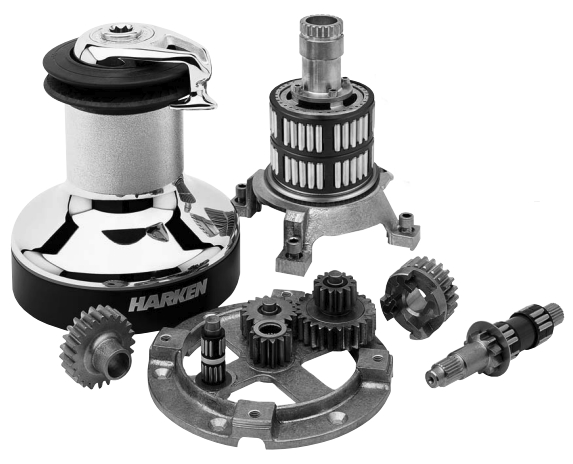
- A complete winch overhaul requires taking the winch down to its component parts, cleaning these parts, inspecting them for damage, replacing those damaged parts, relubricating, and reassembling. This should be done at least once a year, preferably at the end of the season. Although the first time you do this the procedure will take a while, due to unfamiliarity, for the typical winch aboard a 30- to 35-footer, it can be done in about 30 to 45 minutes.
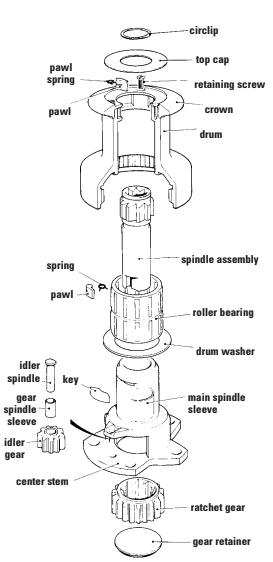
Whenever you’re doing a complete overhaul, especially for the first time, have the manufacturer’s diagram of the exploded view of the winch, along with the manufacturer’s service sheet, so you can follow the lubrication procedure and be certain the reassembly is correct. With this important diagram, you can identify any parts by number that need replacement.
Winch manufacturers supply service manuals for each of their winches, along with kits for routine servicing. These kits usually include drum screws, pawls, springs, and winch grease. Be careful during the disassembly that the drum bearings don’t stick inside the drum and go overboard! Inspect the bearings, gears, and spindles for signs of wear or corrosion. Winches should be lubricated with winch grease, but avoid over-greasing. This can trap salt and water inside the winch. Check the pawls and springs for signs of wear and lubricate them with a light machine oil, such as 3-in-1, rather than grease. Do not grease plastic roller- or ball-bearings. Never grease the pawls or the ratchets they lock in; the pawl springs can’t push the grease out of the way, and the winch will fail to lock against the load. Winch grease can be purchased at marine supply stores, through marine catalogs, and from winch manufacturers.
With simple and regular maintenance procedures, your winches can give you decades of reliable service.
Thank you to Sailrite Enterprises, Inc., for providing free access to back issues of Good Old Boat through intellectual property rights. Sailrite.com